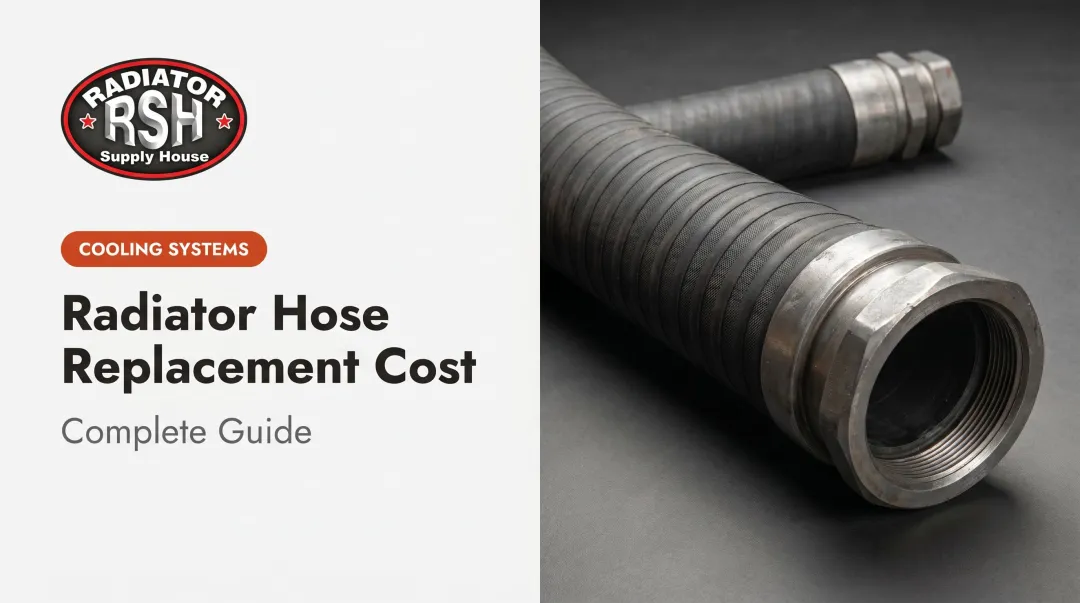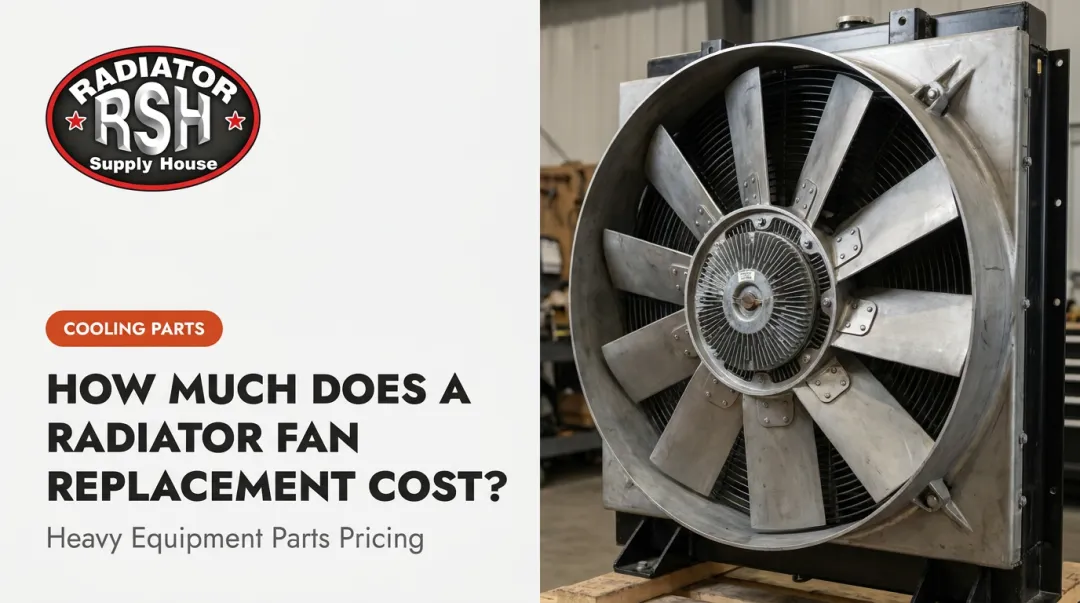
What most operators underestimate is how much that replacement cost varies. A light commercial truck and a Cat D9 dozer both need radiators — but the price gap between them spans thousands of dollars. Equipment class, cooling system complexity, part sourcing, and labor all move the final number significantly.
This guide breaks down real cost ranges by equipment category, explains what drives the price up or down, and covers the full cost picture — parts, labor, ancillary components, and downtime.
Key Takeaways
- Radiator replacement for heavy equipment ranges from roughly $500 for light commercial vehicles to $5,000+ for large construction or mining machinery (parts + labor combined)
- Labor can equal or exceed parts costs on complex machines — budget for both upfront
- OEM-equivalent aftermarket radiators can run 30–50% less than OEM pricing without sacrificing performance
- Replacing the radiator without inspecting hoses, thermostat, and coolant is a common cause of repeat failures
- Sourcing from a supplier with deep inventory across many manufacturers directly reduces costly downtime
How Much Does It Cost to Replace a Radiator?
There's no universal price for radiator replacement. Costs vary based on equipment class, cooling system complexity, and where the part comes from. Operators who treat it as a fixed-cost item consistently underbudget, often ending up with an incompatible or undersized unit that fails early.
Use the table below as a quick reference, then review each tier for what actually drives those numbers.
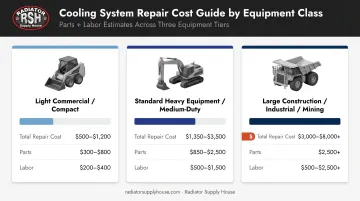
| Equipment Class | Typical Total Cost | Parts Range | Labor Range |
|---|---|---|---|
| Light commercial / compact equipment | $500–$1,200 | $300–$800 | $200–$400 |
| Standard heavy equipment / medium-duty trucks | $1,350–$3,500 | $850–$2,500 | $500–$1,500 |
| Large construction, industrial, and mining | $3,000–$8,000+ | $2,500+ | $500–$2,500+ |
Entry-Level: Light Commercial Vehicles and Smaller Equipment
Typical range: $500–$1,200 (parts + labor)
- Basic aluminum radiator unit with standard coolant refill; parts start around $300 for compact loaders
- Covers light-duty commercial trucks, compact utility vehicles, smaller agricultural units, and skid steers with single-pass radiator cores
Labor on these machines is minimal — the radiator is typically accessible without major disassembly, keeping shop time to 1–2 hours.
Step up to standard fleet equipment, and both parts costs and labor hours climb considerably.
Mid-Range: Standard Heavy Equipment and Medium-Duty Trucks
Typical range: $1,350–$3,500 (parts + labor)
Parts run $850–$2,500 for an OEM-equivalent or quality aftermarket radiator; labor adds $500–$1,500 for partial disassembly, coolant flush, and hose inspection, based on Dura-Lite's Volvo heavy-duty truck benchmark. This tier covers:
- Medium-duty commercial trucks (Freightliner M2, International)
- Common agricultural machinery (John Deere, Case)
- Standard construction equipment running single or dual-pass cores
Fleet operators running vocational trucks and mid-class construction equipment will recognize this range as their baseline budgeting target.
High-End: Large Construction, Industrial, and Mining Equipment
Typical range: $3,000–$8,000+ (parts + labor)
- Heavy-duty or OEM-spec radiator with full cooling system service; parts start at $2,500+ for large excavators and dozers, per FSR Products
- Extended labor for complex disassembly and likely ancillary component replacement (hoses, clamps, thermostats)
- Applies to large excavators (Cat 320/330 series), mining haul trucks, industrial generators, off-highway dozers, and high-hour fleet machines
On machines at this scale, labor complexity and coolant volume both drive costs well beyond the radiator unit itself. Cat 797F-class mining trucks carry coolant volumes of 306 gallons, making fluid cost alone a meaningful budget line.
Key Factors That Affect Radiator Replacement Cost
The final bill depends on a combination of technical, equipment-specific, and sourcing decisions. Understanding each one prevents budget surprises.
Equipment Make, Model, and Fitment
The manufacturer and model directly dictate radiator specifications. A Cat D8 has fundamentally different cooling demands than a Freightliner M2 — different BTU rejection requirements, core configurations, and mounting geometry.
Hard-to-find fitments for older or less-common machines typically carry a premium over common models with wide aftermarket coverage. This is where supplier depth matters: Radiator Supply House covers a broad range of manufacturers, including a wide selection of Caterpillar-compatible cooling components, which means faster sourcing on fitments that would be weeks-long dealer orders elsewhere.
Radiator Size and Core Configuration
Radiator size is determined by the engine's heat rejection requirements. Larger-capacity units cost more than single-pass standard cores. Higher-spec configurations typically include dual-pass cores, additional tube rows, and wider or denser fin arrangements.
Machines operating under high load cycles, in extreme heat, or in dusty environments often warrant these upgrades. Undersizing to save money creates a repeat failure risk.
Material: Aluminum vs. Copper-Brass
| Material | Characteristics | Best Suited For |
|---|---|---|
| Aluminum | Lighter, corrosion-resistant, dominant in modern equipment | Most heavy-duty trucks and current-gen construction equipment |
| Copper-Brass | Heavier, field-repairable, tube-replaceable designs available | Mining, off-highway, high-vibration applications where on-site repair matters |
Radiator Supply House stocks both materials across its heavy equipment inventory — aluminum construction dominates for Cat, Komatsu, and John Deere equipment, while copper-brass options remain available for specific applications like Bobcat models and specialized industrial machinery.
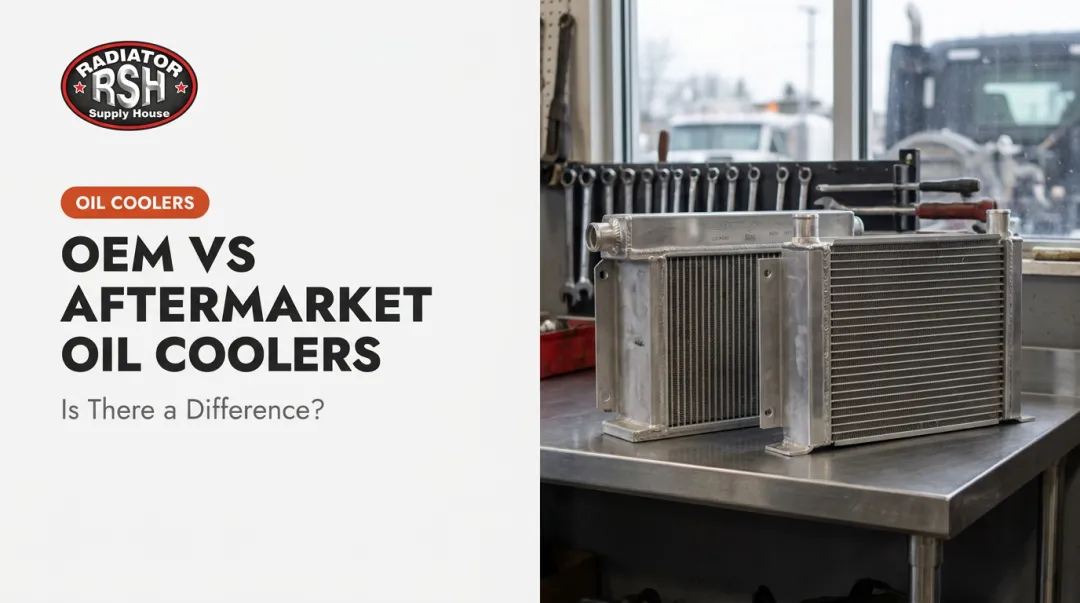
OEM vs. Aftermarket vs. Rebuilt
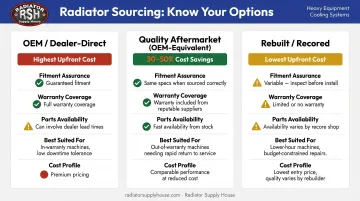
Three sourcing tiers exist, each with different cost and risk profiles:
- OEM (dealer-direct): Highest upfront cost, guaranteed fitment, necessary for warranty-covered equipment or dealer-only part numbers
- Quality aftermarket (OEM-equivalent): Typically 30–50% less than OEM pricing, same specs and cooling capacity when sourced from a reputable supplier — this is where Radiator Supply House's ICEBOX replacement parts line competes directly
- Rebuilt/recored: Lowest upfront cost, variable quality, best suited for lower-hour machines or situations where extended service life isn't the priority
Aftermarket quality varies significantly by supplier. Fitment accuracy, material thickness, and pressure ratings all differ — a low-grade unit sourced purely on price frequently fails within six months, turning a one-time repair into a repeat job.
Labor Complexity and Equipment Accessibility
On heavy machinery, accessing the radiator often requires removing guards, hoods, cab components, or interconnected hydraulic lines. That adds hours — and skilled-labor hours cost more than automotive technician rates.
BLS May 2024 data shows heavy vehicle and mobile equipment technicians earn a median wage of $30.16/hour — compared to $23.88/hour for automotive technicians. Shop billing rates sit above those wage figures. On complex machines, labor can easily match or exceed the cost of the radiator unit itself.
Complete Cost Breakdown: What You're Actually Paying For
Operators who budget only for the radiator unit are frequently caught off guard. Here's the full picture:
| Cost Component | Typical Range | Notes |
|---|---|---|
| Radiator unit | $300–$5,000+ | Varies by equipment class, material, sourcing channel |
| Coolant flush and refill | $100–$800+ | Scales dramatically by machine size — a Cat 320 excavator holds 9.2 gallons; a D6 dozer holds up to 20.3 gallons |
| Hoses, clamps, and ancillaries | $150–$600+ | Heavy-duty radiator hoses run $40–$235+ each; clamp kits add $80–$100 |
| Thermostat and radiator cap | $50–$200 | Often replaced proactively during a radiator job |
| Labor | $500–$3,000+ | 1–2 hours on light equipment; 6–10+ hours on large construction or mining machines |
| Equipment downtime | Variable — often exceeds all other costs combined | The hidden line item most operators don't quantify |
For commercial operators, downtime is often the most expensive line on the invoice. Every day a machine sits idle represents lost revenue — and waiting 2–3 weeks on a dealer order can cost far more than any discount on the part itself. Radiator Supply House maintains a deep inventory and ships in-stock items within 24 hours, which matters when a job is on hold.
OEM vs. Aftermarket Radiators: What's the Real Cost Difference?
| Factor | OEM | Quality Aftermarket (OEM-Equivalent) |
|---|---|---|
| Upfront price | Highest | 30–50% less |
| Fitment accuracy | Guaranteed | High, when sourced from reputable supplier |
| Material quality | OEM spec | Matches OEM spec on quality units |
| Warranty coverage | Manufacturer warranty | Varies by supplier |
| Lead time | Days to weeks via dealer | In-stock units ship same/next day from specialists |
For most operators running out-of-warranty equipment, a quality OEM-equivalent aftermarket unit performs comparably to OEM — at 30–50% less cost. The decision comes down to supplier verification: can they confirm fitment and back the material construction?
That verification starts with core construction standards: material thickness, tube row configuration, pressure ratings, and direct cross-referencing to OEM part numbers. A part that checks those boxes is a fundamentally different product than a generic low-grade substitute.
ICEBOX replacement parts from Radiator Supply House are built to those standards — cross-referenced to specific OEM part numbers across Cat, Komatsu, John Deere, Freightliner, Volvo, and many other manufacturers.
When OEM is worth the premium:
- Equipment still under manufacturer warranty
- Precision-critical applications where dealer-only part numbers make aftermarket sourcing impractical
- Situations where warranty claim compliance requires original components
What Most People Get Wrong About Radiator Replacement Costs
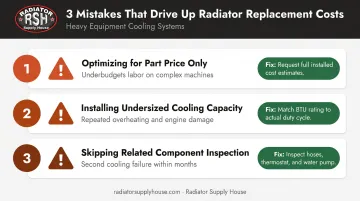
Most budget overruns and repeat failures come down to three predictable mistakes — and all three are avoidable with the right planning upfront.
1. Optimizing for part price while ignoring labor costs On heavy equipment, labor often equals or exceeds the radiator cost. Operators who focus on the cheapest part without accounting for labor complexity routinely underbudget by a wide margin. Get a total installed cost estimate, not just a parts quote.
2. Installing a unit that doesn't match the OEM cooling capacity An undersized radiator on a high-load machine leads to repeated overheating events. The engine damage that follows — head gaskets, liner damage, turbo failures — dwarfs any savings on the radiator. Verify that the replacement unit matches the OEM's cooling capacity specification, not just the physical dimensions.
3. Swapping the radiator without inspecting related components A new radiator paired with a worn water pump, degraded hoses, or depleted coolant is one of the most common setups for a second cooling failure within months. A full replacement should include inspection of all related components — thermostat, hoses, clamps, coolant condition, and water pump. Budget for it upfront.
How to Estimate the Right Budget
Budgeting for radiator replacement means evaluating the machine's situation, not just finding the lowest part price. Consider:
- Machine age and remaining value — a $4,000 radiator on a machine worth $6,000 requires a different decision than the same repair on a $150,000 excavator.
- Operating environment — machines running in high-heat, high-load, or dusty conditions need higher-spec cooling solutions. Budgeting for a standard unit in a demanding application is a short-term savings that becomes a long-term cost.
- Total cost of ownership — Cummins estimates that up to 40% of total engine repair costs originate in the cooling system. A radiator that fails prematurely doesn't just cost the replacement price — it costs the downstream engine damage it enables.
Before requesting quotes, know your machine's hours, its remaining service life, and the environment it operates in. That context determines whether a standard replacement makes sense or whether a higher-spec unit is the smarter spend.
Frequently Asked Questions
How much does radiator replacement cost?
Parts and labor combined typically start around $500–$1,200 for light commercial vehicles, $1,350–$3,500 for mid-range heavy equipment and commercial trucks, and $5,000–$8,000+ for large construction or mining machines once labor, coolant, and ancillary components are included.
Is replacing a radiator a big job?
On lighter commercial vehicles, it's a moderate task. On heavy equipment — excavators, dozers, haul trucks — accessing the radiator often requires removing guards, panels, and interconnected hydraulic or engine components. That makes it a multi-hour job requiring technicians with specialized heavy equipment experience.
Should I repair or replace my radiator?
Minor leaks or damaged cores can sometimes be repaired, but in heavy-duty applications, replacement is often the most reliable long-term solution. If you're not sure whether to repair or replace, contact us at +1 877-615-3002 or info@RadiatorSupplyHouse.com.
Can I operate equipment with a failing radiator?
No. A failing radiator causes engine overheating under load, and the resulting damage — to heads, liners, turbochargers, or the engine block — can cost tens of thousands of dollars to repair. Stop the machine at the first sign of overheating; the radiator replacement cost is a fraction of an engine rebuild.
Is aluminum better at cooling than copper/brass?
Not necessarily — it depends on the application. Copper has higher thermal conductivity, so copper-brass cores transfer heat very efficiently and hold up well in high-temperature, heavy-duty conditions, while also resisting corrosion. Aluminum has lower conductivity but dissipates heat well, and its lighter weight helps where reducing weight matters. A well-designed radiator — with the right fin density, surface area, and build quality — cools efficiently in either material, so the best choice comes down to your cooling needs, operating conditions, and weight priorities. For help selecting the right radiator, contact us at +1 877-615-3002 or info@RadiatorSupplyHouse.com.