The distinction matters. Unlike the upper radiator hose, which operates under positive pressure, the lower hose sits on the suction side of the water pump. That placement makes it structurally vulnerable to collapse when pump demand increases at high RPM — a problem that's diagnosable and fixable once you understand the mechanics.
This article covers the five primary causes, what happens if you ignore the signs, and how to fix the problem at the root without repeat failures.
Key Takeaways
- The lower hose sits on the suction side of the water pump, so high RPM directly increases vacuum force on its walls
- A missing anti-collapse spring is one of the most common overlooked causes, especially after hose replacement
- Symptoms appear at speed and clear at idle, making this easy to misdiagnose as a thermostat or fan issue
- Diagnose in order: check the anti-collapse spring first, then the hose condition, cap pressure, and coolant quality
- Inspect the lower hose at every oil change interval; don't wait for visible damage
Common Causes of Lower Radiator Hose Collapse When Revving
The lower radiator hose connects the bottom of the radiator to the water pump inlet — it pulls coolant into the pump, not pushes it out. That suction-side position explains every failure mode below.
The upper hose operates under positive pressure. The lower hose doesn't get that structural support. When the pump spins faster and draws harder, the lower hose has to resist collapsing inward on its own. When it can't, flow stops.
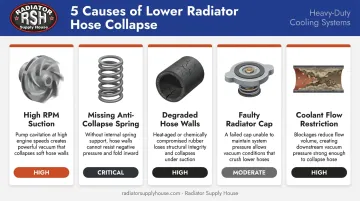
Collapse during revving traces back to one or more of these conditions:
Water Pump Suction Overpowering the Hose at High RPM
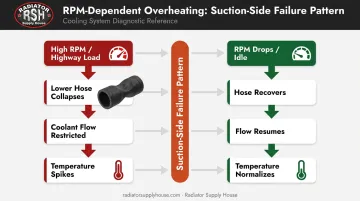
As engine RPM climbs, the water pump spins faster and demands more coolant volume from the lower hose. If the hose walls can't hold their shape against that increasing suction force, they draw inward , partially or fully blocking flow.
The typical symptom: normal temperatures at idle, overheating above highway speed or under heavy load, temperatures returning to normal once RPM drops. This pattern is distinctive but easy to attribute to a weak thermostat or a a restricted radiator.
Missing or Discarded Anti-Collapse Spring
Many OEM molded lower radiator hoses are designed to include an internal coil spring that holds the hose round under suction. This spring is frequently discarded during installation , treated as packing material rather than a functional component.
A brand-new hose then collapses within days or weeks because the actual cause was never addressed. This is one of the most consistently overlooked issues in cooling system maintenance, particularly in restoration work and used equipment servicing.
Degraded or Structurally Weakened Hose Walls
Heat cycling, age, and chemical exposure gradually soften rubber hose walls. Research from Gates Australia notes that hose failure incidence increases sharply after four years of service, with electrochemical degradation (ECD) being a primary failure mechanism , creating internal cracks that aren't visible from outside.
A hose that looks intact and shows no external leaks may have lost the wall rigidity needed to resist suction at high RPM. The tell: it feels soft or spongy when squeezed with the engine warm.
Faulty Radiator Cap Disrupting Pressure Balance
The radiator cap controls system pressure retention and vacuum equalization. A cap that releases early (or fails to hold its rated pressure) lets the cooling system run at lower-than-designed pressure. That lowers the baseline resistance to vacuum at the lower hose, amplifying the collapse risk under high-RPM demand.
DTNA maintenance documentation specifies that caps must hold within 10% of their marked pressure rating. A stuck vacuum-relief valve is a documented failure mode that can directly cause hose collapse. The cap is cheap to test and frequently tested last , which is the wrong order.
Coolant Flow Restriction Amplifying Suction
Internal scale deposits, radiator blockage, or debris near the pump inlet reduce the coolant volume reaching the pump. The pump continues pulling at the same rate. The suction vacuum at the lower hose intensifies as a result, even if the hose itself is new and the spring is in place.
Scale buildup is a genuine threat. According to Cummins coolant documentation, scale acts as an insulator on hot engine surfaces, preventing coolant from absorbing heat and potentially causing engine failure. Systems past their coolant service interval are at elevated risk.
What Happens If You Ignore a Collapsing Lower Radiator Hose
A collapsed hose cuts coolant supply to the water pump, and the engine overheats under load fast. In heavy equipment and commercial trucks, that means:
- Head gasket failure — warped sealing surfaces from thermal stress
- Cylinder head warping — expensive machining or full head replacement
- Thermal shutdowns — unplanned downtime in the field
The warning signs to catch before any of this happens:
- Temperature gauge spikes at highway speed or high load, clears at idle
- Lower hose feels soft or deformed when the engine is warm
- Coolant consumption without visible external leaks
- Hissing or gurgling sounds during RPM increases
That RPM-dependent pattern is the key diagnostic detail. Because symptoms resolve at idle, the collapse gets misdiagnosed as a thermostat, fan clutch, or radiator problem — sometimes repeatedly. Each misdiagnosis buys the hose more time to stress the system until a costlier failure makes the real cause impossible to ignore.
How to Fix a Collapsed Lower Radiator Hose
Work from root cause first. Replacing only the hose without checking the spring, cap, and restriction status almost guarantees the problem comes back.
Install or Restore the Anti-Collapse Spring
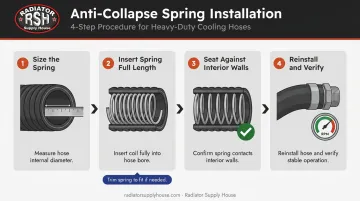
Source a coil spring sized to match the lower radiator hose's internal diameter. Insert it through the full length of the hose before reinstalling, so it should seat firmly against the interior walls and hold the hose round under suction.
Springs are widely available at auto parts suppliers and can be trimmed to fit. This fix works best when the hose walls are still in good condition and collapse is driven by high-RPM suction alone. If you're sourcing a replacement hose, confirm whether the OEM design includes a spring — and add one if it doesn't.
Replace the Lower Radiator Hose
Replace the hose when:
- It feels soft or spongy under hand pressure with the engine warm
- It shows deformation that doesn't recover after the engine cools
- It collapses even at moderate RPM
- You're completing any major cooling system service
For commercial trucks and heavy equipment, Radiator Supply House carries radiator hoses and cooling components across a wide range of equipment makes and models — including applications for Caterpillar, Kenworth, Peterbilt, John Deere, and Komatsu machinery. For hard-to-find hose specifications or serial-number-specific parts, their team can be reached via email (info@RadiatorSupplyHouse.com) by phone (877) 615-3002 or by clicking the Talk to an Expert button below at Radiator Supply House.
Test and Replace the Radiator Cap
Once the hose is addressed, the radiator cap deserves a quick check before closing out the repair.
Use a radiator cap pressure tester to verify the cap holds its rated pressure — the rating is typically stamped on the cap face. If it releases early or fails to hold, replace it with a cap matching the exact system specification.
This is a low-cost test that belongs early in any collapse diagnosis. A cap that's even slightly off-spec amplifies the vacuum effect at the lower hose under high-RPM demand — test it every time hose collapse is being investigated.
Flush the Cooling System and Clear Restrictions
A clean system is the foundation the other fixes depend on. Perform a coolant flush and inspect the radiator for internal blockage, scale deposits, and debris near the water pump inlet. A restricted system forces the pump to generate stronger suction to maintain flow — worsening collapse even when the hose and spring are in good condition.
Schedule this flush as a priority when:
- The vehicle has exceeded the manufacturer-recommended coolant service interval
- Collapse is accompanied by slow warm-up or reduced heater output
- Temperature readings are inconsistent rather than consistently high
Cat ELC, for reference, is rated for up to 1,000,000 km (600,000 miles) or 6 years for on-highway trucks with proper sampling and extender additions — but only when those intervals are actually observed.
Tips for Long-Term Prevention
Most repeat hose collapse failures are preventable. A few consistent habits — built into existing maintenance routines — catch the problem before it escalates into a coolant loss event or engine damage.
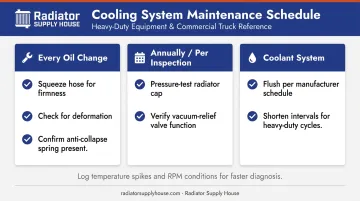
At every oil change:
- Squeeze the lower radiator hose — it should hold firm, not feel spongy
- Check for deformation, soft spots, or clamp looseness
- Confirm the anti-collapse spring is present any time a hose is removed or replaced
Annually or during any collapse investigation:
- Test the radiator cap against its rated pressure specification
- Verify the cap's vacuum-relief valve functions correctly (a stuck valve can cause collapse during cooldown)
Coolant system maintenance:
- Flush on the manufacturer-recommended schedule — don't extend intervals based on coolant color alone
- For heavy equipment in construction, mining, or agriculture, consider shorter flush intervals given the intensity of heat cycling
Operator and driver training:
- Teach the symptom pattern: overheating at high RPM that resolves at idle is not a thermostat problem
- Train operators to log coolant temperature spikes and note whether symptoms appear under load — that detail alone cuts diagnostic time significantly
Conclusion
Lower radiator hose collapse during high-RPM operation follows a clear mechanical logic. The suction side of the water pump generates increasing vacuum as RPM climbs. When the hose walls, anti-collapse spring, cap pressure, or coolant flow path can't compensate, the hose draws inward and flow stops.
The good news: this is both diagnosable and fixable. A spring, a hose replacement, a cap pressure test, and a coolant flush resolve most cases at a fraction of the cost of head gasket repair or unplanned engine downtime. For fleet operators and equipment owners running Caterpillar, Komatsu, Freightliner, or similar heavy-duty equipment, identifying the problem early keeps maintenance costs predictable — and engines running.
Frequently Asked Questions
What would cause a lower radiator hose to collapse?
The lower hose sits on the pump's suction side, where vacuum forces intensify with RPM. Common causes include a missing anti-collapse spring, degraded hose walls, a faulty radiator cap that can't hold system pressure, and internal flow restrictions that amplify pump suction.
Can I drive with a collapsed lower radiator hose?
Driving with a collapsed lower hose risks coolant starvation to the water pump, causing rapid overheating under load and potential engine damage. The hose should be inspected and repaired before continued operation at highway speed or under any significant engine load.
How do you tell if you have a collapsed lower radiator hose?
Squeeze the lower hose when the engine is warm — a healthy hose holds its shape while a collapsing one feels soft or deforms under light pressure. The classic operational symptom is overheating at highway speed or high RPM that resolves when engine speed drops back to idle.
Does a collapsed lower radiator hose cause overheating?
Yes. Collapse restricts coolant flow to the water pump, causing overheating specifically under load — while temperatures appear normal at idle. The RPM-dependent pattern is the diagnostic key; overheating that tracks with engine speed points directly to the lower hose or a related suction-side issue.
What is an anti-collapse spring and do I need one?
It's a coil spring inserted inside the lower radiator hose to keep it round against suction forces. OEM hoses often include one, and it should always be reinstalled — or sourced separately — when replacing a lower hose on any vehicle at sustained high RPM, as discarding it during installation is a common mistake that causes immediate repeat failures.
How often should I replace the lower radiator hose to prevent collapse?
Inspect the hose at every oil change and replace by condition, not mileage. Soft walls, permanent deformation, or cracking all indicate replacement is needed — heavy equipment and commercial vehicles under frequent high-RPM demand warrant checks more often than standard service intervals suggest.