That decision hinges on understanding what coolant hose sealants can actually do, where they fail, and how to apply them correctly. According to Cummins, estimates project that over 40% of total engine repair costs originate in the cooling system — which puts the stakes of any cooling system repair decision in sharp focus.
This guide covers when sealant is the right call, which type to use, and how to apply it step by step — written specifically for heavy equipment operators, fleet maintenance teams, and repair shops dealing with machinery that runs harder and hotter than passenger vehicles.
Key Takeaways
- Coolant hose sealant is a temporary bridge repair — not a permanent fix
- External sealants (RTV silicone, self-fusing tape) address the hose exterior; liquid additives circulate through the system and carry higher risk in heavy-duty and multi-circuit cooling systems
- Always depressurize and cool the system completely before any sealant application
- Match sealant temperature ratings to your equipment's actual operating range — heavy equipment and commercial trucks run hotter and harder than standard ratings assume
- Every sealant repair should be logged and followed by hose replacement at the next scheduled service interval
When to Use Coolant Hose Sealant
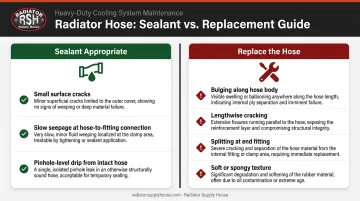
Sealant has a defined use case: minor, localized leaks where the hose structure is still fundamentally sound. The leak must have a visible, accessible source.
Appropriate conditions:
- Small surface cracks on the hose exterior
- Slow seepage at a hose-to-fitting connection
- Pinhole-level dripping from an otherwise intact hose section
Sealant won't produce a lasting repair if the hose shows any of the following:
- Bulging along the hose body
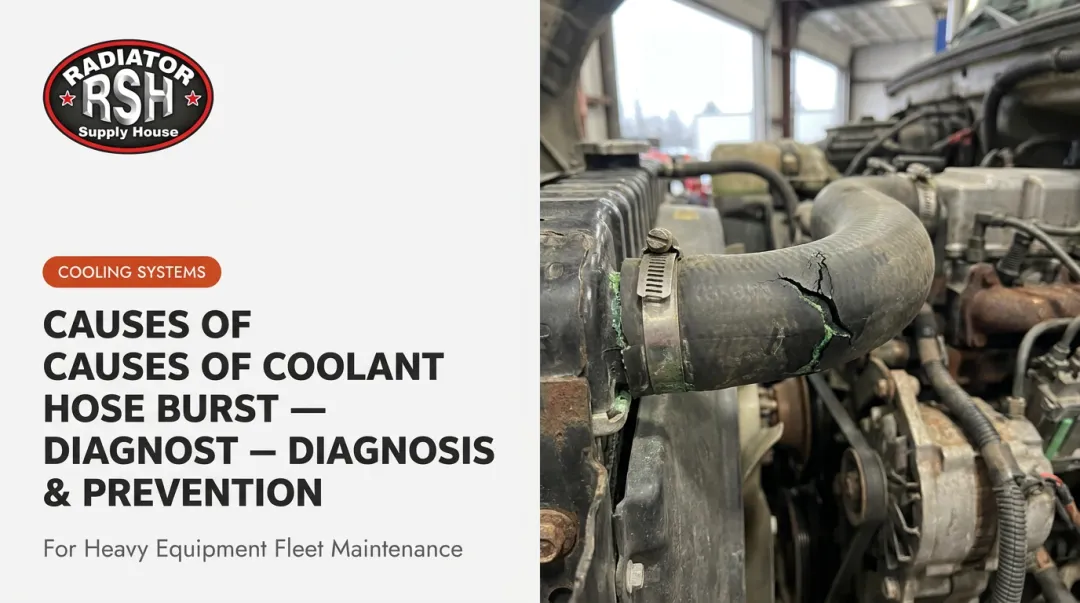
- Cracking that runs along the hose length (not just surface-level)
- Splitting at the end fitting
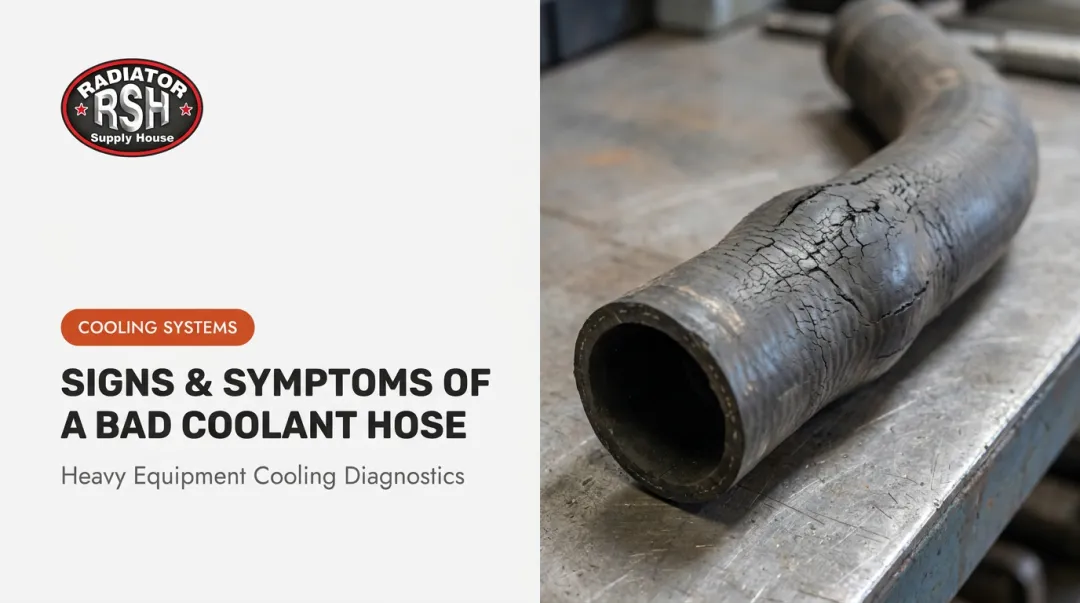
- Soft or spongy texture — a sign of internal deterioration
Heavy equipment cooling systems run under constant vibration, significant temperature cycling, and pressures that exceed passenger vehicle ranges. Sealant applied over structural hose failure won't hold under those conditions — and it can mask a worsening failure mode that only becomes apparent under load. Use it to get through a field situation, then replace the hose at the next scheduled maintenance window.
Types of Coolant Hose Sealant
External Application Sealants
RTV (Room Temperature Vulcanizing) silicone is the most common external option. It bonds to the hose exterior and fitting connections, cures flexible, and handles high temperatures. Permatex's Water Pump & Thermostat RTV specifies a range of -65°F to 500°F intermittent and a full 24-hour cure — but note that this product is designed for flange and housing gasket applications, not hose wall patching. For hose connection points and exterior seam sealing, use an RTV product that explicitly covers those applications and verify it's rated above your system's operating temperature.
Cummins fire-pump engine data sheets show thermostat ranges reaching 180–203°F — and heavy-duty diesel equipment in construction and mining can push those ranges higher. An under-rated sealant softens and fails under sustained heat.
Self-fusing silicone tape is the fastest emergency field option. It requires no adhesive, fuses to itself under tension, and creates a pressure-resistant wrap. Permatex's self-fusing tape is rated for -50°F to 400°F continuous operation. The published 700 psi tensile strength is a material property — not a universal coolant hose working-pressure rating — so don't treat it as a permanent structural fix.
Self-fusing tape works best on straight hose sections and loses effectiveness on tight bends or fitting necks where consistent wrap tension is difficult to maintain.
Internal Liquid Additives
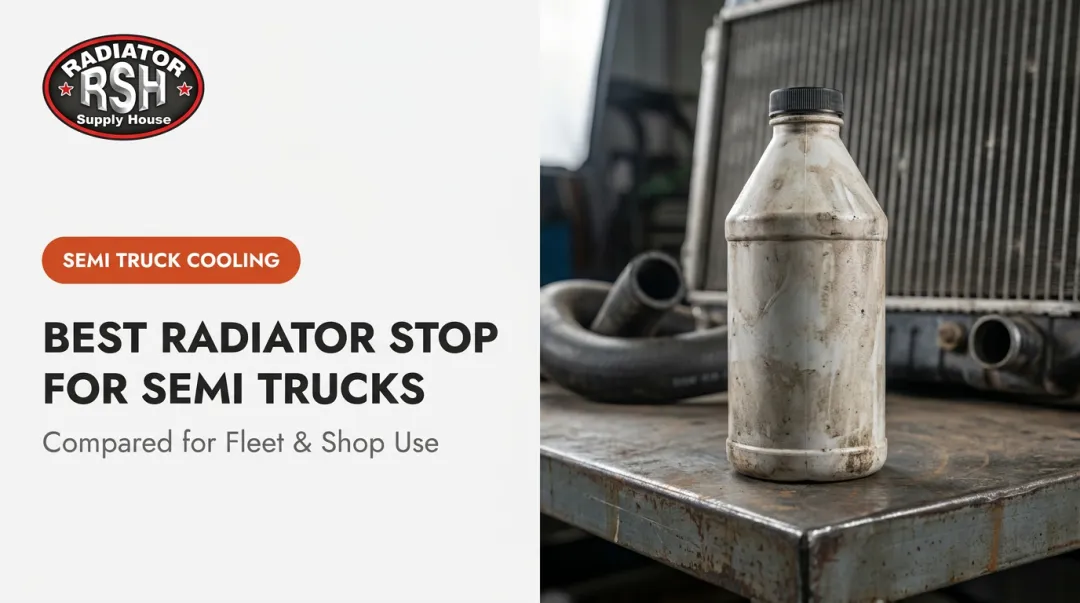
External sealants address leaks at hose connections and exterior surfaces. When the leak originates deeper in the system, liquid stop-leak additives take a different approach: they circulate through the cooling system and seek out pinhole leaks to seal from the inside.
The mechanism works, but the risk profile for heavy equipment is higher than for passenger vehicles. Cummins' industrial engine manual states that sealing additives can cause plugging, inadequate coolant flow, and overheating. Detroit Diesel's manuals prohibit sealer additives entirely.
These are OEM-level restrictions that reflect real consequences. Complex heavy equipment cooling systems include narrow passages through:
- Oil coolers and transmission coolers
- Heater cores and charge-air coolers
- Thermostat housings and coolant crossovers
Stop-leak particles can partially or fully block any of these points, triggering the overheating events they were meant to prevent.
For mission-critical heavy equipment: use liquid additives cautiously, and verify against your specific OEM documentation before use.
How to Apply Coolant Hose Sealant: Step-by-Step
Surface preparation determines seal quality more than the sealant product itself. Skipping steps here is the primary reason field repairs fail under operating pressure.
Setup and Preparation
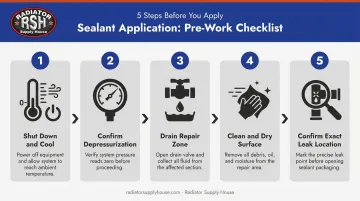
Shut down and cool completely — the system must reach ambient temperature before any access. A Queensland mining safety alert documents hand and chest burns on a Caterpillar 980G operator after pressurized coolant was released unexpectedly.
Confirm depressurization by checking the reservoir cap carefully before opening. Never remove a cap on a warm system.
Drain coolant from the repair zone if needed — coolant on the bonding surface will prevent adhesion regardless of the sealant product used.
Clean the repair area thoroughly — remove all coolant residue, grease, and grime with a degreaser-dampened rag. Wipe dry with a clean cloth. For RTV silicone, lightly scuffing smooth rubber with fine sandpaper improves adhesion.
Confirm the exact leak location visually — don't apply sealant broadly or guess at a source. Use a pressure test or observe under idle before shutdown to pinpoint the exact site.
Applying the Sealant
For RTV silicone:
- Apply a smooth, continuous bead over and around the leak site
- Press the material into any crack or seam
- At connection joints, apply around the full circumference of the hose-to-fitting interface and over the clamp area
- Avoid gaps or voids — these become pressure failure points
For self-fusing silicone tape:
- Start wrapping 2–3 inches below the leak
- Stretch the tape to approximately half its width with each pass
- Overlap each layer by 50%
- Continue 2–3 inches past the leak
- Maintain consistent tension throughout — loose wrapping will not fuse properly
Curing and Testing
- RTV silicone: Allow a minimum of 1 hour before any fluid contact, with full cure at 24 hours. Do not restart the system before this minimum is met.
- Self-fusing tape: Functional immediately but reaches full strength in 30–60 minutes.
Before restarting, inspect the applied sealant for complete coverage and re-apply if any gaps are visible. Once restarted, bring the equipment to operating temperature slowly, observe the sealed area during warm-up, and confirm coolant level and pressure indicators before returning to full load.
Best Practices for Coolant Hose Sealant
Never apply sealant to a pressurized or hot system. Sealants applied under heat and pressure fail to cure properly, creating a false sense of repair while the underlying leak continues.
Match temperature ratings to your specific machine. Research the sealant product's rated range and compare it against your equipment's documented operating temperature. Caterpillar, Komatsu, and similar heavy-duty platforms may exceed the temperature ranges for which standard automotive-grade sealants are designed.
At hose-to-fitting connections, inspect and re-torque the hose clamp as part of the same repair. A loose clamp is frequently the primary cause of connection-point seepage. Sealant applied over a loose clamp won't compensate for inadequate mechanical compression.
Log every sealant repair in the maintenance record. Note the location, date, and product used. Schedule a proper hose inspection and replacement within the next service interval. On fleet equipment, this discipline prevents a known temporary fix from drifting into an overlooked failure point.
Repeated sealant applications at the same location signal a systemic problem. Common causes include:
- Hose material degradation from age or heat cycling
- Chemical incompatibility between the hose compound and coolant formulation
- An incorrectly spec'd hose for the application
If recurring failures at the same point indicate a hose that needs proper replacement, Radiator Supply House stocks cooling system components for Caterpillar, Komatsu, John Deere, Freightliner, Kenworth, Peterbilt, and other major manufacturers. Their team can help you identify the right OEM-equivalent component for your specific machine and serial number range.
Frequently Asked Questions
Do coolant leak sealers work?
They can work on minor pinhole leaks and small seepage points, but are ineffective on larger splits, structural failures, or damaged fittings. Results depend on leak type and size — and OEMs including Cummins and Detroit Diesel have documented risks of plugging and restricted flow when additives are used in complex cooling systems.
What is the best sealant for coolant hose connections?
RTV high-temperature silicone is the most reliable external option for hose-to-fitting connection points. It bonds to both rubber and metal, remains flexible after curing, and handles the temperature ranges found in most heavy equipment cooling systems when properly rated.
Can you use RTV silicone on coolant hoses?
Yes — as an external sealant for cracks, seeping joints, and connection points, provided the surface is clean and dry and the product is rated above the system's operating temperature. RTV is not designed for hose wall patching and won't substitute for a structurally compromised hose.
How long does coolant hose sealant last?
Self-fusing tape and RTV silicone repairs typically hold for weeks to several months under normal conditions. Duration depends on leak size, operating pressures, and temperature cycling. Treat every sealant repair as temporary until a proper hose inspection or replacement is completed.
When should you replace a coolant hose instead of sealing it?
Replace the hose when it's bulging, cracking along its length, soft or spongy to the touch, leaking repeatedly at the same point after prior sealant repairs, or showing deterioration beyond a localized, accessible leak site.
Is coolant hose sealant safe for heavy equipment cooling systems?
External sealants like RTV silicone and self-fusing tape are generally safe when applied to properly prepared surfaces. Internal liquid additives carry far more risk in systems with tight passages or oil coolers — some OEMs prohibit them outright — so always check your equipment's OEM documentation first.