Introduction
Pick the wrong hose size for an engine oil cooler, and you risk more than a leaky fitting. Restricted oil flow, elevated operating temperatures, and bearing failure under load can follow — sometimes quickly. On heavy equipment running sustained high-demand cycles, that progression can happen fast.
The confusion usually starts with terminology. "Hose size" sounds simple, but it refers to three different measurements — inner diameter, outer diameter, and wall thickness — and only one of them governs whether the hose will perform correctly in an oil cooler circuit.
This guide covers what hose size means in an oil cooler system, how dash-size conventions translate to real dimensions, and how to measure and verify the correct size before ordering. It also addresses why sizing errors hit harder on heavy equipment than most technicians expect.
Key Takeaways
- Inner diameter (ID) is the governing dimension — not OD or wall thickness — because it controls flow area and restriction.
- Industry dash sizing uses 1/16" increments of nominal ID: -6 = 3/8", -8 = 1/2", -10 = 5/8", -12 = 3/4", -16 = 1".
- Light-duty applications typically use -8AN to -10AN; heavy equipment commonly requires -10AN to -16AN or larger.
- Always reference the oil cooler's port size first — it's the definitive anchor point for the entire sizing chain.
- Sizing errors go both ways: undersized hose restricts flow, while oversized hose cuts cooling velocity and causes sealing problems.
What Hose Size Represents in an Engine Oil Cooler System
Inner Diameter Is the Only Dimension That Matters for Flow
Every hose has three physical dimensions: inner diameter (ID), outer diameter (OD), and wall thickness. For oil cooler hose selection, ID is the parameter that governs performance.
ID sets the cross-sectional flow area — the actual channel through which oil moves — and determines how much fluid can pass at a given pressure without creating a restriction.
OD and wall thickness affect routing clearances, fitting compatibility, and pressure rating, but neither one tells you whether the hose can carry the required oil volume. Two hoses with identical ODs can have dramatically different IDs depending on wall construction.
The Industry Dash-Size Convention
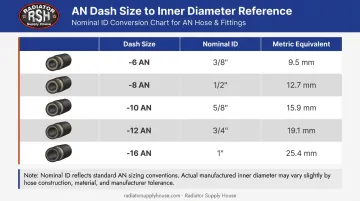
The hose industry uses a dash-size (or dash-number) convention based on nominal ID in sixteenths of an inch. Parker's hydraulic hose technical handbook defines this system as follows:
| Dash Size | Nominal ID | Metric Equivalent |
|---|---|---|
| -6 | 3/8" | 9.5 mm |
| -8 | 1/2" | 12.7 mm |
| -10 | 5/8" | 15.9 mm |
| -12 | 3/4" | 19.1 mm |
| -16 | 1" | 25.4 mm |
These are nominal values, not guaranteed actuals. Actual manufactured ID varies by construction type. For example, Eaton's PTFE hose series lists minimum actual bores of 0.406", 0.500", 0.630", and 0.878" for -8, -10, -12, and -16 respectively — measurably different from the nominal fractions. Always confirm against the specific hose series data sheet, not just the dash number.
Hose Size Is a Design Parameter, Not a Free Variable
That nominal-vs-actual gap matters because hose size isn't a judgment call — it's set by the system. The correct size for an oil cooler circuit is determined by the cooler's inlet and outlet port size, the engine oil pump's flow rate, and the operating pressure range. An installer cannot freely choose a different size without violating one or more of those constraints.
- Undersized hose increases flow velocity and pressure drop, restricts oil delivery, raises oil temperature, and increases system pressure upstream of the restriction.
- Oversized hose reduces oil velocity through the cooler circuit, decreasing heat transfer efficiency, and makes reliable sealing at fittings harder to achieve.
Standard Engine Oil Cooler Hose Size Ranges by Application
Size selection without reference to the specific application is one of the most common and costly mistakes in oil cooler service work. The ranges below are starting points — the OEM specification for the actual cooler and engine always takes precedence.
Nominal Size Ranges by Equipment Class
Light-duty passenger vehicles and small gasoline engines:
- Typically -8AN (1/2" ID); some compact applications use -6AN (3/8" ID)
- Lower oil pump output and heat rejection demand keep circuit sizes smaller
Commercial diesel pickups, medium-duty trucks:
- Generally -10AN (5/8" ID) to -12AN (3/4" ID)
- Higher oil pump output and sustained load cycles require larger flow capacity
Heavy construction equipment, agricultural machinery, and industrial engines:
- Commonly -12AN (3/4" ID) to -16AN (1" ID) or larger
- Two OEM-verified examples from the research: Cat part 1N-4692 specifies a 19mm ID engine oil cooler hose (fitting D3B/D3C tractors and 931B/931C loaders), and John Deere part R70438 specifies 16mm (5/8") ID for 3029D/T, 4039D, and 4045D engines
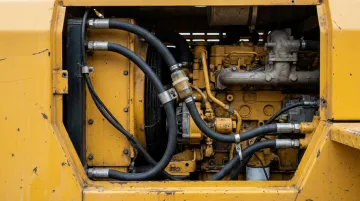
These OEM data points confirm that even within the heavy equipment category, port size varies by model — there is no universal "heavy equipment" size.
Knowing the right size range is only half the equation — the fitting standard determines whether that size actually connects to your cooler and port.
Fitting Standards and Cross-Reference Considerations
Metric and AN sizes approximate each other but are not interchangeable without verification:
- 10mm ≈ -6AN | 12mm ≈ -8AN | 16mm ≈ -10AN | 19mm ≈ -12AN
These are close references, not exact equivalents. The manufactured ID of a hose must be confirmed against both the fitting and the port spec.
Port thread standards also interact with hose size selection:
- AN hose ends, ORB (O-Ring Boss), NPT, BSP, and metric ports each require specific adapter fittings
- The hose ID must match the AN size of the hose end fitting, which must match the port thread on the cooler
- A -10AN ORB port requires a -10AN hose end, which requires a -10AN hose (5/8" ID) — the chain must be consistent end to end
The product's technical specification drawing is the reference point for port diameter when ordering any replacement cooler. Radiator Supply House publishes these spec drawings for ICEBOX-branded units, showing port sizes with the Ø symbol and calling out asymmetric inlet/outlet dimensions where inlet and outlet differ.
Key Technical Properties That Interact With Hose Size
Pressure Rating and Wall Construction
Oil cooler circuit pressure varies by engine type and application. Cummins publishes 40–70 psi for a 6.7L industrial engine; Cat's 3600-series engines specify approximately 55 psi nominal manifold pressure. Both are engine-specific figures, not universal benchmarks.
What pressure rating directly affects is wall construction:
- Single-wire braid (SAE 100R1): lighter, smaller OD at a given ID, lower working pressure
- Double-wire braid (SAE 100R2): higher pressure ceiling, larger OD, stiffer
- PTFE-lined with stainless braid: highest temperature and chemical resistance, largest OD at a given ID
The hose must be rated above the system's maximum transient pressure — not just the nominal operating pressure. Spikes during cold starts and high-load conditions regularly exceed steady-state values.
Temperature Rating and Material Compatibility
| Material | Temp Range | Oil Resistance | Notes |
|---|---|---|---|
| Rubber (standard) | Moderate | Good | Most common, widest ID availability |
| Silicone | High | Variable | Lower pressure ceiling; confirm oil-service rating |
| PTFE-lined, braided | -65°F to +450°F | Excellent | Preferred for high-performance/heavy-duty; larger OD |
PTFE-lined hose at the same dash size carries a larger OD than a rubber equivalent. That size difference can create routing clearance conflicts in tight engine bays — so material choice directly constrains available ID options.
Minimum Bend Radius
Minimum bend radius scales with hose OD — and larger ID hoses have larger ODs. Eaton's PTFE series data shows:
- -8: 4.62" minimum bend radius
- -10: 5.50" minimum bend radius
- -12: 6.50" minimum bend radius
- -16: 7.38" minimum bend radius
In complex equipment chassis routing, the required hose size may not physically fit through the intended path without exceeding minimum bend radius. Pre-formed hose, swivel hose ends, or adapter fittings solve this problem. Forcing a tighter bend than the hose allows creates an internal restriction that partially negates correct ID selection.
How Oil Cooler Hose Size Is Specified, Measured, and Verified
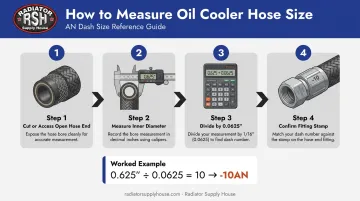
Measuring an Existing Hose
- Cut or access the open end of the hose to expose the bore
- Measure inner diameter with calipers — not OD, not the barb or sleeve diameter
- Divide the measurement by 1/16" to convert to the nearest dash size (e.g., 0.625" ÷ 0.0625 = 10 → -10AN)
- Confirm against the hose end fitting stamp, which should show the matching dash size
ISO 4671:2022 is the formal standard governing hose dimensional measurement methods for rubber and plastics hoses.
Determining Size From the Cooler Port
- Identify the port thread standard (NPT, ORB, BSP, or metric)
- Measure or reference the thread size
- Cross-reference to the correct dash size for that port standard
- Confirm the hose end fitting matches the port type and the hose matches the fitting
When to Consult OEM Documentation
Field measurement alone isn't a reliable reference. OEM service manuals, parts diagrams, and equipment manufacturer specifications are the authoritative source.
For Caterpillar equipment, the Cat Parts Store lists hose dimensions directly. For example, part 7W-9079 is specified as a 25.4mm (1" ID) oil cooler hose. Cross-referencing OEM part numbers with supplier technical drawings provides the highest confidence before ordering.
Consequences of Using the Wrong Hose Size
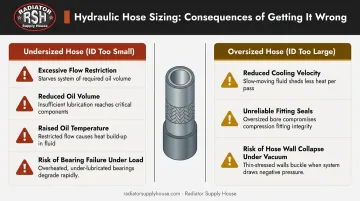
Undersized hose (ID too small):
- Creates excessive flow restriction
- Reduces oil volume delivered to the cooler and back to the engine
- Raises oil temperature and increases upstream system pressure
- Under sustained high-load conditions in heavy equipment, this can progress from reduced oil pressure to bearing failure quickly
Oversized hose (ID too large):
- Reduces oil velocity through the cooler circuit, decreasing heat transfer efficiency
- Makes it harder to achieve reliable seals at fittings
- Can cause hose walls to collapse inward under vacuum or negative pressure if the hose construction isn't rated for vacuum service
Compliance and warranty risk:
- SAE J1019 defines test and evaluation standards for high-temperature engine lubricating oil hose
- Non-OEM-specified hose sizes on commercial vehicles can create liability exposure if an oil system failure occurs
- Using the wrong hose size may void component warranties — check manufacturer policy before substituting sizes
Common Oil Cooler Hose Sizing Mistakes to Avoid
Three mistakes account for most oil cooler hose failures in the field — and all three are avoidable.
- Selecting hose by OD instead of ID. Technicians unfamiliar with the dash-size system sometimes match hose to a barb fitting or sleeve clamp by outside diameter. The result looks correct externally but has the wrong bore — the only dimension that actually controls flow.
- Using heater hose as a substitute. Parker's chemical compatibility guide classifies EPDM — the material in SAE J20 heater hose — as "Not Recommended" for ASTM Oils 1–4. Contact with petroleum lubricants causes internal delamination and oil circuit contamination. A size match is irrelevant if the material fails.
- Carrying over specs from a different application class. A -8AN hose suited to a light-duty gasoline engine is not the right starting point for a Cat D-series dozer or a Komatsu PC. Verify against the specific cooler's port spec and the engine's oil pump output.
Frequently Asked Questions
What size hose is used for an engine oil cooler?
Size varies by application. Light vehicles typically use -8AN to -10AN (1/2" to 5/8" ID); heavy-duty trucks and equipment commonly require -10AN to -16AN (5/8" to 1" ID). The oil cooler's inlet and outlet port diameter is the definitive reference — start there, not with a general range.
Can you use a heater hose for an engine oil cooler?
No. Heater hose is EPDM-based and not oil-resistant. Exposure to petroleum-based engine oil causes internal delamination, contaminates the lubrication circuit, and leads to premature hose failure. A hose specifically rated for oil service is required, regardless of whether the size happens to match.
What is the dash-size convention and how does it relate to oil cooler hose size?
Dash sizes represent 1/16" increments of nominal inner diameter: -8 equals 1/2" ID, -10 equals 5/8" ID, -12 equals 3/4" ID. The hose dash size must match both the hose end fittings and the cooler's port specification — the entire sizing chain must stay consistent.
How do I measure the correct hose size for my oil cooler?
Using calipers, measure the inner diameter at a cut or open end — not the OD — then divide by 1/16" to find the nearest dash size. Confirm by matching to the cooler's port thread size, and cross-check against the OEM parts manual before ordering.
What happens if my oil cooler hose is too small?
Undersized hose restricts oil flow, raises oil temperature, increases upstream pressure, and can cause oil starvation under load. In heavy equipment operating under sustained high loads, this can lead to bearing damage or engine failure.
Does hose material affect the size I should choose?
Material doesn't change the required ID, but it does affect OD and wall stiffness. PTFE-lined and wire-braided hoses at the same dash size will have larger ODs than rubber equivalents, which can affect routing clearances and fitting compatibility in tight installations.
Conclusion
Hose size in an oil cooler system is a governed parameter — defined by the cooler's port diameter, the engine's oil pump output, and the system's pressure and temperature requirements. Getting it right means matching all three simultaneously — guessing from a general range introduces failure points that are expensive to diagnose.
For anyone replacing or upgrading an oil cooler on heavy equipment, commercial trucks, or agricultural machinery, the replacement cooler's inlet and outlet port specifications are the correct starting point. Radiator Supply House supplies oil coolers for over 300 equipment manufacturers (including Caterpillar, Komatsu, John Deere, Freightliner, and Kenworth), with technical specification drawings that identify port diameters directly.
Confirming the cooler spec before ordering hose is faster than diagnosing an oil system failure after the fact.