The radiator sits at the center of this challenge. It's the primary mechanism for shedding engine heat, and when it fails — or even partially underperforms — the consequences cascade quickly. Yet many fleet operators and owner-operators only think about the radiator when the temperature gauge climbs.
This guide breaks down exactly how a semi truck radiator works, from cold start to sustained highway operation, and covers the warning signs that indicate something is going wrong.
Key Takeaways
- A semi truck radiator is a liquid-to-air heat exchanger that removes engine heat by cycling coolant between the engine block and the radiator core
- The thermostat controls when hot coolant enters the radiator, and the fan clutch controls supplemental airflow
- Heat transfers from coolant through metal tube walls into aluminum fins, then dissipates into passing air from vehicle speed or the engine-driven fan
- A failing radiator shows warning signs before complete failure; catching them early prevents catastrophic engine damage
- Aftermarket radiators for Freightliner, Kenworth, Peterbilt, and Volvo deliver OEM-equivalent performance at a lower cost than dealer parts
What Is a Semi Truck Radiator?
A semi truck radiator is a heavy-duty liquid-to-air heat exchanger built to continuously remove excess thermal energy from a diesel engine's coolant circuit. Its job is to prevent the engine from reaching temperatures that degrade oil viscosity, damage cylinder seals, and warp metal components.
Two components are commonly confused with the radiator but serve separate functions:
- Charge air cooler (CAC/intercooler) — cools compressed intake air after the turbocharger, not engine coolant
- Heater core — diverts a small portion of coolant heat into the cab for cabin warming
The radiator's sole responsibility is shedding engine heat to outside air.
Construction Types
Modern commercial trucks use two primary radiator designs:
| Type | Construction | Common In |
|---|---|---|
| Aluminum core / plastic tanks | Lightweight, cost-efficient | Most modern trucks |
| All-metal copper-brass | More field-repairable | Older fleets, vocational applications |
The heat transfer principle is identical across both types. According to SAE engineering documentation, the heavy-duty industry has shifted toward aluminum construction, though copper-brass remains relevant for fleets that prioritize repairability over weight savings.
For fleets sourcing either type, Radiator Supply House carries both aluminum-core and copper-brass options under its ICEBOX replacement parts brand, with coverage for Freightliner, Kenworth, Peterbilt, International, and Volvo, among others.
How Does a Radiator Work in a Semi Truck?
The radiator doesn't operate independently — it's one part of a closed-loop coolant circuit that responds continuously to engine heat output, vehicle speed, load, and ambient temperature. The process unfolds in three coordinated stages.
Stage 1: Initiation — How Coolant Flow Begins
When a cold engine starts, the thermostat stays closed. Coolant circulates only within the engine block, allowing the engine to reach operating temperature faster. This matters because a diesel running too cool produces incomplete combustion and allows fuel to dilute engine oil.
Once coolant temperature reaches the thermostat's opening threshold — which varies by engine manufacturer and application — the thermostat valve opens. Hot coolant flows out of the engine and into the upper radiator tank, and the radiator actively enters the cooling loop.
The water pump drives this entire flow. Mechanically connected to the engine's crankshaft, it runs whenever the engine does, maintaining pressure and flow throughout the system.
Stage 2: Core Operation — How Heat Is Transferred
This is where the actual heat removal happens. Hot coolant enters the upper tank and distributes across dozens of narrow tubes running through the radiator core. As coolant travels through these tubes:
- Heat conducts through the tube walls into surrounding aluminum fins
- The fins multiply surface area exposed to moving air
- Air flowing across the fins absorbs heat and carries it away from the truck
At highway speed, ram air moving through the grille does most of this work. At low speeds or idle, the engine-driven fan draws air through the core to maintain airflow when the truck isn't moving fast enough to generate it naturally.
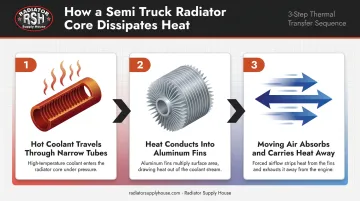
Cooled coolant exits through the lower tank, returns to the engine through the lower radiator hose, and the cycle repeats continuously.
Stage 3: Regulation — Keeping Temperature Stable
The thermostat doesn't simply open fully and stay open. It modulates between open and closed positions to hold coolant temperature in a consistent range — preventing inefficient combustion on the cool side and component damage on the hot side.
The fan clutch adds a second layer of control. A fully engaged heavy-vehicle fan can draw 50–70 horsepower, so modern thermostatic and electronically controlled clutches (Horton, BorgWarner Visctronic) engage at full capacity only when conditions demand it:
- Heavy grade climbing
- Stop-and-go traffic
- Hot weather idling
At highway speed, the fan partially disengages because ram air handles cooling demand, reducing parasitic engine load.
Coolant mixture rounds out the system's regulation. The ratio of water to antifreeze concentrate sets both the boiling point and freeze point of the coolant — and an incorrect mix, too much or too little glycol, reduces heat transfer capacity and risks boil-off or freeze-up depending on operating conditions.
Key Components That Support Radiator Function
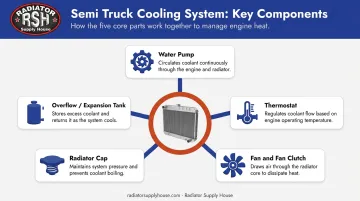
The radiator doesn't work alone. These components make the system function as a whole:
- Water pump — mechanically driven by the crankshaft; circulates coolant through the entire closed loop continuously
- Thermostat — regulates coolant flow based on temperature; prevents overcooling and overheating
- Fan and fan clutch — provides supplemental airflow when vehicle speed alone is insufficient; variable engagement reduces fuel consumption
- Radiator cap — maintains system pressure, raising the coolant's effective boiling point above what an unpressurized system could achieve
- Overflow/expansion tank — accommodates coolant volume changes as temperatures fluctuate; keeps the system sealed
In heavy-duty diesel applications, pressurization isn't optional — it's what keeps coolant from boiling at the temperatures these engines produce. A cap that can't hold proper pressure will cause coolant to boil prematurely, triggering overheating symptoms even when the radiator is in good condition. Volvo specifies a 16-lb pressure cap on VNL surge tanks; always match cap pressure rating to the truck's specification.
Hoses are just as critical to system integrity. Degraded hoses can collapse under negative pressure or restrict flow, creating localized hot spots in the engine even when the radiator is clean and functional. Freightliner's Cascadia maintenance documentation specifically calls for hose inspection alongside radiator checks.
Signs Your Semi Truck Radiator Is Failing
Radiator problems rarely appear without warning. Catching them early is the difference between a planned shop visit and a roadside breakdown.
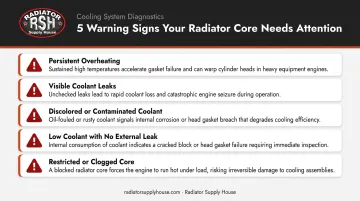
Primary warning signs:
- Persistent or intermittent overheating — temperature gauge climbing under load is the most direct indicator
- Visible coolant leaks — beneath the truck, around hose connections, or at tank seams
- Discolored or contaminated coolant — rust-colored coolant indicates scale buildup; oily or foamy coolant suggests internal engine contamination
- Low coolant with no visible external leak — points toward internal leakage into the engine, which is serious
A less obvious symptom is a clogged or restricted core. Scale buildup from high-mineral water, debris intrusion, or collapsed tubes reduce cooling capacity gradually rather than catastrophically — the engine runs hotter than normal under load, but coolant level is correct and the fan is working.
Detroit's service documentation identifies mineral scale and excess glycol concentration as direct causes of reduced heat transfer and overheating.
Copper-brass radiators can often be repaired by a competent shop. Aluminum-core units with persistent leaks or irreversible internal scaling are generally more cost-effective to replace outright. Radiator Supply House stocks ICEBOX-brand replacement radiators for Freightliner, Kenworth, Peterbilt, Volvo, International, and other brands — with both aluminum and copper-brass options available depending on the application.
Frequently Asked Questions
How long does it take to fix a radiator on a semi truck?
A straightforward radiator replacement typically takes 3 to 8 hours depending on the truck model and shop access. Jobs that include a system flush, hose replacement, or related component work will take longer — plan for a full day in those cases.
How much does a radiator cost for a semi truck?
Cost varies by brand, construction type, and whether you're buying OEM or aftermarket. Aftermarket options from suppliers like Radiator Supply House typically offer meaningful savings over dealer OEM pricing while meeting equivalent performance standards — contact RSH or visit radiatorsupplyhouse.com for current pricing on your specific make and model.
How long does a semi truck radiator last?
A well-maintained radiator can last 8 to 15 years or several hundred thousand miles. Lifespan depends heavily on coolant maintenance intervals, water quality used when topping off the system, and operating environment — dusty or corrosive conditions accelerate wear.
What are the signs of a failing semi truck radiator?
The key indicators are persistent overheating, visible coolant leaks, discolored or contaminated coolant, and an engine running hotter than normal under load despite correct coolant levels. Any of these warrants immediate inspection.
What coolant should be used in a semi truck radiator?
Heavy-duty diesel engines require either extended-life coolant (ELC) or conventional coolant maintained with supplemental coolant additives (SCAs). These are not interchangeable — Detroit and Volvo, for example, publish different intervals and additive requirements for each chemistry type, so always follow your engine manufacturer's specifications.
How is a semi truck radiator different from a car radiator?
Semi truck radiators are significantly larger and built for the sustained heat output of diesel engines running hundreds of hours under load. They're engineered to tighter pressure tolerances and designed for continuous operation — demands that are categorically different from passenger vehicle use.
Understanding how a semi truck radiator works — from thermostat opening to fan clutch engagement to coolant chemistry — gives fleet managers and owner-operators a practical foundation for preventive maintenance and smarter replacement decisions. Every component in the system has a role; recognizing early failure signs keeps a manageable repair from becoming a roadside breakdown.