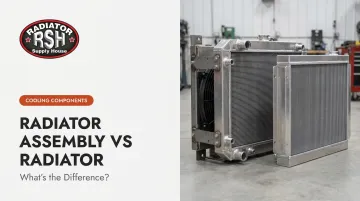
Introduction
Picture this: a fleet manager orders a replacement radiator for a Caterpillar D6H dozer. The part arrives on time — but the fan shroud is warped, the overflow tank is cracked, and the mounting brackets don't match the replacement unit. The radiator itself fits fine. The machine still can't run.
This scenario plays out repeatedly across construction sites, mining operations, and repair shops. The confusion between a "radiator" and a "radiator assembly" seems minor until it costs two extra days of downtime and a second parts order.
According to industry data, unplanned downtime rates of 20–30% are not uncommon in construction — and cooling system failures are a consistent contributor. Getting the parts order right the first time affects more than cost — it directly determines project timelines and equipment ROI.
This guide breaks down exactly what separates a standalone radiator from a radiator assembly, when each makes sense, and how to avoid a common procurement mistake that sends technicians back to the parts counter twice.
Key Takeaways
- A radiator is a single heat exchanger — core, tanks, inlet/outlet connections — and nothing else
- A radiator assembly bundles the radiator with supporting components — fan shroud, oil cooler, mounting hardware — with contents varying by SKU
- Standalone radiators suit targeted repairs where surrounding components are confirmed serviceable
- Assemblies reduce re-work risk when multiple cooling components are damaged or worn together
- Component inclusion is not standardized — always verify what each SKU includes before ordering
Radiator Assembly vs Radiator: Quick Comparison
| Factor | Standalone Radiator | Radiator Assembly |
|---|---|---|
| Scope | Core, tanks, inlet/outlet only | Radiator + some combination of shroud, oil cooler, mounting hardware (varies by SKU) |
| Upfront Cost | Lower | Higher |
| Total Cost of Ownership | Higher if follow-up parts needed | Lower when multiple components require replacement |
| Installation | Assumes existing parts are reusable | Pre-matched components reduce compatibility guesswork |
| Downtime Risk | Risk of second repair visit if adjacent parts fail | Lower re-work risk |
| Best For | Isolated core damage, newer equipment | Multi-component damage, high-hour machines, overhauls |
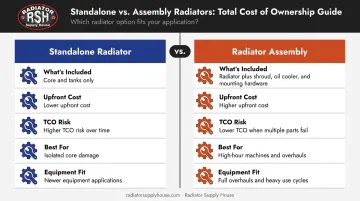
One catch: assembly SKU contents vary by part number, so what's included isn't always spelled out clearly in the listing. Verifying the component list before ordering saves a trip back to the parts counter.
What Is a Radiator?
A radiator is a heat exchanger that transfers thermal energy from engine coolant to the surrounding air, keeping combustion engines within safe operating temperatures. That's its only job.
Core Components
A standalone radiator consists of:
- Radiator core — Tubes carrying hot coolant surrounded by fins that maximize surface area for heat dissipation. Fin density varies by application: Cat part 140-7690 uses 9 fins per inch, while part 468-7365 uses 6.4
- Inlet and outlet tanks — Manage coolant flow direction into and out of the core. Modern heavy equipment tanks are commonly made from aluminum or fiberglass-reinforced polyamide
- Pressure cap — Seals the system and maintains operating pressure. Freightliner's 2022 M2 maintenance manual specifies the cap must hold pressure within 10% of its marked rating, with periodic inspection of the vacuum-relief valve
Flow Configurations
Two layouts exist across most equipment:
- Crossflow — Coolant flows horizontally; tanks sit on the left and right sides
- Downflow — Coolant flows vertically; tanks sit on top and bottom
Both configurations appear across heavy equipment and on-highway trucks. The right configuration for your machine is determined by the OEM design — not a general rule.
Material Construction
Older radiators used copper-brass construction. Aluminum cores and tanks are now common across heavy equipment — Cat part 326-3870 is cataloged as an aluminum radiator core, and MAHLE specifies aluminum cores for commercial-vehicle radiators.
Copper-brass hasn't disappeared, though. Radiator Supply House stocks both options depending on the application. For the Caterpillar 320/323 excavator, for example, both an aluminum version and a steel tank/copper-brass core version are available — letting customers choose based on budget, preference, or repairability.
When a Standalone Radiator Is the Right Call
Order a standalone radiator when:
- Damage is isolated to the core (puncture, tube failure, fin damage)
- The fan shroud, overflow tank, and mounting hardware have been inspected and confirmed serviceable
- The equipment is relatively new with low hours
- The replacement unit is confirmed compatible with existing surrounding components
What Is a Radiator Assembly?
A radiator assembly is a broader cooling unit that integrates the radiator with some or all of the surrounding components required for installation. The key word is "some" — scope varies significantly by equipment make, model, and specific SKU.
What Assemblies May Include
Depending on the application, a radiator assembly can bundle:
- Main radiator core with inlet/outlet connections
- Integrated oil cooler or hydraulic oil cooler
- Fan shroud (where applicable)
- Mounting brackets and isolators
- Coolant overflow or expansion reservoir
Cat part 361-4662, for instance, combines a radiator and hydraulic oil cooler in one unit (17 radiator tube rows, 12 oil-cooler tube rows). Cat part 253-1218 is a completely separate standalone oil cooler. The word "assembly" alone tells you nothing definitive — always verify the SKU details.
Real Examples from the Radiator Supply House Catalog
This variability shows up clearly in practice:
- Caterpillar D4H (RSH #850917) — Complete radiator assembly with integrated oil cooler, coolant inlet/outlet fittings, and mounting brackets. Cross-references OEM part numbers 4P-8238 and 6I-1085
- Komatsu D65EX-15 (RSH #930030) — Full radiator core with inlet/outlet connections in a 36¾ x 20⅜ x 5½-inch configuration, direct-fit for D65EX-15EO, D65PX-15EO, and D65WX-15EO dozers
- Freightliner Coronado (RSH #601146) — Complete assembly with integrated oil cooler, multiple hose connection ports, and a 40¼ x 42-inch core. The "-OC" suffix in OEM reference RFR80AA-OC explicitly signals oil cooler inclusion
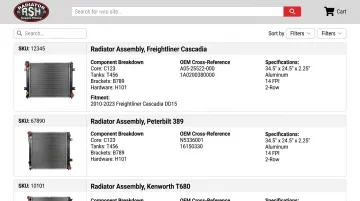
By contrast, Freightliner radiator #601100 is explicitly listed as having no oil cooler — a clear example of why reading the SKU details matters.
Fan shrouds, overflow tanks, mounting brackets, and standalone oil coolers are all stocked at Radiator Supply House as separate SKUs, not default inclusions. The Caterpillar C27 fan shroud (#851181), for example, is a standalone item — as is the Freightliner reservoir tank (#601157) and mounting bracket (#601482).
When a Radiator Assembly Is the Right Call
These catalog differences aren't just technical footnotes — they directly affect which part you order. Choose an assembly when:
- Multiple cooling system components show wear or damage simultaneously
- The equipment has high operating hours where adjacent components are likely near end-of-life
- The machine experienced a front-end collision or severe overheating event
- A repair shop needs a pre-matched, complete cooling solution for a faster customer turnaround
- The equipment is undergoing a major overhaul or refurbishment
For construction equipment, mining trucks, and high-utilization fleets, cascading cooling failures are a real risk. A cracked radiator on a high-hour Cat excavator often accompanies a warped shroud or corroded oil cooler. Catching those problems in one order — rather than after the first repair is already complete — is exactly what an assembly purchase is designed to prevent.
Which Should You Order?
The decision comes down to four variables:
- Damage scope — Is only the radiator core affected, or do surrounding components show wear?
- Equipment age and hours — Higher-hour machines carry greater risk of adjacent component failures
- Total cost of ownership — A lower upfront cost on a standalone radiator can be offset by labor revisits and additional parts orders
- Procurement efficiency — One assembly order vs. multiple sourcing steps for individual components
Decision Guide
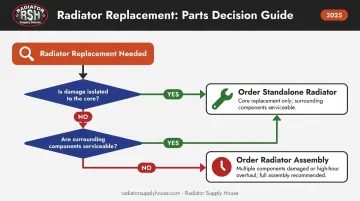
Choose a standalone radiator if:
- Core damage is isolated and confirmed
- Shroud, tanks, and mounting hardware have passed inspection
- Equipment is newer with lower operating hours
- Budget constraints require a targeted replacement
Choose a radiator assembly if:
- Multiple components show wear or damage
- High operating hours increase the probability of adjacent failures
- Downtime cost outweighs the price difference between options
- The job is a full overhaul or refurbishment
Beyond standard assemblies, Radiator Supply House also offers complete cooling packages that bundle the radiator, charge air cooler, and oil cooler into a single order: for example, the John Deere 6090 Cooling Package (#871171) and the Hyster H190HD Forklift Cooling Package (#940222), which includes a transmission cooler as well. For high-utilization fleet customers where sourcing from multiple vendors is impractical, these packages eliminate the compatibility guesswork.
The ICEBOX Replacement parts line covers both standalone radiators and complete assemblies across 300+ manufacturers (including Caterpillar, Komatsu, John Deere, and Freightliner), with OEM-equivalent fitment and cross-referenced part numbers for direct replacement.
If you're uncertain which option fits your specific equipment model, the Radiator Supply House team is available to confirm scope before you order.
Conclusion
Neither option is universally better. A standalone radiator is the right call for isolated, confirmed core damage where surrounding components are in good condition. A radiator assembly — or a complete cooling package — is the smarter investment when multiple components need replacement, when equipment hours are high, or when the cost of a second repair visit exceeds the price difference.
The costlier error is ordering parts without confirming exactly what the job requires — that gap between assumption and specification is what drives second service visits and extended downtime.
For fleet operators, repair shops, and equipment managers, getting this right the first time directly affects:
- Unplanned service visits — fewer callbacks and repeat teardowns
- Total labor costs — one installation instead of two
- Return-to-operation time — equipment back on-site faster
Frequently Asked Questions
What is a radiator assembly?
A radiator assembly is a cooling unit that integrates a radiator with some combination of supporting components — such as a fan shroud, oil cooler, or mounting hardware — pre-matched for a specific equipment make and model. Exact contents vary by SKU; always verify what's included before ordering.
What is the life expectancy of a radiator assembly?
No universal service life figure applies across all equipment types. OEM manuals for brands like Caterpillar and Freightliner provide inspection schedules and coolant service intervals rather than fixed replacement timelines. Replace components based on observed condition, not a set number of hours.
What are the two main types of radiators?
Crossflow radiators move coolant horizontally, with tanks positioned on the left and right sides. Downflow radiators move coolant vertically, with tanks on top and bottom. Both configurations appear across heavy equipment and commercial trucks — the correct type for a given machine is determined by its OEM design.
Can I replace just the radiator without replacing the entire assembly?
Yes — if the fan shroud, overflow tank, and mounting hardware are intact and confirmed compatible with the replacement unit. Inspect all cooling system components before proceeding; on high-hour equipment, adjacent parts often show wear that isn't visible until the primary repair is done.
Does a radiator assembly cost more than a standalone radiator?
Assemblies carry a higher upfront cost. The overall cost often comes out lower once you account for reduced labor hours, fewer separate part orders, and the avoided expense of a repeat repair from adjacent component failures.