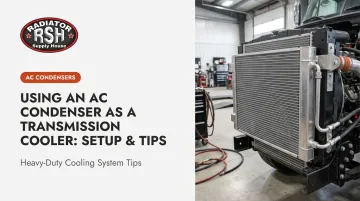
That's pushed technicians and fleet operators toward AC condenser-based cooling solutions: both OEM-integrated designs that combine refrigerant and transmission cooling in a single assembly, and aftermarket setups added to supplement factory coolers on high-demand equipment.
The catch is that these setups require more planning than a standard cooler install. Fluid routing, fitting compatibility, and the separation between refrigerant and transmission fluid circuits all matter. Get one wrong, and you're looking at leaks, cross-contamination, or a cooling system that underperforms regardless of how much hardware you bolt on.
This guide covers when the setup makes sense, how to do it correctly, and what keeps it running reliably long-term.
Key Takeaways
- OEM-integrated and aftermarket condenser-cooler setups are two distinct configurations with different installation requirements.
- Refrigerant and transmission fluid run through completely separate passages; the two must never mix.
- Mounting position, line ratings, and fitting type are prerequisites — confirm all three before starting.
- Ford Crown Victoria, Chrysler minivans, and Ram trucks use factory-integrated condenser-transmission cooler assemblies requiring OEM service procedures.
- Replacing an integrated OEM unit requires EPA Section 609-certified refrigerant handling.
When to Use an AC Condenser as a Transmission Cooler
Confusing these two scenarios leads to wasted money or under-built cooling systems. The setup works well in specific contexts — and fails when applied where it doesn't belong.
OEM-Integrated Designs
Some manufacturers engineer the AC condenser and transmission oil cooler into a single assembly. These aren't aftermarket combinations — they're purpose-built units where both circuits share the same heat exchanger core but use entirely separate fluid passages.
This design appears across a range of light-duty and commercial platforms. When replacing these units, use only matched OEM-equivalent components. A generic condenser won't have the correct internal passages for transmission fluid, which can lead to cross-contamination or inadequate cooling.
Aftermarket Auxiliary Setups
Aftermarket condenser-style coolers work as supplemental coolers in high-demand applications — commercial trucks, towing rigs, construction equipment, and fleet vehicles where the factory in-radiator cooler isn't enough.
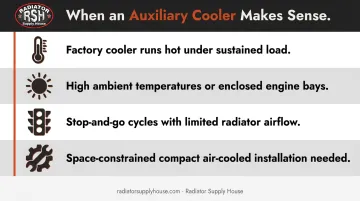
This setup adds real value when:
- The factory cooler runs consistently hot under sustained load
- Ambient temperatures are high (desert climates, enclosed engine bays)
- Equipment operates in stop-and-go cycles with limited airflow across the radiator
- A compact, air-cooled solution is needed in a space-constrained installation
Where this gets misapplied: using a repurposed condenser on applications where a purpose-built standalone transmission cooler would do the job. If the heat load is modest and space isn't constrained, a correctly sized dedicated cooler is simpler, cheaper, and easier to service.
What You Need Before Starting
Don't touch fluid lines until you've confirmed these prerequisites.
System compatibility check Determine whether you have an OEM-integrated assembly or an aftermarket auxiliary application. Check VIN-specific parts diagrams or manufacturer service documentation. This determines fitting type, line diameter, and what certifications are required for service.
Required components
- Transmission cooler lines rated for transmission fluid pressure (not low-pressure coolant hose)
- Correct fittings — rubber hose and clamps for most aftermarket setups; OEM quick-connect fittings for factory-integrated Ford and Chrysler applications
- Mounting brackets and hardware appropriate for the unit size and vibration environment
- Transmission fluid temperature gauge if one isn't already installed
Skill and certification requirements Aftermarket auxiliary installs require mechanical competence in fluid line routing and leak-free connections. Any work involving an OEM-integrated unit — including replacement — is a different matter entirely.
These jobs require an EPA Section 609-certified technician and approved refrigerant recovery equipment. The AC system must be fully evacuated before the unit can be removed — skipping this step risks illegal refrigerant release and significant fines.
Once you've confirmed compliance, sourcing the right cooler is the next step. Radiator Supply House stocks ICEBOX-branded OEM-equivalent transmission coolers and oil coolers for heavy equipment and commercial truck applications — including units for Peterbilt/Allison Transmission systems, International Navistar, and Case construction equipment — sized for high-demand duty cycles.
How to Set Up an AC Condenser as a Transmission Cooler
Setting up an AC condenser as a transmission cooler follows a defined sequence. Connecting fluid lines before confirming position and compatibility is the most common source of leaks, vibration damage, and premature fitting failure.
Mounting and Positioning
The unit must be placed where it gets consistent airflow — typically in front of the radiator or in a ram-air position. Cooling performance depends entirely on air moving across the fins. A poorly positioned unit will underperform regardless of how well the lines are connected.
Common mounting errors to avoid:
- Mounting too close to the radiator without an air gap — hot air recirculates and reduces cooling capacity
- Using rubber hose rated for low-pressure coolant instead of transmission fluid spec lines
- Failing to secure the unit against vibration — fitting fatigue from movement causes slow leaks that often go undetected until low fluid triggers a transmission fault
Connecting the Fluid Lines
Identify inlet and outlet ports before connecting anything. Transmission fluid should flow inlet-at-bottom, outlet-at-top to prevent air pockets from forming in the circuit.
Two connection types:
- Rubber hose and clamps — more flexible, appropriate for most aftermarket auxiliary setups
- OEM quick-connect fittings — used on factory-integrated Chrysler and Ford applications; require the correct release tool before attempting disconnection
- Chrysler: special tool 8875A confirmed in Jeep Wrangler recall documentation; connector 68034089AA referenced in Mopar catalog for Town & Country assemblies
- Ford: consult model-specific service documentation for tool requirements
In integrated OEM designs, the refrigerant and transmission fluid circuits are separate passages within the same core — they never share fluid. Any internal crack allowing cross-contamination between circuits requires immediate unit replacement. This is not a field repair.
Bypass Valves
Some OEM designs include thermostatic bypass valves. Ford's service documentation confirms the Crown Victoria family uses an internal thermostatic bypass valve — and specifically notes that the transmission fluid cooler on these vehicles cannot be flushed because of it. Be aware of this before attempting any cooler line service on Crown Victoria, Grand Marquis, or Town Car applications.
Operating and Monitoring
Once the setup is complete, fluid circulates through the cooler whenever the engine is running and the transmission is in gear. There's no manual activation.
Confirm correct operation after the first 10–15 minutes:
- Slight warmth and pressure at the return line confirms fluid flow
- Check all fittings for external leaks before continuing operation
Operating parameters to maintain:
| Application | Normal Range | Max Recommended | Source |
|---|---|---|---|
| Ford TorqShift6 | 196–215°F | 215°F | Ford service documentation |
| 48RE, 68RFE, AS68RC | Below 200°F | 200°F | ATRA trade guidance |
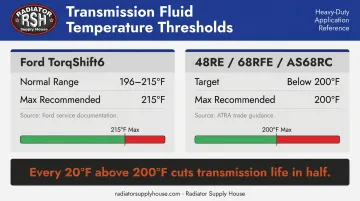
Every 20°F above 200°F cuts expected transmission life in half for the 48RE, 68RFE, and AS68RC units — a useful benchmark when evaluating whether your cooling setup is adequate.
Watch for these warning signs during operation:
- Transmission slipping or delayed gear engagement — suggests insufficient cooling
- Weeping fluid at connections or visible line chafing — fitting stress or line routing issue
- In integrated OEM units: refrigerant odor or a drop in AC performance may indicate internal cooler failure affecting the refrigerant circuit
Where This Setup Appears in Practice
OEM-integrated condenser-transmission cooler designs appear across a range of vehicle classes, driven by the need to reduce component count and save space in tight engine bays. The same logic scales up to commercial and heavy-duty applications, where thermal management becomes even more critical under sustained load.
Aftermarket condenser-style auxiliary coolers show up in different contexts:
- Long-haul and vocational trucks — sustained high-load operation generates more heat than the factory radiator-tank cooler can handle
- Towing rigs and performance builds, where thermal load spikes sharply during grade climbs or high-demand cycles
- Construction and heavy equipment — Komatsu wheel loaders, for example, use dual block-style oil coolers integrated into the primary cooling assembly as a factory design
- Agricultural and forestry equipment, where space constraints and the preference for simplicity make air-cooled designs a natural fit over water-to-oil configurations
Across these heavy-duty applications, purpose-built coolers consistently outperform adapted alternatives. Radiator Supply House stocks ICEBOX-branded transmission and hydraulic oil coolers for platforms including the Case 580 Super E, Case 650K/850K, John Deere feller bunchers, and International Navistar commercial trucks — each designed specifically for high-load duty cycles.
Best Practices for Reliable Transmission Cooling
Staying ahead of transmission cooling problems means building inspection and maintenance habits before symptoms show up — not after.
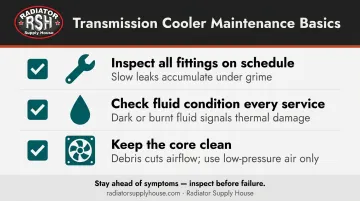
Follow these maintenance basics at every service interval:
- Inspect all fittings on schedule — slow leaks from condenser-cooler connections accumulate under road grime and don't become obvious until fluid loss reaches the point of transmission damage
- Check fluid condition during every cooling system service — per GM's service bulletin on 9-speed applications, fluid that's very dark or black with a burnt odor signals internal clutch damage, not just degraded fluid; it means the system has already exceeded its thermal limits
- Keep the core clean — debris and compressed dirt on the fins cut airflow and reduce cooling capacity; use low-pressure compressed air or a gentle rinse; high-pressure washing bends fins permanently in ways that can't be reversed
OEM Integrated Units
Don't defer replacement when an integrated unit shows signs of leaking transmission fluid. A failed cooler left in service will eventually contaminate the AC refrigerant circuit. What starts as a straightforward component swap becomes a refrigerant recovery, flush, and recharge — adding labor, refrigerant costs, and potentially contaminated component replacement to the job scope. Those are separate operations, and contamination remediation is billed on top.
Aftermarket Setups
For aftermarket setups, the calculus is different: size matters more than position. An undersized unit will run hot regardless of where you mount it. If a purpose-built standalone transmission cooler from Radiator Supply House is available in a size matched to your transmission type and duty cycle, it will typically outperform a repurposed condenser and eliminate compatibility guesswork.
Conclusion
Whether through a factory-integrated design or an aftermarket auxiliary setup, using an AC condenser as a transmission cooler is manageable when you understand how the two circuits interact, size the unit correctly for the actual heat load, and stay consistent with inspection and fluid monitoring.
A properly sized cooler and a clean, leak-free installation costs a fraction of what a transmission rebuild runs — and protects a component that's far more expensive to replace than the cooling hardware itself. Keep the fittings tight, the core clear of debris, and the fluid in spec, and the setup will do its job reliably for a long time.
Frequently Asked Questions
Does transmission fluid run through the AC condenser?
In OEM-integrated designs (such as Chrysler minivans and Ram trucks), transmission fluid passes through a dedicated internal circuit within the condenser assembly — completely separate from the refrigerant passages. In standard aftermarket setups using a standalone condenser-style unit, only transmission fluid flows through the unit; no refrigerant is involved.
What is the best way to cool your transmission?
Most vehicles use an in-radiator oil-to-water cooler as the primary method. For towing, performance, or heavy equipment applications, a correctly sized external air-to-oil cooler — positioned for maximum airflow — typically delivers the most reliable supplemental cooling. The right choice depends on the specific transmission, duty cycle, and available mounting space.
Can any AC condenser be used as a transmission cooler?
No. OEM-integrated units are engineered specifically for both refrigerant and transmission fluid circuits and should be replaced with matched OEM-equivalent components. Aftermarket condenser-style coolers used as auxiliary transmission coolers must be rated for transmission fluid pressure and temperature ranges, which differ from refrigerant operating conditions.
What temperature should transmission fluid be kept at?
Ford's TorqShift6 documentation lists 196–215°F as a normal operating range; ATRA guidance for the 48RE, 68RFE, and AS68RC sets 200°F as the practical maximum. Sustained operation above these thresholds accelerates fluid breakdown and mechanical wear.
What are signs that the transmission cooler is not working properly?
Key warning signs include transmission slipping or delayed gear engagement, dark brown or black fluid with a burnt odor, and visible fluid leaks at cooler fittings or lines. In integrated OEM condenser units, a simultaneous drop in AC performance may indicate internal failure between the two circuits.
Do I need an AC technician to service an integrated condenser-transmission cooler?
Yes. Because the refrigerant circuit is part of the same assembly, any replacement requires the AC system to be evacuated and recharged by an EPA Section 609-certified technician using approved recovery equipment.