The frustrating part? Radiator hose replacement cost is genuinely hard to pin down. Depending on the vehicle class, hose configuration, coolant requirements, and whether you're paying shop labor or doing it in-house, the total can range from under $200 to well over $900. That spread leads to two common mistakes: underbudgeting the job or choosing the cheapest part available — both of which tend to cost more in the long run.
This guide breaks down realistic cost ranges by vehicle class, the factors that drive those numbers up or down, and what fleet operators and equipment managers should account for when budgeting a hose replacement properly.
Key Takeaways
- Passenger vehicle replacement typically runs $150–$530 installed; heavy equipment jobs can exceed $900 once coolant volume and labor access are factored in
- Labor complexity, hose type, and coolant specification are the primary cost drivers
- Fleet and equipment operators face compounding costs when a hose fails unexpectedly: downtime, field service, and potential engine damage
- A correctly specified, durable hose costs less over time — cheaper parts that fail early erase any upfront savings
How Much Does Radiator Hose Replacement Cost?
Costs vary significantly by vehicle class, and the gap is wider than most people expect. The same 45-minute hose swap on a sedan becomes a two-hour job on a Class 8 truck once you account for coolant draining, component removal, and system bleeding.
Two budgeting mistakes come up repeatedly:
- Choosing the cheapest available part without checking pressure ratings, diameter, or material grade
- Ignoring the full scope of the job — coolant drain and refill, system bleed, replacement clamps, and any access labor aren't always included in the quoted hose price
Here's how costs break down by vehicle class.
Passenger Cars and Light SUVs
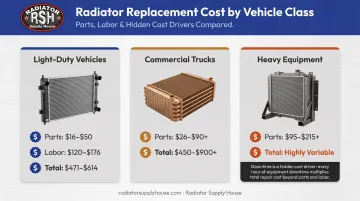
According to RepairPal, professional shop cost for radiator hose replacement on passenger vehicles runs $471–$527, with labor accounting for $120–$176 of that total. KBB puts the average slightly higher at $536–$614. DIY parts alone — just the hose — range from roughly $16–$50 depending on the vehicle and brand.
What's typically included in the shop price: the hose, replacement clamps, coolant top-up, and labor. What may be billed separately: a full coolant flush, system pressure test, or additional access labor if the hose location requires bumper or component removal.
Best for: Everyday commuter vehicles with standard EPDM hose designs and accessible engine bays.
Commercial Trucks and Heavy-Duty Vehicles
No authoritative all-in cost range for Class 6–8 trucks exists in public databases. Fleet contract pricing and regional shop rate variance make reliable published averages scarce. What is documented: DIY hose parts for a 2014 Freightliner Cascadia run $26–$47 at retail. Installed cost climbs significantly once you factor in larger coolant volume, wider hose diameters, tighter engine bay access, and the higher labor rates typical of diesel shops.
Expect the total installed cost to run meaningfully higher than passenger vehicles — budget at least $450–$900+ depending on the truck, hose location, and shop.
Best for: Fleet trucks, long-haul vehicles, and buses where cooling reliability under sustained load is non-negotiable.
Heavy Equipment and Industrial Machinery
This is where cost can escalate quickly, and where the repair bill is often the smaller number compared to downtime exposure.
Aftermarket parts pricing varies considerably by machine. Some documented reference points:
| Equipment / Part | Part Number | Approx. Aftermarket Cost |
|---|---|---|
| Cat 320C lower radiator hose | 183-8120 | ~$210 |
| Cat 320D/323D coolant pipe assembly | — | ~$160 |
| John Deere upper radiator hose assembly | (via RDO Equipment) | $93+ |
| OEM Cat parts | — | Dealer pricing only |
Installed cost for heavy equipment can reach into the four-figure range on complex machines. Field service labor, coolant volume (a Cat 320 GC holds 25 liters / 6.6 gallons), and any component disassembly required for access all add up fast.
On equipment running 10+ hours a day, the hose itself is rarely the expensive part of a failure — unplanned downtime is.
Key Factors That Affect the Cost of Radiator Hose Replacement
Operators who understand what actually drives the price can budget more accurately and avoid getting caught by surprise charges.
Hose Type and Configuration
Not all radiator hoses are equivalent in cost or complexity:
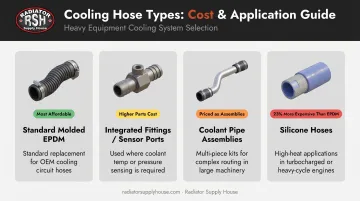
- Standard molded EPDM hoses: most affordable, adequate for the majority of applications
- Hoses with integrated fittings, sensor ports, or quick-connect ends: higher parts cost due to added complexity
- Coolant pipe assemblies: used on many modern excavators and diesel engines; priced as assemblies rather than simple hoses
- Silicone hoses: Gates technical data shows silicone is 23% more expensive than EPDM and can lose approximately 20 liters of water per year through permeation versus 1 liter for EPDM — worth noting for Class 8 trucks where coolant level matters
For most commercial cooling applications, quality EPDM is the correct specification. Silicone may be justified where specific heat or packaging constraints require it, but it's not automatically the better choice.
Vehicle Complexity and Access
Labor cost tracks almost directly with how hard it is to reach the hose:
- Upper hoses in open engine bays: shortest labor time
- Lower hoses, or hoses behind intercooler piping, fan shrouds, or coolant tanks: significantly longer
- Heavy equipment with structural disassembly required: can multiply labor time several times over
Shop type matters too. Independent garages generally carry lower hourly rates. Dealerships may have faster parts access but charge more per hour. Equipment specialty shops charge the highest rates but bring familiarity with specific machine layouts that can actually reduce total labor time.
Coolant Type and Volume
Coolant is not universal, and using the wrong chemistry damages hoses, seals, and the radiator over time:
- Caterpillar equipment requires Cat ELC Advanced (OAT), rated for a 20,000-hour / 6-year drain interval
- Detroit Diesel engines specify coolants meeting DFS 93K217, with NOAT PowerCool Plus intervals of 600,000 miles / 6 years
- Cummins X15 engines specify coolants meeting CES14603, with engine-only capacity of 26.5 liters
On heavy equipment, coolant volume alone is a line item. A Cat 320 GC holds 6.6 gallons — at current commercial coolant prices, that refill adds meaningfully to every service event.
Parts Sourcing and Quality Grade
The sourcing decision affects both price and lead time:
- OEM dealer parts: guaranteed specification fit, but typically priced at a premium with potentially longer lead times
- Quality aftermarket / OEM-equivalent parts: can match pressure, temperature, and fitment requirements at lower cost with faster availability — verify specification against the application before ordering
- Generic low-grade hoses: lowest upfront cost, but higher failure risk under sustained heat, pressure cycling, or oil contamination
For fleets running multiple equipment makes, sourcing from a single supplier simplifies ordering and cuts lead times. Radiator Supply House stocks cooling system components across 300+ equipment brands — including Caterpillar, John Deere, Komatsu, Freightliner, Kenworth, and Volvo — with ICEBOX-branded OEM-equivalent parts available as an alternative to dealer pricing.
Full Cost Breakdown of Radiator Hose Replacement
The hose price is rarely what you actually pay. Here's what goes into a complete job:
| Cost Component | Heavy Equipment | Commercial Truck | Light-Duty Vehicle |
|---|---|---|---|
| Hose / parts | $95–$215+ | $26–$90+ | $16–$50 |
| Labor (installed) | Field service rates; varies significantly | Higher — varies by access | $120–$176 |
| Coolant refill | High volume; OEM chemistry required | Larger system capacity | Lower volume |
| Clamps / fittings | Often additional | May be additional | Often included |
| Total installed estimate | Highly variable | $450–$900+ | $471–$614 |
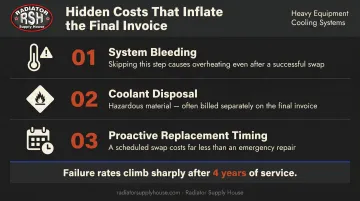
Those totals assume a straightforward job. Three line items that inflate the final invoice — and often catch operators off guard:
- System bleeding — skipping this step after a DIY hose swap is one of the most common reasons an engine overheats even after a technically successful hose replacement
- Coolant disposal — old coolant is a hazardous material requiring proper handling; many shops charge separately
- Proactive replacement intervals — Gates technical data shows failure rates climb sharply after four years of service; swapping during a scheduled maintenance window costs far less than an emergency repair plus equipment recovery
What Most People Get Wrong About Radiator Hose Replacement Costs
Three patterns come up consistently — and each one leads to a second repair bill that could have been avoided.
Focusing only on the part price. A lower-cost hose may look like savings upfront, but if it fails within 18 months, you're paying labor, coolant, and downtime all over again. For fleet operators running multiple units, that cost multiplies fast.
Replacing only the failed hose. If one hose has degraded from heat cycling, age, or oil contamination, the adjacent hose and nearby clamps have been through the same conditions. Replacing only the visible failure sets up a second repair within months.
During any hose replacement, inspect — and seriously consider replacing — the matching hose and any clamps showing wear.
Skipping the cooling system diagnosis. A coolant leak doesn't always start at the rubber hose. Plastic fittings, O-rings, quick-connect adapters, and the radiator itself are all common sources. Replacing the hose without confirming the actual leak origin wastes money and leaves the real problem in place. A pressure test is the most reliable way to pinpoint where the leak is coming from.
Frequently Asked Questions
How long does it take to replace a radiator hose?
A straightforward upper hose on a passenger vehicle typically takes a professional mechanic 30–60 minutes. Lower hoses or hoses on heavy equipment requiring coolant draining, component removal, refill, and system bleeding can take 1–3 hours or more. Access complexity is the main variable.
Can I drive with a leaking radiator hose?
No. Coolant loss from a leaking hose causes rapid engine overheating. Continuing to drive risks head gasket failure, warped cylinder heads, or complete engine damage — RepairPal puts head gasket replacement at $2,475–$3,246, which is far more than a hose replacement under any scenario.
How often should I flush my radiator?
It depends on the equipment and coolant type, but a common guideline is every 2 to 3 years, or per your manufacturer's maintenance schedule. Heavy-duty and severe-duty applications may need more frequent service. Regular flushing clears out rust, scale, and old coolant that reduce cooling efficiency and shorten radiator life. For guidance on your specific application, contact us at +1 877-615-3002 or info@RadiatorSupplyHouse.com.
How often should radiator hoses be replaced on heavy equipment?
Intervals vary by machine — for example, Caterpillar C4.4 engines call for hose inspection every 500 service hours or annually, while John Deere manuals typically require annual checks. Always follow your OEM service manual; equipment in high-heat or high-load environments may need earlier replacement.
Do I need to use coolant in my radiator?
Yes. Coolant (antifreeze mixed with water) does more than prevent freezing — it raises the boiling point, carries heat away from the engine, lubricates the water pump, and protects the system against corrosion and scale. Running plain water or no coolant can lead to overheating, internal corrosion, and early radiator failure. Always use the coolant type and mix ratio specified for your equipment. For coolant or product questions, contact us at +1 877-615-3002 or info@RadiatorSupplyHouse.com.
How do I know if the leak is from the hose or a fitting?
Coolant often drips lower than the actual leak source. Clean the area, run the engine to operating pressure, and trace back to the highest wet point to determine whether the leak is from the hose body, a clamp seat, or a fitting. A pressure test is the most reliable method when the source isn't visually obvious.