Introduction
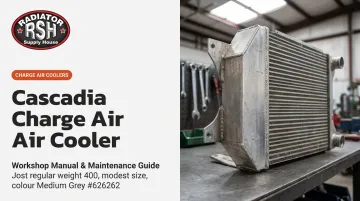
The charge air cooler on a Freightliner Cascadia does one job: cool the hot, compressed air coming off the turbocharger before it enters the engine. That job matters more than most drivers realize.
A failing CAC doesn't just cause a minor performance dip. It can mean power loss, spiking fuel costs, engine overheating, and unplanned downtime that eats into a fleet's bottom line.
SAE J1148 defines charge air cooling's purpose: boosting engine output and fuel economy through more complete combustion. Any degradation in the CAC works directly against both goals.
This guide walks through how to inspect a Cascadia's CAC, the warning signs that signal trouble, the different types of maintenance you'll encounter, and a service schedule built around Freightliner's own maintenance intervals.
TL;DR
- The CAC cools turbocharged air, boosting combustion and reducing thermal stress
- Warning signs include power loss, poor fuel economy, smoke, or oil in the intake
- Inspections combine visual checks, boost monitoring, and periodic pressure/leak testing
- Maintenance should align with Freightliner's M1, M2, and M3 service intervals
- Replace with an OEM-equivalent unit when the core is beyond repair
Why Your Cascadia Charge Air Cooler Needs Regular Maintenance
Turbocharged air is hot, often exceeding 300°F by the time it leaves the turbo. Hot air is also less dense, meaning it carries less oxygen per cubic inch. The CAC cools that air before it reaches the combustion chamber, packing more oxygen into every cylinder stroke.
More oxygen means more complete combustion. That translates to better power output and less thermal stress on pistons, valves, and exhaust components. When the CAC starts losing efficiency, none of that happens the way the engine was designed to run.
What Accelerates CAC Wear
A handful of conditions cause premature CAC failure on Cascadia trucks:
- Oil contamination from turbo seal wear, which coats internal fins and blocks airflow
- Moisture intrusion, especially in humid or high-altitude routes
- Vibration cracks at end tank welds and core-to-tank joints — the most common failure points
- Clogged external fins from road debris, insects, and dust buildup
A slow leak rarely announces itself. It starts as a minor boost drop, then compounds. Detroit's own operator documentation notes that high intake restriction can cause oil pullover from the turbocharger into the charge-air system, a problem that worsens the longer it goes unaddressed (Detroit Diesel Operators Manual).
Preventive Maintenance vs. Reactive Repair
A routine inspection and fin cleaning takes a technician minutes and costs almost nothing in parts. Compare that to the alternative: a truck running lean or hot because of a failed cooler puts the turbocharger (and potentially internal engine components) at risk. Early detection means a technician swaps a gasket or clears a blocked fin; a missed leak can mean a turbocharger rebuild and days of downtime.
How to Inspect the Cascadia Charge Air Cooler (Step-by-Step)
Before starting, make sure the engine is off and fully cooled. Follow the safety precautions outlined in Freightliner's service documentation — hot components and pressurized systems are involved.
Visual Inspection
Start with the physical structure of the cooler and its connections:
- Check the CAC core, end tanks, and inlet/outlet pipes for cracks, dents, or corrosion, especially at weld seams and end tank joints
- Inspect charge air piping, boots, and clamps between the CAC, turbocharger, and intake manifold for cracks, soft spots, collapsed sections, or loose clamps
- Look for oil residue inside intake pipes or on the CAC face , which points to a turbo seal issue that's already reducing CAC efficiency
Pressure / Leak Test Procedure
If the visual check raises questions, move to a pressure test:
- Cap the inlet and outlet ports of the CAC system
- Pressurize to the manufacturer-specified PSI — typically around 30 PSI for Cascadia applications
- Hold and monitor for pressure drop over a defined period, often 15 seconds
- Flag any pressure drop as an indicator of an internal or external leak
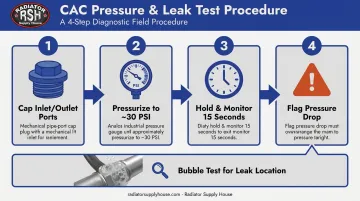
To pinpoint the exact leak location, apply soapy water or a leak detection spray at the suspect areas. Bubbles will form at end tank seams, core tubes, or piping connections, pinpointing exactly where the leak originates.
Fin and Core Cleaning
External fins collect road grime fast. Use low-pressure air or water to clear debris from the CAC face. High-pressure washing can bend the fins, which restricts airflow just as badly as the dirt did.
If oil contamination has reached the internal passages, external cleaning won't fix it. Severe internal fouling usually calls for CAC removal and a professional flush, or replacement if the fouling is too severe. Radiator Supply House stocks Freightliner-compatible charge air coolers and cores for shops that need a fast replacement.
Warning Signs Your Cascadia CAC Is Failing
CAC problems rarely show up overnight. They build gradually, which is exactly why catching the early indicators matters — waiting for a dramatic failure means you've already absorbed weeks or months of compounding damage.
Performance or Output Changes
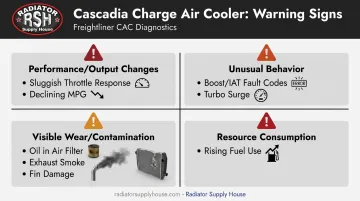
Sluggish throttle response under load is often the first thing drivers notice. Hotter, less dense intake air reduces combustion efficiency, so the engine can't produce the power it should.
Declining fuel economy on familiar routes follows close behind. The engine compensates for inefficient combustion by burning more fuel to hit the same output.
Unusual Behavior or Operation
Watch for fault codes tied to boost pressure or intake air temperature on the Cascadia's Detroit Diesel system. Codes referencing MAP sensor readings, IAT deviation, or boost performance deserve a CAC inspection, even if they don't point directly at the cooler.
Turbo surge or compressor instability is another red flag. A partially blocked or damaged CAC creates downstream restriction that throws off the compressor's normal operating range.
Visible Wear and Contamination
During inspection, check for:
- Oil in the air filter housing or intake piping
- White or black exhaust smoke under load
- Fin damage, bent sections, or corrosion on the CAC face
If the truck runs a combined cooling module (CAC and radiator in one assembly, common on many Cascadia configurations), also check for coolant or water cross-contamination in the charge air circuit. It's a separate issue but one that can hit at the same time.
Increased Resource Consumption
Rising fuel consumption without a change in load or route is measurable, not anecdotal. Track MPG over time as part of routine CAC condition monitoring. A consistent decline is a signal worth acting on, not writing off as "normal variation."
Types of CAC Maintenance for the Freightliner Cascadia
Not every CAC issue calls for the same response. The right approach depends on how the problem was found and how far it's already progressed.
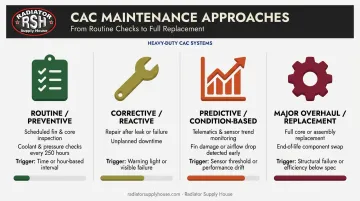
Routine / Preventive Maintenance
This is the default approach for well-run fleets. It typically includes:
- Visual inspections of the CAC and surrounding piping
- Piping and clamp checks for looseness or wear
- External fin cleaning to maintain airflow
- Monitoring for boost-related fault codes
It's the most cost-effective form of CAC upkeep, and an in-house technician can usually handle it during regular service without specialized equipment.
Corrective / Reactive Maintenance
Triggered by a detected leak, a fault code, or a driver complaint. This involves pressure testing, leak identification, and repairing or resealing end tanks and piping connections where possible.
Relying on this approach as your primary strategy is risky. A small crack causing minor boost loss can worsen fast under thermal cycling, and by the time oil-fouled fins get noticed, the turbocharger may already be compensating for reduced airflow.
Predictive / Condition-Based Maintenance
This method tracks boost pressure and intake air temperature readings from telematics or diagnostic systems to catch trends before failure. A gradual drop in boost efficiency at consistent loads is an early indicator, often visible well before it becomes a driver complaint.
Major Overhaul / Replacement
Full replacement becomes necessary when:
- The CAC core is cracked beyond repair
- End tanks are structurally compromised
- Oil fouling is severe and unrecoverable
Patching or sealing a failed core is a short-term fix at best — it typically fails again under normal pressure cycling. Radiator Supply House stocks OEM-equivalent Cascadia charge air coolers under its ICEBOX brand, including all-aluminum units built to OEM specifications and backed by a lifetime warranty.
These units are marketed as direct-fit, drop-in replacements rather than budget substitutes, which matters when you're trying to restore full boost efficiency rather than just get the truck moving again.
Cascadia CAC Maintenance Schedule (General Guidelines)
Freightliner's published service schedule for the New Cascadia uses Initial Maintenance (IM), M1, M2, and M3 designations based on mileage. CAC inspection fits within the broader engine cooling system checks at these intervals (New Cascadia Maintenance Manual).
| Interval | CAC-Related Tasks |
|---|---|
| Daily / Pre-Trip | Visually scan piping, boots, and clamps for damage; check dash for fault codes |
| M1 (first scheduled service) | Full visual inspection of core, end tanks, fins, and connections; clean external fins if debris is present |
| M2 (extended service) | Full pressure/leak test per specified PSI and hold-time criteria; inspect intake piping for oil contamination |
| M3 / Annual or High-Mileage | Evaluate thermal efficiency using boost pressure data; consider replacement if tests show degradation |
Duty cycle affects how closely you should follow these intervals. Freightliner's Schedule I applies to trucks running under 60,000 miles annually, primarily in cities or with heavy stop-and-go operation.
Adjust inspection frequency based on your operating environment:
- City/stop-and-go routes: Follow Schedule I's shorter intervals for CAC checks
- Dusty, high-heat, or construction/mining sites: Move inspections up ahead of the standard interval
- Long-haul highway routes: Expect slower fin fouling; stick closer to the published intervals
Replacement CAC cores and end tanks from suppliers like Radiator Supply House help avoid OEM lead-time delays.
Conclusion
The charge air cooler is a small, easy-to-overlook component with an outsized effect on how a Cascadia performs and how long its engine lasts. Left unchecked, minor issues compound into expensive failures.
A structured approach costs far less than reactive replacement:
- Visual checks catch cracks and leaks early
- Periodic pressure testing finds pinhole leaks before they spread
- Condition-based monitoring tied to boost data flags problems in real time
This approach protects the turbocharger and engine from running lean or hot for months at a time.
When replacement becomes unavoidable, an OEM-equivalent unit — like those in Radiator Supply House's ICEBOX line — restores the truck's designed performance instead of a compromised approximation.
Frequently Asked Questions
What does hysteresis mean in a Freightliner Cascadia?
Hysteresis refers to the temperature gap built into fan clutch or cooling system controls — the difference between the engagement and disengagement temperature. This gap prevents rapid on/off cycling that would cause premature wear.
How do you test a charge air cooler for leaks on a Freightliner Cascadia?
Cap the CAC inlet and outlet, pressurize to the specified PSI (typically around 30 PSI), and monitor for pressure drop over 15 seconds. Soapy water or leak detection spray helps pinpoint the exact leak location.
What are the symptoms of a failing charge air cooler on a Cascadia?
Common symptoms include power loss under load, reduced fuel economy, black or white exhaust smoke, boost-related fault codes, and oil contamination in the intake piping.
How often should the charge air cooler be inspected on a Freightliner Cascadia?
Inspections should align with Freightliner's M1 and M2 service intervals. Trucks operating in dusty, hot, or stop-and-go conditions should be inspected more frequently.
Can you drive a Cascadia with a leaking charge air cooler?
It's not advisable. A leaking CAC reduces boost pressure and raises intake air temperature, causing the engine to run lean or overheat. Continued operation risks turbocharger and engine damage.
How long does a charge air cooler last on a Freightliner Cascadia?
Lifespan varies based on operating conditions and maintenance history. Regular inspections and fin cleaning, paired with prompt repair of piping leaks, can help a CAC last several hundred thousand miles on a well-maintained truck.