Introduction
Picture a Caterpillar excavator digging through an August afternoon, temperature gauge creeping toward the red. Or a Freightliner hauling freight across the desert on hour nine of a long run. Both scenarios raise the same question: is the coolant overheating, or is the oil?
Radiators and oil coolers both live inside a machine's cooling system, but they don't share the same job. A radiator manages engine coolant, while an oil cooler manages lubricating or hydraulic oil.
Mix up the two, and you risk ordering the wrong part or letting damage build unnoticed, extending downtime along the way.
This article breaks down what each component does, how they differ, and how to figure out which one your equipment actually needs before you place an order.
Key Takeaways
- Radiators cool engine coolant; oil coolers cool lubricating or hydraulic oil, entirely different fluids.
- The two components aren't interchangeable; neither can substitute for the other.
- Oil running too hot loses viscosity, while too cold oil traps moisture that forms damaging acids.
- Heavy-duty equipment typically needs a properly sized radiator and oil cooler working together.
- Correct part selection depends on fluid type, duty cycle, and manufacturer specs, not guesswork.
Radiator vs Oil Cooler: Quick Comparison
Before getting into the mechanics of each part, here's how they stack up side by side.
| Category | Radiator | Oil Cooler |
|---|---|---|
| Purpose | Prevents engine coolant from overheating | Preserves oil viscosity and lubrication properties |
| Fluid Cooled | Water/antifreeze mixture | Engine oil, hydraulic fluid, or transmission fluid |
| Cooling Medium | Ambient air (ram air or fan-driven) | Air, or engine coolant depending on design |
| Typical Location | Front of the engine bay, behind the grille | Near the engine, in front of or behind the radiator, or built into the radiator tank |
| Primary Failure Symptom | Engine overheating, coolant loss | Rising oil temperature, oil/coolant mixing, contamination |
| Most Common Application | Every liquid-cooled engine | Hydraulic systems, high-load diesel engines, transmissions |
Both parts belong to the same thermal system, but a failure in one won't show up the same way as a failure in the other. Knowing which symptom points to which part is the first step in diagnosing a cooling issue correctly.
What Is a Radiator?
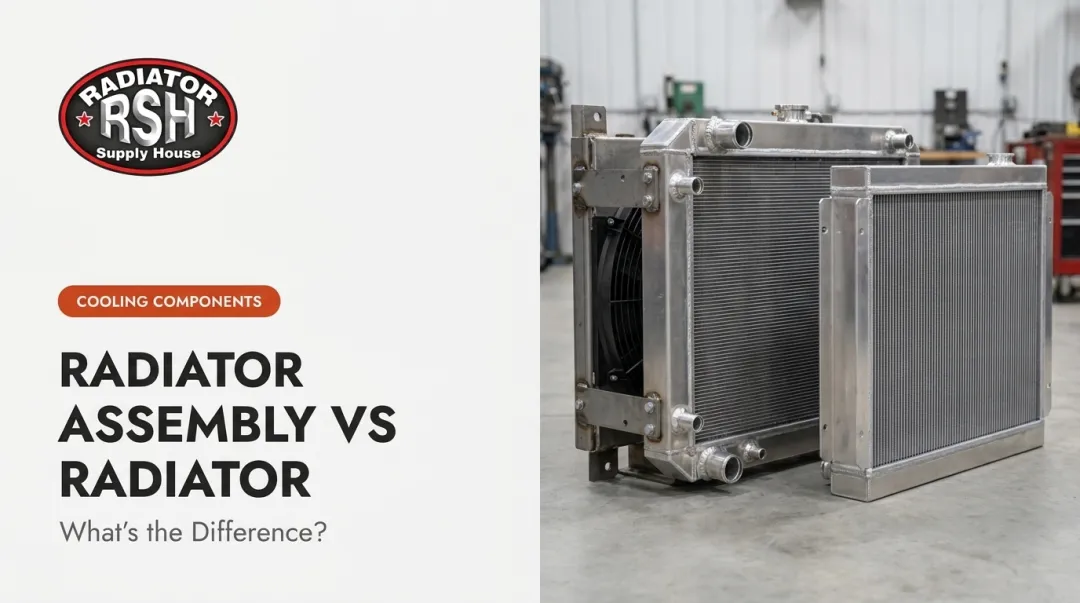
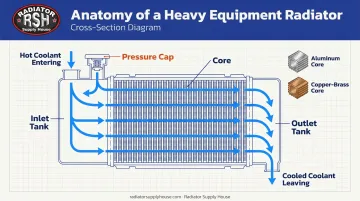
A radiator is the primary heat exchanger in a liquid-cooled engine's cooling loop. As coolant circulates through the engine block, it absorbs heat from combustion. That heated coolant then flows into the radiator core, where tubes and fins expose it to moving air, stripping the heat away before it cycles back to the engine.
This loop keeps the engine inside a safe operating temperature range. Break the loop, and heat has nowhere to go.
Core Components and Construction
Heavy equipment radiators share a few structural basics:
- Core: tubes and fins where the actual heat transfer happens
- Inlet and outlet tanks: direct coolant flow into and out of the core
- Pressure cap: keeps the system pressurized, which raises coolant's boiling point and helps prevent premature boil-over
Heavy equipment radiators run larger and hold higher pressure tolerances than passenger vehicle units. A Caterpillar C4.4 industrial engine, for instance, calls for a 100 kPa (14.5 psi) cap, while a John Deere 9-series tractor spec calls for 60 kPa (9 psi). Pressure ratings vary by model, so matching the OEM spec matters more than assuming a single number applies across the board.
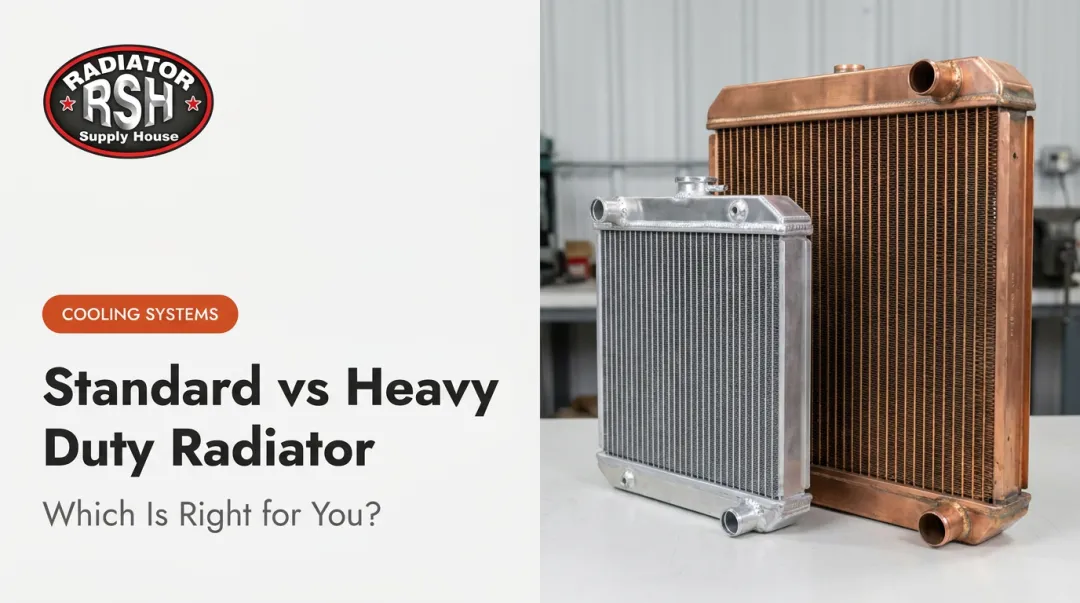
Radiator cores generally fall into two camps: aluminum core radiators, which offer lighter weight and strong thermal efficiency and are common on modern equipment, and copper-brass radiators, heavier and more traditional in construction but still common in older construction and agricultural machinery.
Radiator Supply House stocks both constructions, often for the same model, through its ICEBOX aftermarket line covering more than 300 manufacturers including Caterpillar, Komatsu, John Deere, and Freightliner. That gives fleet managers and repair shops an option beyond OEM lead times and OEM pricing when a core needs replacing.
What Happens When a Radiator Fails
When a radiator fails, coolant temperature spikes fast. Left unaddressed, that spike can lead to:
- Head gasket failure
- Warped cylinder heads
- Catastrophic engine seizure
None of those are cheap fixes. Komatsu documented a case where catching a leaking head gasket early on a mining haul truck, through coolant pressure monitoring and oil analysis, avoided roughly $250,000 in engine replacement and downtime costs. That's one documented case, not an industry average, but it shows how fast a coolant-side problem can turn into a serious repair bill.
Use Cases of a Radiator
Every liquid-cooled internal combustion engine needs a radiator, full stop. Road trucks, excavators, agricultural tractors, generator sets, industrial compressors: if it runs on liquid cooling, it runs a radiator.
Sizing and specification matter most in a few situations:
- Construction equipment operating in high-ambient-temperature environments, where airflow already works against the machine
- Commercial trucking running continuous highway duty cycles, where sustained load means sustained heat rejection demand
- Generator sets, which hold steady under load for hours without the free airflow benefit a moving vehicle gets
Cummins rates standard skid-mounted generator radiators for full cooling capacity at 40°C (104°F) ambient, and recommends up to 115% cooling capability in dusty environments where fouling reduces airflow over time.
What Is an Oil Cooler?
An oil cooler is a heat exchanger built to bring down the temperature of oil, whether that's engine lubricating oil, hydraulic fluid, or transmission fluid, before it recirculates through the system.
Oil has to stay within a workable temperature band. Run it too hot, and it loses viscosity, sacrificing the protective film between moving parts.
Run it too cold, and moisture condensing in the crankcase never boils off. That moisture combines with combustion byproducts to form acids, attacking bearings and seals independent of any overheating risk.
Air-Cooled vs. Coolant-Based Designs
Oil coolers come in two main configurations:
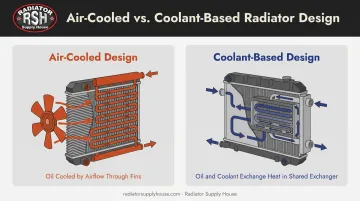
- Air-cooled: oil passes through a finned core exposed to airflow, similar in principle to a radiator
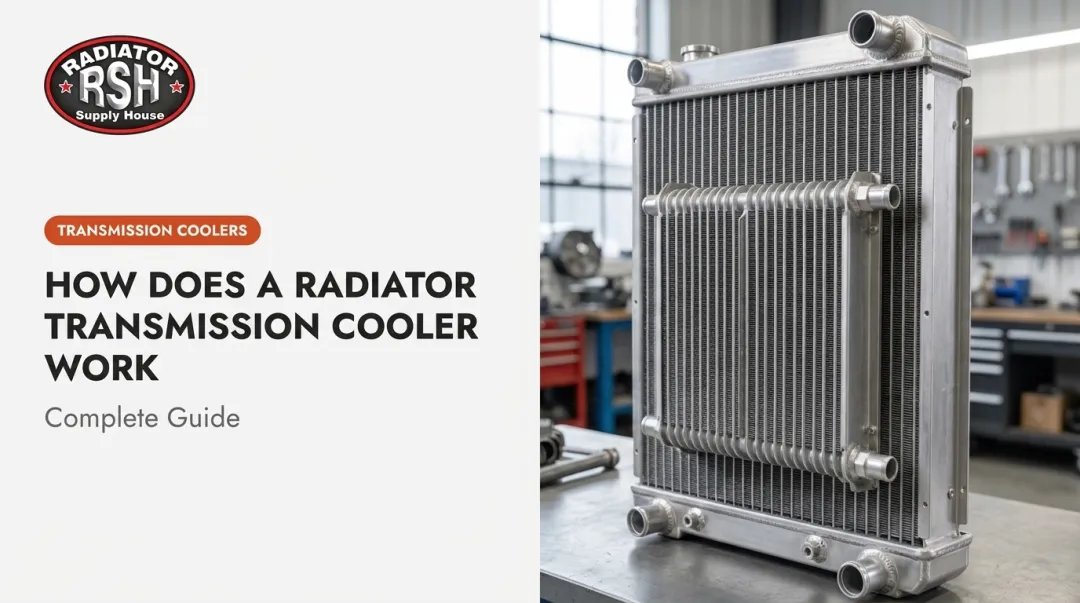
- Coolant-based: oil and engine coolant exchange heat through a separate heat exchanger, often built into or near the radiator tank
Coolant-based designs show up more often in heavy equipment because they regulate oil temperature relative to coolant temperature. That prevents both overheating and over-cooling in one design, rather than leaving oil temperature purely at the mercy of outside air.
One Term, Multiple Components
"Oil cooler" isn't a single part. It's a category. A single machine might run:
- An engine oil cooler
- A hydraulic oil cooler (critical in excavators, loaders, and cranes, where the hydraulic system generates serious heat)
- A transmission oil cooler
Each manages a separate fluid circuit, and heavy equipment often runs more than one at the same time.
Radiator Supply House's ICEBOX catalog reflects that reality, stocking:
- Standalone hydraulic oil coolers for machines like the Caterpillar 944H
- Combo units pairing a radiator with an integrated oil cooler on select Freightliner and Caterpillar skid steer models
- Coolant-based coolers such as the Caterpillar D6K2 unit
Signs of Oil Cooler Trouble
Oil cooler failure lets viscosity drop under heat, which increases metal-to-metal contact and speeds up wear. In severe cases, internal failure lets oil and coolant mix, producing a milky contamination that wrecks lubrication and requires a full flush plus component inspection.
Watch for:
- Rising oil temperature on the gauge
- Visible oil leaks around the cooler housing
- A milky or frothy coolant reservoir
- Unexplained oil level drops with no visible external leak
Use Cases of an Oil Cooler
Oil coolers earn their place in high-load, continuous-duty applications where heat buildup outpaces what the engine can passively shed:
- Hydraulic excavators and skid steers running high-pressure hydraulic circuits
- Agricultural combines and tractors under heavy draft loads
- Mining trucks and haul equipment on extended duty cycles
- Turbocharged commercial diesel engines under sustained load
Unlike radiators, oil coolers aren't universal. Standard passenger vehicles often skip them entirely, while most heavy equipment, high-horsepower diesel engines, and hydraulic-heavy machinery depend on them. That makes sourcing the correct size and flow rating important. An undersized oil cooler won't protect the system, no matter how well-built it is otherwise.
Radiator vs Oil Cooler: Which Does Your Equipment Need?
In most heavy equipment situations, the real question is whether you have the right radiator and the right oil cooler for that machine's duty cycle. Treat radiator issues and oil cooler issues as two separate diagnostic paths.
When the Radiator Is the Priority
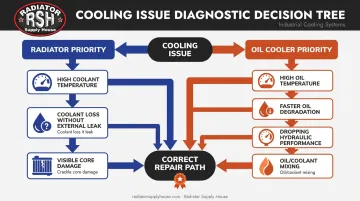
Look at the radiator first if the machine is:
- Running high coolant temperatures
- Losing coolant without an obvious external leak
- Showing visible core damage, corrosion, or blockage
Capacity matters as much as condition. A radiator that's mechanically sound but undersized for an uprated engine or an extreme climate still won't keep up. Match capacity to the engine's actual heat rejection rate, not just the make and model.
When the Oil Cooler Is the Priority
Shift focus to the oil cooler if you're seeing:
- High oil temperatures on the gauge
- Oil degrading faster than the change interval suggests it should
- Hydraulic performance dropping under sustained load
- Signs of internal oil and coolant mixing
Equipment running in high-ambient-heat environments or under continuous duty needs an oil cooler sized specifically for that heat load. An undersized unit leaves the system exposed, even if every other component checks out fine.
A Field Scenario
A construction fleet running an excavator in a hot climate starts seeing repeated overheating. The instinct is to replace the radiator, but that only addresses half the possible problem.
Diagnosing whether the issue sits in the coolant circuit (radiator blockage, coolant loss) or the hydraulic/engine oil circuit (cooler failure, undersized capacity) determines which repair actually fixes it.
Sourcing OEM-equivalent parts for both components from one place reduces the risk of a spec mismatch and gets the machine back to work faster. Radiator Supply House's catalog, for example, covers Komatsu, Caterpillar, John Deere, and hundreds of other manufacturers.
Conclusion
A radiator and an oil cooler perform complementary roles inside one thermal management system. Neither replaces the other, and in heavy equipment applications, both need to be correctly specified and maintained to protect the engine and drivetrain.
If coolant temperature is the issue, start with the radiator. If oil temperature, degradation, or hydraulic performance is the concern, start with the oil cooler. When either fails on construction, agricultural, trucking, or industrial equipment, fast access to the correct replacement part is what keeps downtime short.
Radiator Supply House stocks radiator and oil cooler replacements across 300+ equipment manufacturers. Reach out to the team at +1 877-615-3002 when you need the right part the first time.
Frequently Asked Questions
Can a radiator be used as an oil cooler?
No. Radiators and oil coolers are built for different fluids, flow rates, and pressure tolerances. Using a radiator in place of an oil cooler won't give oil the temperature regulation it needs, risking overheating, over-cooling, and downstream engine damage.
What are the signs of a failing oil cooler?
Watch for rising oil temperatures on the gauge, unexplained oil loss with no visible external leak, a milky or frothy coolant reservoir, and reduced hydraulic performance on equipment with hydraulic oil coolers.
Does engine coolant flow through an oil cooler?
In coolant-based designs, common in heavy equipment, coolant flows through or around the cooler housing to absorb heat from the oil. Air-cooled designs skip coolant entirely and rely on airflow through the cooler's fins.
Do all heavy equipment engines need an oil cooler?
Most do. High-horsepower diesel engines and hydraulic-heavy machinery generate more heat than passive cooling can handle. Passenger vehicles often skip oil coolers, but construction, mining, and trucking equipment typically can't.
What's the difference between an air-cooled and a coolant-based oil cooler?
Air-cooled units pass oil through a finned core exposed to airflow, while coolant-based units use the engine's coolant circuit for more stable temperature control. Heavy equipment favors coolant-based designs, per SAE J1468 oil cooler testing standards.