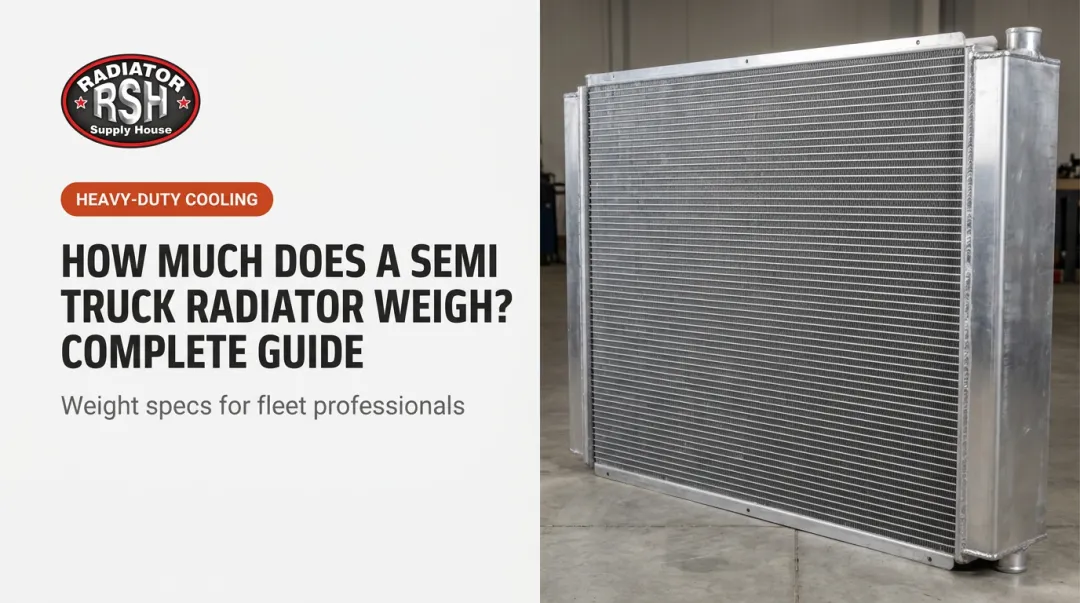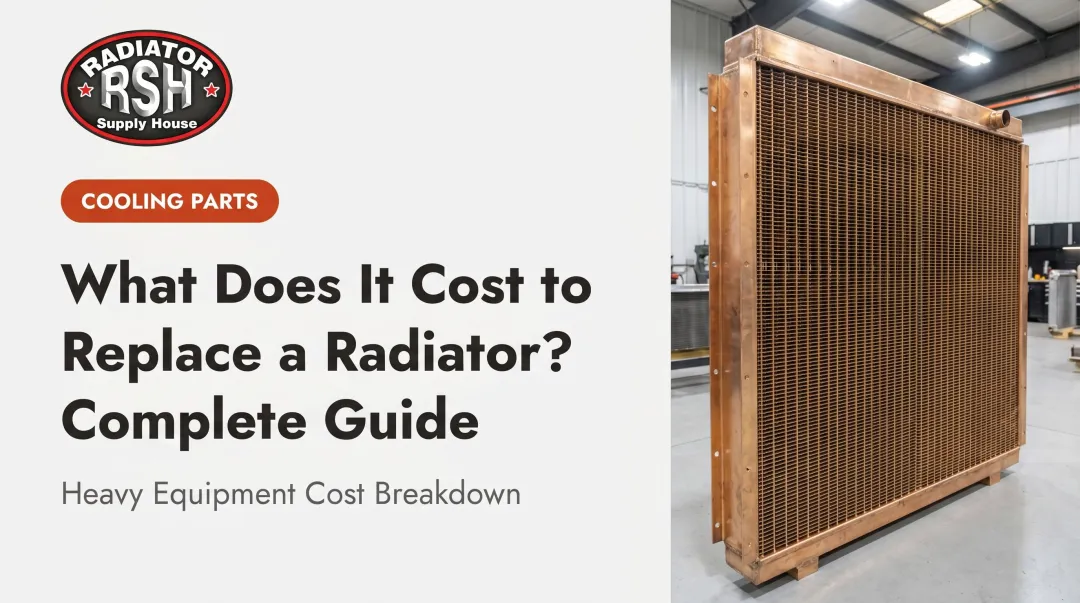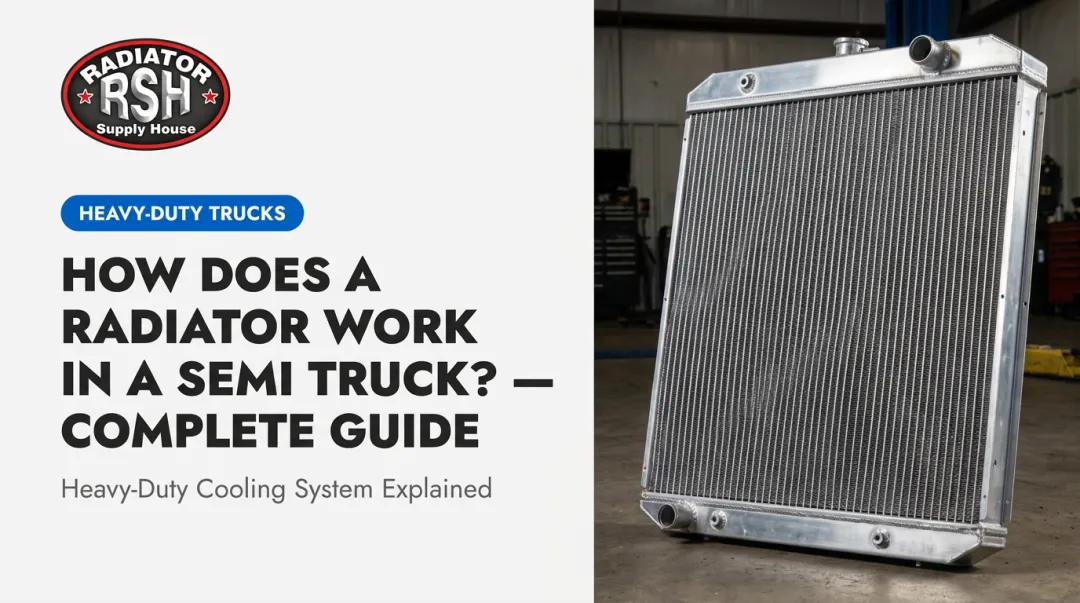
That financial pressure is compounded by rising repair costs. ATA/TMC's Decisiv VMRS data showed combined heavy-duty parts and labor costs rose 2.2% quarter over quarter in Q3 2024, with 19 of 25 tracked systems posting higher costs.
Unlike a passenger car radiator swap, semi truck radiator replacement involves heavy-duty components, brand-specific parts pricing, and labor that can run 3–6 hours at a specialized shop. The total cost swings dramatically depending on the truck make, radiator type, parts source, and who does the work.
This guide breaks down real cost ranges, the factors that move the price, a full line-item breakdown, and practical strategies for keeping replacement costs under control.
Key Takeaways
- Total replacement cost typically ranges from ~$1,200 to $3,500+ depending on parts tier, shop type, and truck model
- Truck make/model, OEM vs. aftermarket parts, and labor location are the three biggest cost drivers
- Independent shops with quality aftermarket parts offer the best value for most owner-operators and fleets
- Downtime revenue loss often exceeds the cost difference between budget and mid-range parts
- Replacing related components (hoses, thermostat, coolant) in the same job prevents a costly return visit
How Much Does a Semi Truck Radiator Replacement Cost?
There's no single national benchmark for Class 8 radiator replacement — no RepairPal equivalent exists for heavy-duty trucks. The most defensible approach is building a cost estimate from verified inputs: published part prices, documented labor hours, and current shop rates.
Fullbay's 2025–2026 State of Heavy-Duty Repair report puts median independent shop labor rates at $145–$149/hour. Dura-Lite's guidance documents the average semi truck radiator replacement at 3–6 labor hours. Combine those with published aftermarket part prices and you get the following planning ranges.
Tiered Cost Estimates
| Tier | Typical Part Cost | Labor Estimate | Planning Total |
|---|---|---|---|
| Budget / Aftermarket | ~$750 | $435–$894 | ~$1,185–$1,650 |
| Mid-Range / OE-Equivalent | ~$2,000-$5,000 | $435–$894 | ~$2,500–$6,000 |
| OEM / Dealership | $1,500–$6,000+ | $500–$1,500+ | ~$2,000–$7,500+ |
These are planning estimates, not published benchmarks. Final invoices vary based on truck configuration, shop location, ancillary repairs, and current parts availability. Always get a VIN-specific quote before budgeting a job.
Brand-Level Part Price Reference
Part availability and pricing vary significantly by manufacturer. Publicly listed aftermarket pricing for common Class 8 models:
- Freightliner Cascadia : aftermarket radiators range from approximately $750 (OTR budget tier) to $4,000 for OE-equivalent heavy duty units
- Kenworth T680 / Peterbilt 579 : shared PACCAR platform; aftermarket units typically list around $4,000
- Mack Anthem : limited public pricing data available; VIN-specific quotes are essential
- International : pricing varies widely by model year and configuration
OEM dealer pricing is typically quote-only. Factor in freight, coolant flush, and hose replacement when building your budget — those line items routinely add $100–$300 to the final invoice.
Key Factors That Affect Semi Truck Radiator Replacement Cost
Truck Make, Model, and Configuration
High-volume models like the Freightliner Cascadia, Kenworth T680, and Peterbilt 579 have the broadest aftermarket coverage and the most competitive part pricing. Older or low-production models face limited availability, which drives up both part costs and lead times.
Cab layout also affects labor time. Conventional tractors typically fall within a 3–6 hour window, while cab-over configurations add access complexity and push that number higher.
Radiator Type and Construction
Two construction types dominate the Class 8 market:
- Aluminum core / plastic tank — lighter and lower cost; the standard for most modern semi trucks
- Steel tank / copper-brass core — higher upfront cost; better suited for high-heat or corrosive environments
Specialty configurations add significant cost. Combination coolers — where the radiator, charge air cooler, and oil cooler are integrated into a single assembly — require more complex removal and replacement. Individual components can often be sourced and installed separately at lower total cost than a pre-assembled combination unit.
OEM vs. Aftermarket Parts
OEM parts are manufactured to factory specifications and typically backed by manufacturer warranty networks. They carry premium pricing, and for some models, public OEM pricing isn't listed — quotes come only through dealerships.
Quality aftermarket parts from established suppliers can match OEM specifications at notably lower cost. The key variable is supplier quality — fitment verification by VIN, warranty terms, and the supplier's track record all matter more than the price tag alone. Radiator Supply House's ICEBOX line, for instance, covers hundreds of Class 8 fitments — including Freightliner Cascadia, Kenworth T680, Peterbilt 579, and Volvo VNL configurations — with OEM part number cross-references and a standard one-year manufacturer warranty on most radiators.
Labor Location and Shop Type
Where the work gets done significantly affects the labor portion of the bill:
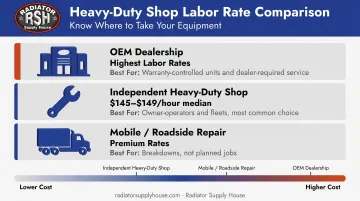
- OEM dealerships — highest rates; appropriate for warranty-controlled units where factory documentation is required
- Independent heavy-duty shops — mid-range rates ($145–$149/hour median); the most common choice for owner-operators and fleets
- Mobile / roadside repair — premium rates; the right call for a breakdown, not a planned job
Geographic labor markets also shift rates. Urban areas with tight technician supply tend to run higher than rural markets.
Additional Components Required
Radiator replacement rarely covers just the radiator. During disassembly, shops commonly identify — and recommend replacing — several ancillary components:
- Coolant hoses and clamps
- Thermostat and gasket
- Radiator pressure cap
- Coolant (full flush and refill)
- Coolant reservoir / overflow tank
Replacing these during the same job is almost always cheaper — the labor is already on the clock, and adding parts costs far less than paying for another 3–6 hours of shop time.
Complete Cost Breakdown: Parts, Labor, and Additional Expenses
Understanding the full invoice means accounting for every line item, not just the radiator.
Parts Cost
Aftermarket and OE-equivalent heavy duty radiators for Class 8 trucks range from approximately $750 on the budget end to $1,200+ for quality mid-range units. OEM radiators can reach $2,500 or more depending on the model. The part number matters — configurations with integrated oil coolers or specific engine fitments typically cost more than standard radiators.
Labor Cost
At $145–$149/hour for an independent shop and 3–6 hours of typical labor time, the labor band runs roughly $435–$895 for a standard job. Poor accessibility, corrosion, charge air cooler stack removal, or additional cooling system repairs push that higher.
Ancillary Components
Individual cooling system items add up quickly. Based on published supplier pricing:
- Extended-life antifreeze: ~$14–$20/gallon (most trucks require multiple gallons)
- T-bolt clamps: ~$6 each
- Coolant reservoir: ~$215
- Radiator pressure cap: ~$6–$10
- Coolant level sensor: ~$60–$65
A full cooling system refresh alongside radiator replacement can add several hundred dollars to the total invoice, but it's almost always worth it when the truck is already disassembled.
Downtime and Indirect Costs
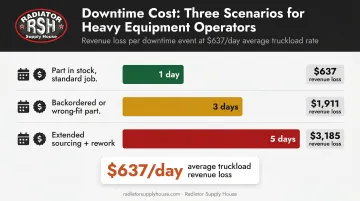
For commercial operators, the indirect cost column is the one that most often gets ignored. At ~$637/day in average truckload revenue loss (Penske, 2024), a two-day sourcing delay on a wrong-fit or backordered radiator costs more than the price difference between a budget and mid-range part.
To put that in concrete terms:
| Scenario | Repair Days | Estimated Revenue Loss |
|---|---|---|
| Part in stock, standard job | 1 day | ~$637 |
| Backordered or wrong-fit part | 3 days | ~$1,911 |
| Extended sourcing + rework | 5 days | ~$3,185 |
Parts availability and order-to-ship speed deserve as much attention as the part price itself. Radiator Supply House stocks over 10,000 units with a 24-hour processing target on in-stock orders. That inventory depth is what keeps a one-day repair from stretching into a three-day downtime event.
OEM vs. Aftermarket Semi Truck Radiators — What's the Real Cost Difference?
Choosing between OEM and aftermarket comes down to your truck's situation — warranty status, fleet requirements, and how fast you need the part.
Side-by-Side Comparison
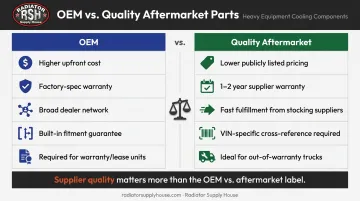
| Factor | OEM | Quality Aftermarket |
|---|---|---|
| Upfront part cost | Higher; often quote-only | Lower; publicly listed pricing common |
| Warranty | 1-year / unlimited miles (e.g., Freightliner Alliance) | 1–2 years depending on supplier (ICEBOX: 1-year standard; lifetime on charge air coolers) |
| Availability | 800+ Alliance locations (Freightliner); varies by model | Supplier-dependent; broad-network suppliers offer fast fulfillment |
| Fitment verification | Built to factory spec | Requires VIN-specific cross-reference; varies by supplier quality |
| Long-term value | High for warranty-controlled or lease units | High when supplier quality and fitment are verified |
When OEM Makes Sense
- Truck is under active manufacturer warranty
- Fleet operates under lease agreements requiring OEM documentation
- Highly specialized configurations with limited aftermarket coverage
- Manufacturer-mandated service requirements apply
When Quality Aftermarket Is the Smarter Call
- Trucks outside warranty coverage
- Cost-sensitive fleets where equivalent performance is available at lower price
- Models with strong aftermarket coverage and verified fitment options
- Situations where faster parts availability reduces downtime exposure
The real variable isn't OEM vs. aftermarket — it's supplier quality. Reputable aftermarket suppliers cross-reference OEM part numbers, back their products with warranties, and stock inventory for rapid shipping. The risk comes from unvetted low-cost sources that skip those steps, not from the aftermarket category as a whole.
How to Budget for and Reduce Semi Truck Radiator Replacement Costs
Build the Right Budget Framework
Before approving a repair, answer three questions:
- Is the truck under warranty? OEM is typically required if yes — if not, evaluate aftermarket on merit.
- How critical is uptime? Higher uptime sensitivity justifies spending more on faster parts sourcing and a reliable shop.
- Calculate total replacement cost — parts, labor, ancillary components, and estimated downtime revenue exposure, not just the radiator price.
Practical Cost-Reduction Strategies
- Get multiple quotes. Independent shops typically run lower rates than dealerships for the same labor hours.
- Source parts directly from specialized suppliers — Radiator Supply House, for example, stocks inventory across 300+ manufacturers and often fulfills faster than dealer channels at lower cost.
- Replace ancillary components in the same job. Hoses, thermostat, pressure cap, and coolant cost far less installed now than as a return labor charge later.
- Many quality aftermarket options carry comparable warranty terms to OEM at lower cost — verify coverage before defaulting to dealer pricing.
- Pre-approve part numbers before a truck goes down. A VIN-specific parts matrix — OEM number, approved aftermarket equivalent, local stock source — eliminates sourcing delays during an unplanned failure.
Even with a solid sourcing strategy, certain decisions consistently inflate the final bill. Here's where most buyers leave money on the table:
What Most Buyers Get Wrong
- Focusing on the part price while ignoring labor complexity and downtime exposure
- Choosing the cheapest aftermarket option without verifying fitment or warranty terms
- Paying OEM prices for applications where a verified aftermarket part performs equally well
- Delaying replacement after early warning signs appear — a failed radiator can escalate to head gasket failure, warped cylinder heads, or cracked engine blocks
Frequently Asked Questions
How much does a semi truck radiator cost?
Aftermarket and OE-equivalent heavy duty radiators for Class 8 trucks generally run $750–$1,200 for common models like the Freightliner Cascadia or Kenworth T680. OEM radiators can reach $2,500 or more. Price varies significantly by truck make, model year, and whether the unit includes an integrated oil cooler or other configurations.
How much should labor cost to replace a semi truck radiator?
At independent heavy-duty shops, expect $435–$895 for a standard replacement based on 3–6 labor hours at $145–$149/hour median rates. Dealership labor runs higher. Complex configurations or cab-over layouts add time and cost.
How long does it take to replace a semi truck radiator?
An experienced heavy-duty mechanic typically completes the job in 3–6 hours for a standard conventional tractor. Cab-over layouts, combination cooler stacks, or significant corrosion can push the job beyond that range.
What are the signs that a semi truck radiator needs replacement?
Key warning signs include:
- Persistent overheating or temperature spikes under normal load
- Visible coolant leaks under the truck
- Sludge or discoloration in the coolant reservoir
- Frequent low-coolant warnings without a visible external leak
- Poor heater performance at operating temperature
Overheating damage escalates quickly to head gaskets and cylinder heads, so act on these symptoms early.
How does a charge air cooler (CAC) affect performance?
The charge air cooler (CAC) cools the compressed air coming from the turbocharger before it enters the engine. This increases air density, improves combustion, and boosts both power and fuel efficiency. A clogged or damaged CAC reduces performance and fuel economy. For CAC options or sizing, contact us at +1 877-615-3002 or info@RadiatorSupplyHouse.com.
Can a semi truck radiator be repaired instead of replaced?
Minor leaks or isolated tank damage can sometimes be repaired cost-effectively. For significant core damage, widespread corrosion, or structural failure, full replacement is the more reliable and cost-effective path. Commercial truck engines operate under sustained thermal stress that repaired cores often can't handle long-term.