It's a fair question. Many truck owners have no idea whether their vehicle came with one, and the answer isn't always obvious just by popping the hood. Some coolers hide inside the radiator. Others sit in plain sight but get mistaken for something else entirely.
This guide walks through three practical, hands-on methods for confirming whether your truck has a transmission cooler, what each type looks like, and what to do once you know the answer.
Key Takeaways
- Factory tow packages often include a transmission cooler, but not always — verify, don't assume.
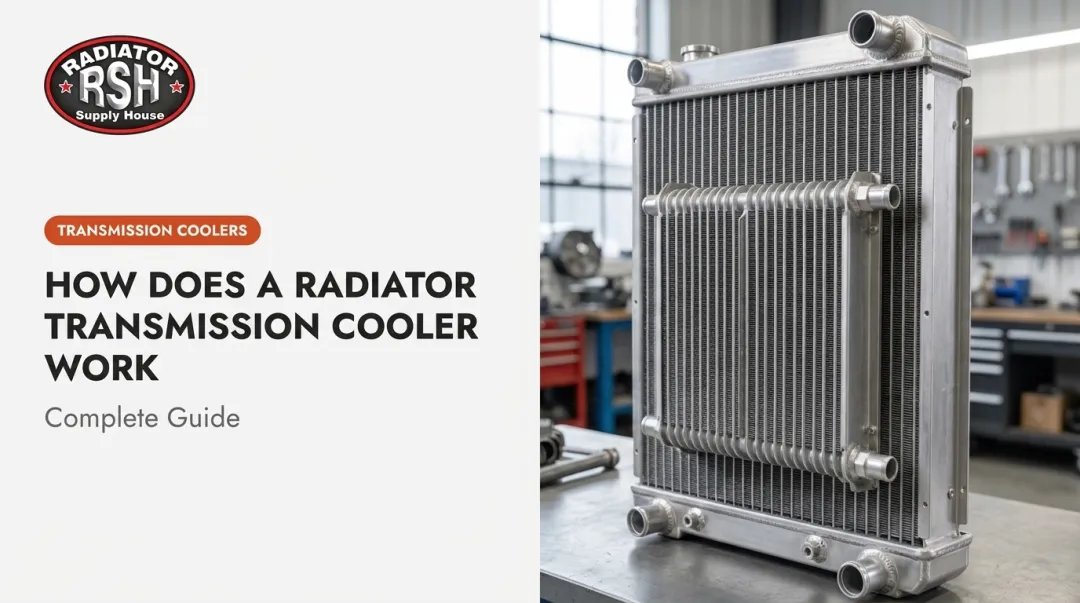
- External coolers resemble a small finned radiator with two fluid lines running to the transmission.
- Confirm cooler presence with visual inspection, fluid-line tracing, or OEM documentation.
- No cooler and regular towing? Adding one is far cheaper than a transmission rebuild.
What You Need to Check for a Transmission Cooler in Your Truck
You don't need specialty tools for this. A few basics and a little prep make the inspection faster and safer.
Tools and Reference Materials
Gather these before you start:
- Flashlight or work light: engine bays get dark, especially near the grille
- Mechanic's mirror: helps you see behind the condenser without disassembly
- Owner's manual or OEM build sheet: lists factory-installed equipment
- VIN number: found on the driver's side door jamb, useful for dealer lookups
Preconditions and Setup
Safety comes first here, since you'll be working near fluid lines and radiator components:
- Let the engine cool completely before touching anything near the radiator or transmission lines, since residual heat and pressure can cause burns.
- Park on level ground and engage the parking brake.
- Use wheel chocks if you need to get underneath the truck.
- Wear gloves and eye protection, particularly if lines show any sign of residual pressure or leakage.
Skip these steps and you risk a burn from a line that's hotter than it looks, even after the engine shuts off.
Methods to Check If Your Truck Has a Transmission Cooler
Three approaches work here, ranging from a two-minute glance to a documentation deep-dive. Your best bet depends on how confident you need to be and how much access you have to the engine bay.
Method 1: Visual Inspection of the Engine Bay
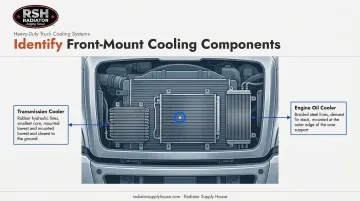
Open the hood and look at the area directly in front of the radiator and A/C condenser. An external transmission cooler typically shows up as a small, rectangular finned unit, noticeably smaller than the main radiator, positioned to catch incoming airflow through the grille.
What to look for:
- Two rubber or metal fluid lines (not coolant hoses) connecting to the unit
- Neat OEM-style brackets and hose clamps versus zip-tied aftermarket mounting
- Aluminum construction with brazed fins, the standard build for heavy-duty front-mounted coolers
This method is fast, but it has a real blind spot. If the cooler is tucked behind the condenser, coated in road grime, or built into the radiator's end tank rather than mounted separately, you'll miss it completely. A finned core alone also doesn't prove much, since engine oil coolers and A/C condensers look almost identical from the front.
Method 2: Trace the Transmission Fluid Lines
This is the most definitive method you can do without a dealer lookup. Locate the transmission (typically toward the rear of the engine, connected to the driveshaft) and find the two fluid lines running forward.
- Follow both lines toward the front of the engine bay.
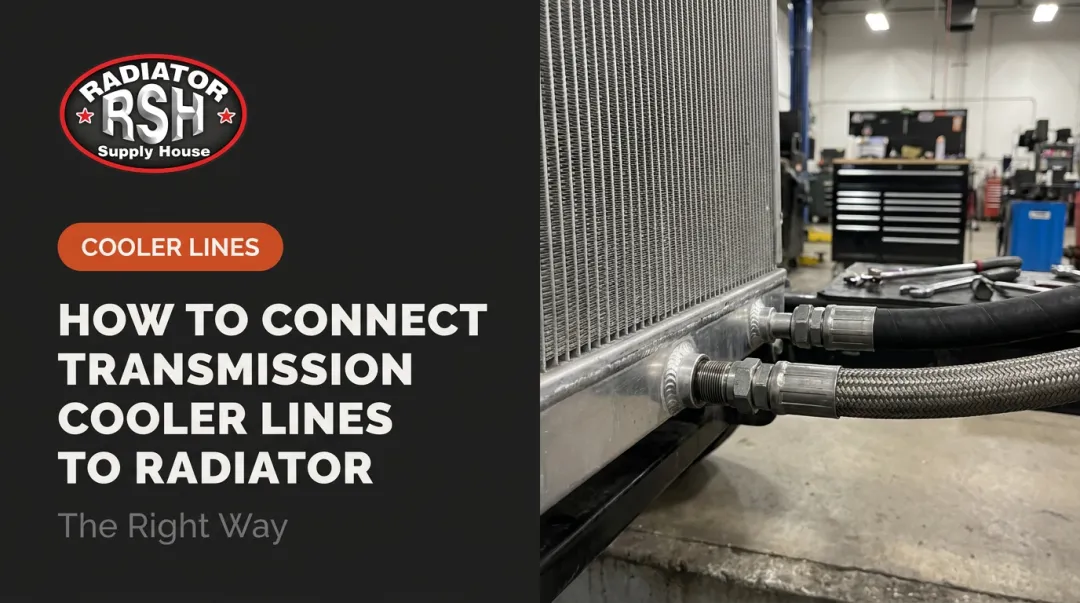
- Check where they terminate. Ports at the bottom or side of the radiator tank mean the cooler is integrated into the radiator itself, common on factory tow-package trucks. A Mack service bulletin for its CHU, CXU, and GU models confirms this setup, with cooler-line fittings at the radiator's bottom.
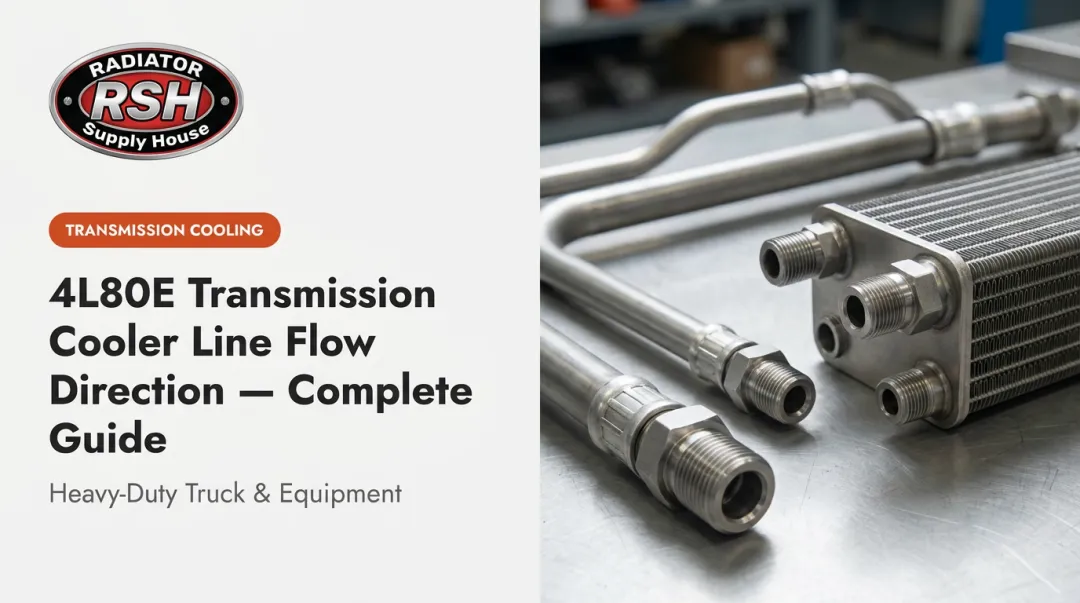
- Note if they bypass the radiator entirely and connect to a separate finned unit. That's a standalone auxiliary cooler.
An external cooler doesn't necessarily bypass the radiator, though. Aftermarket manufacturers like Hayden typically recommend installing auxiliary coolers in series after the radiator, not as a replacement for it. If a line seems to touch both the radiator and a separate unit, that's likely intentional rather than a wiring mistake from a previous owner.
The catch with this method: it requires getting underneath or around the engine, which is tougher on lifted trucks or tightly packaged engine bays.
Method 3: Check Documentation and OEM Build Data
When the physical inspection leaves you uncertain, paperwork settles it.
- Check the owner's manual or window sticker for mentions of "tow package," "heavy-duty cooling," or "transmission oil cooler."
- Run a VIN lookup through the manufacturer's site or a dealership, and ask specifically whether your build included a factory transmission cooler.
- Cross-reference the result with what you saw during inspection. If documentation confirms a cooler but you didn't spot an external unit, it's almost certainly integrated into the radiator.
This method carries real authority for late-model trucks. Ford's 2025 towing guide lists the automatic-transmission oil cooler as standard equipment on F-250, F-350, and F-450 Super Duty pickups.
Chevrolet's 2025 Trailering Guide confirms the same for Silverado HD automatic-transmission models, listed under RPO code KNP.
The one thing this method can't tell you: whether an aftermarket cooler was bolted on later by a previous owner. For that, you still need the visual inspection.
How to Interpret What You Find
Once you've run through these checks, the results point to one of a few scenarios, and misreading them is easier than you'd think. The most common mistake is assuming "no external unit" means "no cooler at all." Often, it just means the cooler is integrated into the radiator.
Here's what your findings actually mean:
| What you found | What it means | Recommended action |
|---|---|---|
| Lines running into radiator tank ports | Factory-integrated cooler, suited for light-to-moderate towing | Adequate for occasional towing; monitor temps under heavy loads |
| Integrated cooler + separate external unit | Truck is set up for demanding, frequent towing | Well-equipped; maintain both systems |
| No cooler found via any method | Transmission relies solely on natural fluid cooling | Risky for towing — add a cooler before hauling serious weight |
If your inspection turns up only a radiator-integrated cooler and you tow frequently or in hot climates, adding an auxiliary unit gives your transmission a real buffer against sustained heat buildup. If you found nothing at all, that's not a truck you want to hitch a heavy trailer to without upgrading first.
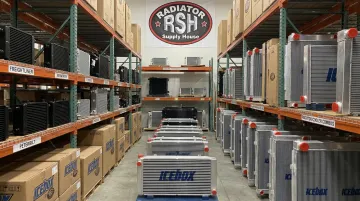
For replacement or upgrade parts, Radiator Supply House stocks transmission coolers and cooling system components for commercial trucks and heavy equipment across major manufacturers. Their inventory includes standalone auxiliary units and radiators with integrated cooler sections for brands like Freightliner, Kenworth, and Peterbilt.
Their catalog also includes ICEBOX-branded OEM-equivalent parts, so a missing or undersized cooler doesn't mean hunting across a dozen suppliers for a replacement.
Common Mistakes When Checking for a Transmission Cooler
A few errors show up again and again during this kind of inspection:
- Confusing components. A/C condensers, engine oil coolers, and transmission coolers all look like similar finned heat exchangers, but the fluid lines and their position in the cooling stack (not appearance) reveal the real difference.
- Assuming no external unit means no cooler. Many factory-equipped trucks route the transmission cooler inside the radiator's end tank, connected through side ports rather than a visible separate core.
- Checking hot lines carelessly. Never test return lines by feel while the engine runs—residual heat and pressure create a real burn risk, so wear gloves for this step.
If you're ever unsure which finned unit you're looking at, trace the fluid lines back to their source rather than guessing from appearance.
Conclusion
Three methods, used together, give you a reliable answer: scan the engine bay, trace the fluid lines to their endpoints, and confirm with OEM documentation. None of them require special tools, just patience and a willingness to look closely.
Knowing your truck's cooling setup before you tow isn't optional if you're hauling anything substantial. Catch a missing or undersized cooler now, and avoid a costly shop visit later. Need a replacement? Radiator Supply House stocks OEM-equivalent and ICEBOX aftermarket transmission coolers for most heavy-duty trucks.
Frequently Asked Questions
Does my truck have a transmission cooler?
Many trucks with factory tow packages include either an integrated or external cooler, but not all do. Trace the transmission fluid lines or run a VIN check with your dealer for a definitive answer.
Where is a transmission cooler located on a truck?
External coolers mount in front of the radiator or A/C condenser to catch airflow. Factory-integrated coolers sit inside one of the radiator's side tanks, connected where the transmission lines attach.
What does a transmission cooler look like in a truck?
It's a small, rectangular finned unit, usually aluminum, resembling a mini radiator. Two fluid lines connect to it, and it's noticeably smaller than the main radiator.
How much does it cost to have a transmission cooler installed?
Costs vary by cooler type and labor rates. As a benchmark, RepairPal lists Ford F-350 Super Duty cooler-assembly replacement at roughly $949 to $1,074, still far less than a full transmission rebuild, and a useful reference point for heavier-duty commercial trucks too.
Can you tow without a transmission cooler?
Light towing may be manageable without a dedicated cooler, but sustained heavy loads without adequate cooling risk overheating the fluid and accelerating wear. Most manufacturers recommend a cooler beyond a certain towing threshold.
Does my truck need an additional transmission cooler if it already has one?
A factory-integrated cooler handles general use fine, but frequent heavy towing, hot climates, or stop-and-go conditions often justify adding an auxiliary external unit for extra protection.