Costs have also shifted. Parts availability, labor rate increases, and supply chain changes since 2022 have pushed repair bills higher across most vehicle categories.
There is no single universal price for this repair. A fan replacement on a compact sedan looks nothing like the same job on a Caterpillar excavator or a Class 8 truck. Vehicle type, fan configuration, part quality, and labor complexity all pull the final number in different directions.
This guide breaks down realistic cost ranges by vehicle category, the specific factors that drive costs up or down, and what commercial operators in particular need to account for beyond the parts invoice.
Key Takeaways
- Radiator fan replacement costs range from roughly $150 to $1,500+ depending on vehicle type and configuration
- Labor often represents 50% or more of the total repair bill; always request an itemized quote before authorizing work
- OEM parts carry higher upfront costs but typically come with longer warranties and tighter specs
- Commercial and heavy equipment operators face the highest total costs, with unplanned downtime adding significantly to the final bill
- Fast access to in-stock parts is one of the most effective ways to limit downtime on jobsite or fleet equipment
How Much Does a Radiator Fan Replacement Cost?
No flat rate exists for this repair. The same job spans a wide range depending on whether you're dealing with a daily-driver sedan, a full-size pickup, or a diesel-powered machine running continuous duty cycles.
RepairPal's 2026 national estimate puts the total cost for a passenger vehicle radiator fan motor replacement at $809–$922, with parts running $611–$632 and labor at $198–$291. That baseline shifts considerably once you move into trucks, SUVs, and heavy equipment.
The most common budgeting mistakes: expecting one universal number, ignoring labor entirely, or assuming any aftermarket part is an inferior option.
Passenger Vehicles — Baseline Reference ($809–$922 installed)
For context, a standard passenger car replacement — single electric fan motor, accessible engine bay, quality aftermarket parts — runs $809–$922 installed per RepairPal's national data. Parts alone on something like a Toyota Camry range from $77 (basic aftermarket) to $323+ (branded Continental/VDO), with labor making up the rest.
This tier is outside the typical scope of commercial and fleet work, but it anchors the low end of the cost spectrum.
Standard Trucks and SUVs ($800–$1,100 installed)
Dual fan assemblies, mechanical clutch fans, and tighter engine bay access push labor hours up. RepairPal documents current installed costs for common platforms:
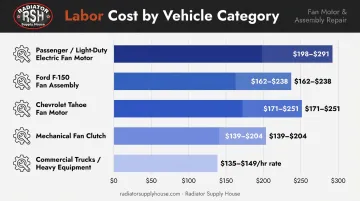
- Ford F-150 fan assembly: $801–$877 total ($162–$238 labor)
- Ram 1500 fan assembly: $836–$901 total ($140–$205 labor)
- Chevrolet Tahoe fan motor: $897–$1,065 total ($171–$251 labor)
Turbocharged engines and vehicles with dual cooling circuits sit at the higher end of this range.
Commercial Vehicles and Heavy Equipment ($900–$1,500+ in parts alone)
This is where costs break from the passenger-vehicle model entirely. Heavy-duty fan assemblies built for diesel engines and continuous-duty cycles carry a parts cost that can exceed what a full passenger car job costs installed.
Fan clutch parts alone for commercial trucks run $416 to $1,338+ depending on the platform. Add higher labor hours, possible radiator removal, and OEM-spec components for equipment where fan failure halts revenue-generating operations — construction equipment, agricultural machinery, buses, commercial fleets — and total costs climb accordingly.
These ranges cover parts and professional labor but exclude diagnostic fees, coolant flush, additional relay or hose replacements, and emergency service premiums.
Key Factors That Affect Radiator Fan Replacement Cost
Four variables drive most of the price variation: fan configuration, parts sourcing, shop labor rates, and how accessible the fan assembly actually is.
Fan Type and Configuration
Three primary configurations, each with different cost implications:
- Single electric fan motor — the simplest and generally least expensive; RepairPal's national estimate for a mechanical fan clutch replacement runs $350–$567 total, with parts at $211–$363 and labor at $139–$204
- Dual electric fan assembly — more involved; parts costs are higher and installation requires more disassembly
- Mechanical belt-driven clutch fan — common on trucks and larger vehicles; clutch replacement is often less expensive in parts but can require significant access work on commercial platforms
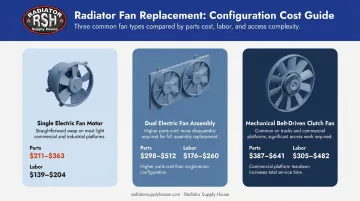
Labor time for each configuration is documented in tools like ALLDATA and Mitchell1 TruckLabor — actual hours vary by make, model, and how the engine bay is packaged.
OEM vs. Aftermarket Parts
OEM parts carry factory specifications and typically come with at least a one-year manufacturer warranty. According to Edmunds, OEM parts are generally more expensive than aftermarket equivalents — with differences of up to 50% in some categories.
Accessibility and Related Work
Fan assemblies buried behind the AC condenser, intercooler, or requiring radiator removal add meaningful labor time. While the cooling system is open, mechanics commonly recommend:
- Coolant flush and refill ($419–$487 total per RepairPal)
- Cooling system pressure test ($37–$54)
- Fan relay inspection (relay replacement runs $94–$112 if needed)
- Hose clamp and connector checks
These bundled services add cost but often prevent repeat failures within months.
Cost Breakdown of Radiator Fan Replacement
Parts Cost
| Category | Aftermarket Range | OEM/OEM-Equivalent Range |
|---|---|---|
| Passenger car (e.g., Toyota Camry) | $77–$324 | $950–$1,361 (genuine OEM) |
| Light truck/SUV (e.g., Ford F-150) | $109–$185 | $332 (Motorcraft) |
| Commercial truck fan clutch | $416–$995 | $925–$1,339 |
Labor Cost
| Vehicle Category | Verified Labor Cost Range |
|---|---|
| Passenger/light-duty electric fan motor | $198–$291 |
| Mechanical fan clutch (national) | $139–$204 |
| Ford F-150 fan assembly | $162–$238 |
| Chevrolet Tahoe fan motor | $171–$251 |
| Commercial trucks / heavy equipment | Higher — apply $135–$149/hr heavy-duty rates to job time |
Additional Components and Fluids
Common add-ons and their approximate costs:
- Fan relay: $94–$112 (total repair; relay part alone $12–$49)
- Coolant flush and refill: $419–$487
- Cooling system pressure test: $37–$54
- Wiring connector repair: $150–$400 depending on damage
- Hose clamps: $10–$15 per clamp (parts only)
The relay is worth checking first — RepairPal notes that a faulty relay is sometimes the actual cause of cooling fan failure rather than the fan motor itself.
Fleet and Downtime Considerations
For commercial operators, the parts and labor invoice isn't the full cost of a fan failure. A machine sitting two days waiting on a hard-to-source assembly can cost far more in lost productivity than the repair itself. Caterpillar's parts catalog, for example, requires equipment-specific selection to verify fitment and pricing — making supplier inventory depth a practical concern, not just a convenience.
Radiator Supply House stocks cooling system components covering a wide range of manufacturers, including Caterpillar, Komatsu, John Deere, Freightliner, Kenworth, Peterbilt, Mack, Volvo, and Case. For fleet operators and repair shops running diesel-powered equipment, sourcing from a specialized cooling system supplier rather than a general distributor can cut lead times by days and reduce unplanned downtime costs.
Low-Cost vs. High-Cost Radiator Fans: What's the Difference?
Performance and Durability
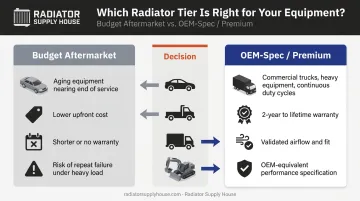
The gap between a generic no-name fan and a branded aftermarket or OEM-spec unit shows up most clearly in demanding applications.
Lower-cost generic fans:
- May use lower-grade motor windings and plastic blade assemblies
- Sufficient for lower-demand applications with infrequent use cycles
- Short or no warranty coverage
Branded aftermarket and OEM-spec fans:
- Built and validated against OE samples for airflow performance, temperature tolerance, and dimensional fit
- Carry meaningful warranties — typically 2 years to lifetime limited coverage depending on manufacturer and application
- Better suited for sustained heat loads on diesel engines and heavy equipment
When to Choose Budget vs. Premium
| Situation | Recommended Approach |
|---|---|
| Aging equipment nearing end of service life | Quality budget aftermarket is reasonable |
| Work truck or fleet vehicle with moderate use | Mid-tier branded aftermarket |
| Commercial truck or high-mileage fleet vehicle | OEM-equivalent or premium branded aftermarket |
| Heavy equipment on continuous duty cycles | OEM-spec; downtime risk outweighs parts savings |
For equipment that runs hard — construction, mining, or agricultural machinery — the math on budget fans often reverses over time. A fan that fails again in 18 months generates a second labor bill that erases the initial savings, plus the added cost of unplanned downtime.
What Most People Miss About Radiator Fan Replacement Costs
Many owners compare fan prices without factoring in labor — which frequently represents 50% or more of the total repair cost. Always request a quote that separates parts and labor. That breakdown reveals where the real cost is coming from, and it's often not the part itself.
For fleet operators, the bigger cost isn't the repair — it's the downtime. A $1,200 repair on a $500,000 excavator that sits idle for three days waiting on a fan assembly is a very different financial event than the invoice suggests. Sourcing from a supplier with deep inventory across commercial equipment brands — Caterpillar, Komatsu, Freightliner, Volvo — directly cuts that exposure.
No-brand fan assemblies may save $50–$100 upfront, but that gap closes fast when a cheap part fails under load. Before purchasing, evaluate:
- Warranty length — established manufacturers back their parts; generic brands often don't
- Brand reputation — names like Dorman, TRQ, and Kit Masters have trackable failure histories
- Return policy — especially important for commercial equipment with long lead times on labor
The warranty terms exist because reputable manufacturers stand behind their product. A missing or minimal warranty is a signal worth taking seriously.
Frequently Asked Questions
How do I tell if my radiator fan is bad?
Key warning signs include engine temperature running higher than normal, the fan not spinning when the engine reaches operating temperature or under load, grinding or rattling noises from the fan area, and repeatedly blown cooling fan fuses. A faulty relay can mimic fan motor failure, so check the relay first before replacing the assembly.
Can you drive with a bad radiator fan?
No — at low speeds or in stop-and-go traffic, the engine depends heavily on the fan for cooling. Ford's official vehicle alert guidance states that an engine coolant over-temperature condition requires stopping the vehicle and switching off the engine as soon as it's safe. Continued operation risks overheating, which can cause severe and expensive engine damage.
What is the lifespan of a radiator fan?
Lifespan varies by application and duty cycle. For heavy equipment, EquipmentShare notes that some fleet operators replace cooling fans proactively at 1,500–2,000 operating hours or annually, while others replace based on wear or damage. Regular cooling system inspections catch early signs of bearing wear, motor degradation, or blade damage before a failure occurs.
How much does radiator fan replacement labor cost on its own?
For commercial trucks and heavy equipment, apply the heavy-duty shop median of $135–$149/hour to the specific job time — complex disassembly can push total labor costs considerably higher. For passenger vehicles, RepairPal data puts independent shop labor at $139–$291. Dealership rates run approximately 25% above independent shops regardless of vehicle type.
Is it cheaper to replace just the fan motor or the entire assembly?
Replacing just the motor costs less in parts, but many modern fan assemblies are sold as integrated units. Since labor time is often identical either way, a full assembly replacement is frequently the more cost-effective and reliable choice — and avoids the risk of a second failure from other worn components in the same assembly.
Does painting a radiator hurt the cooling?
It can. A thick or improper coating on the fins and tubes acts as an insulating layer that slows heat transfer and reduces cooling. A very thin coat of proper high-heat radiator paint has minimal impact, but heavy or built-up paint should be avoided — especially on the fin surfaces where airflow does the cooling. If you're unsure about a coating, contact us at +1 877-615-3002 or info@RadiatorSupplyHouse.com.