This guide covers exactly how the 4L80E cooling circuit works, which port is the feed and which is the return, what changes between the 1991–1996 and 1997-up designs, and what actually happens when the lines are reversed.
Key Takeaways
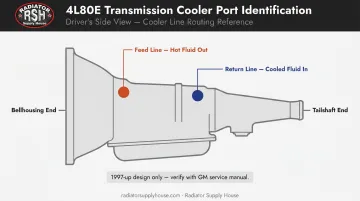
- On 1997-up 4L80E transmissions, the rear port (toward the tailshaft) is the return line; the front port is the feed — confirm with your year-specific GM service manual
- Fluid is actively pressurized by the internal pump — this is not a gravity-fed circuit
- Reversing lines reduces cooling effectiveness and can restrict flow through directional check valves
- External coolers should always be plumbed in series after the factory radiator cooler
- Use Dexron VI fluid — GM Bulletin 04-07-30-037C confirmed it as the backward-compatible replacement for Dexron III
What Is the 4L80E Transmission Cooler Line System?
The cooler line system is a closed hydraulic loop: ATF leaves the transmission case, passes through one or more heat exchangers, and returns at a lower temperature to keep the clutch packs, planetary gearsets, and torque converter lubricated within their effective operating range.
The 4L80E generates significant heat under load. Clutch pack engagement, torque converter slip, and continuous hydraulic activity all add thermal energy to the fluid. ATF viscosity and film strength degrade as temperature climbs.
ACDelco and Mobil both confirm that elevated temperature accelerates oxidation, varnish formation, and deposit buildup. The approved fluid (Dexron VI) is specifically formulated for thermal and oxidative stability, but it has limits under sustained high-load operation.
Two things this system is not:
- It is not pressurized like the engine coolant circuit — though the ATF itself is under hydraulic pressure
- The cooler lines are not interchangeable with engine oil cooler lines — they are separate circuits with different fittings and routing
How Fluid Flows Through the 4L80E Cooling Circuit
The 4L80E cooling circuit is entirely pump-driven. The main pressure-regulator valve controls flow into the torque converter, which then feeds the cooler and lubrication circuit in sequence — as Sonnax's breakdown of GM transmission hydraulics documents.
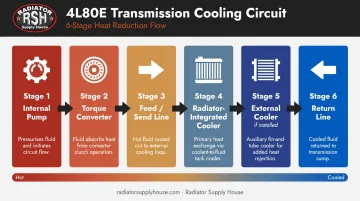
The complete flow sequence:
- Internal pump builds pressure and pushes fluid through the circuit
- Torque converter — fluid absorbs heat from converter slip and clutch apply events
- Feed/send line — hot fluid exits the transmission case
- Radiator-integrated cooler — ATF passes through a heat exchanger in one of the radiator end tanks; surrounding engine coolant absorbs heat
- External cooler (if installed) — additional heat rejection before fluid returns
- Return line — cooled ATF re-enters the transmission and feeds the lubrication circuit
Why the Radiator Cooler Matters in Cold Weather
The radiator-integrated cooler does double duty. In warm conditions, it pulls heat out of the ATF. In cold weather, engine coolant that is already warmer than the transmission fluid actually warms the ATF — helping the transmission reach operating temperature faster and reducing cold-start clutch wear.
For most applications, bypassing the radiator cooler entirely is not recommended. Unless you're running a dedicated thermostat bypass valve with an oversized external cooler, the factory heat exchanger serves a real purpose year-round.
GM's Documented Flow Rate
GM service information for 2007 Express 3500 4L80E/4L85E specifies 1 quart in 15 seconds as the return-flow benchmark during a cooler flow test conducted with the engine running. If your return flow falls short of that, suspect a restriction somewhere in the cooling circuit before assuming an internal transmission fault.
Which Line Is the Feed and Which Is the Return on a 4L80E?
This is where year matters more than most guides acknowledge.
1991–1996 4L80E
According to Transmission Digest, both cooler connections sit near the front of the case, almost side by side. This makes visual identification unreliable — the two ports are close together with no obvious positional cue. Available GM service documentation doesn't explicitly label which forward connection is the feed on these early units. Verify with your year-specific GM service manual or ATSG guide before connecting lines.
1997-Up 4L80E (Center-Lube Design)
Transmission Digest records one key change: the cooler return line was relocated from the pump area to the center support, moving it rearward relative to the earlier design. On these transmissions:
- Rear port (closer to the tailshaft / center support) = return line (cooled fluid coming back in)
- Front port (closer to the bellhousing) = feed line (hot fluid going out)
This relocation is functionally important, not just a positional detail. The return oil on 1997-up units directly supports center and rear gear-train lubrication. Installing the wrong fitting or plugging the wrong port can restrict lube flow to the overdrive section — a genuine failure risk with real consequences for the transmission.
2004-Up Cases
Transmission Digest notes that by 2004, the obsolete forward return boss was removed from the exterior of the case, eliminating the ambiguity that existed on 1997–2003 units.
Field Identification Without a Diagram
If you're working without documentation, two methods work:
- Temperature check: With the engine idling at operating temperature, carefully touch each cooler line. The feed line will be noticeably hotter, carrying fluid that just absorbed heat from the converter and clutch packs.
- Flow test: Disconnect one line at a time over a drain pan at idle. The line that flows under pressure is the pressurized send/feed line.
Hayden's installer documentation references the temperature method as a practical field check. Use proper precautions — ATF at operating temperature can cause burns.
What Happens When 4L80E Cooler Lines Are Connected Backwards?
The transmission won't immediately seize — fluid still circulates and the pump keeps running. Nothing fails in the first few minutes, which is exactly why reversed lines get missed during initial post-install checks.
Cooling Efficiency
Heat exchanger theory shows that counterflow arrangements — where two fluids travel in opposite directions — maintain a more favorable temperature gradient than parallel flow. Reversing your radiator's cooler lines may or may not change its internal flow arrangement; that depends on the tube orientation of your specific radiator, which varies by manufacturer.
Factory cooler circuits are designed with a specific flow direction. Treat that direction as intentional and work with it, not around it.
The Valve Failure Risk
Some external coolers and factory circuits incorporate one-way check valves or bypass valves that are direction-sensitive. Running fluid backwards through these components can:
- Cause the valve to seat incorrectly
- Block or restrict flow entirely
- Starve the transmission of adequate fluid circulation
This is the more serious failure mode — not reduced efficiency, but active flow restriction.
Diagnostic Signs of Reversed Lines
If you suspect your cooler lines are backwards, look for:
- Both lines running warm or hot rather than one noticeably cooler than the other
- Chronic overheating under loads that shouldn't stress the transmission
- Sluggish engagement after the transmission reaches operating temperature
- ATF that darkens or smells burnt faster than expected
Check line routing before assuming internal transmission damage. Shops regularly send transmissions out for rebuilds when the actual problem is two swapped fittings — a 10-minute fix.
Adding an External Transmission Cooler to the 4L80E
The 4L80E is built for heavy-duty use — but it's also deployed in exactly the scenarios that stress factory cooling hardest: towing at rated capacity, mountain grades, commercial stop-and-go routes, and hot climates. If any of those describe your application, an external cooler belongs on your build.
Correct Installation Order
The sequence matters:
Transmission feed port → radiator cooler → external cooler → transmission return port
Both Hayden and Tru-Cool independently specify this order in their installation documentation — downstream of the radiator cooler, not in place of it. This preserves the cold-weather warm-up function while adding air-to-oil heat rejection capacity under load.
Hayden states that adding an auxiliary cooler can reduce transmission temperatures by up to 60°F — though this is a manufacturer maximum figure, not a controlled 4L80E-specific result. Actual reduction depends on cooler size, airflow, and duty cycle.
Cooler Sizing
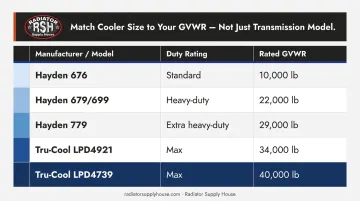
Matching cooler size to your actual GVWR and duty cycle — not just transmission model — is the most important sizing decision you'll make:
| Manufacturer | Model | Rated GVWR |
|---|---|---|
| Hayden Rapid-Cool 676 | Standard | 10,000 lb |
| Hayden 679 / By-Pass 699 | Heavy-duty | 22,000 lb |
| Hayden HD-Cool 779 | Extra heavy-duty | 29,000 lb |
| Tru-Cool Max LPD4921 | Max | 34,000 lb / 34,000 BTU |
| Tru-Cool Max LPD4739 | Max | 40,000 lb / 45,000 BTU |
Flow Direction on External Coolers
Most standalone external coolers are not directional — Hayden explicitly labels several of its auxiliary cooler models as bidirectional. However, any cooler with an integrated bypass or check valve must be installed per the manufacturer's specified flow direction. Confirm the flow direction before routing your lines.
Radiator Supply House carries transmission oil coolers sized for commercial truck and heavy equipment applications. Contact their team at radiatorsupplyhouse.com or +1 877-615-3002 to identify a unit matched to your GVWR and duty cycle.
Frequently Asked Questions
Which 4L80E transmission cooler line is the inlet and which is the return?
On 1997-up transmissions, the rear port (closer to the tailshaft/center support) is the return line bringing cooled fluid back in, and the front port is generally the feed carrying hot fluid out. On 1991–1996 units, both ports were near the front of the case — consult your year-specific GM service manual to confirm which is which.
What happens if 4L80E transmission cooler lines are connected backwards?
The transmission continues to circulate fluid, so failure isn't immediate. Cooling efficiency may be reduced depending on your cooler's internal design, and in systems with directional check or bypass valves, reversed flow can restrict circulation entirely — causing ATF to run hotter under load and degrade faster over time.
Can I add an external transmission cooler to my 4L80E?
Plumb it in series after the factory radiator cooler, not in place of it. This preserves the cold-weather fluid warm-up function while adding heat rejection capacity for towing, grade driving, or commercial use.
How do I identify which 4L80E cooler line is which without a diagram?
At operating temperature with the engine idling, the feed line will be noticeably hotter to the touch than the return line. Or, briefly disconnecting one line over a drain pan at idle will show which line flows under pump pressure.
Does flow direction matter when installing an aftermarket transmission cooler?
Most standalone external coolers are bidirectional, but the connection sequence between the radiator cooler outlet and the external cooler inlet must follow the correct circuit order. Any cooler with an integrated bypass or check valve must be installed per the manufacturer's specified flow direction.
What transmission fluid does the 4L80E use?
The 4L80E uses Dexron VI — GM Bulletin 04-07-30-037C approved it as the backward-compatible replacement for Dexron III and earlier specs. Dexron VI's viscosity and oxidation resistance are matched to the transmission's thermal operating range, so using the correct fluid directly affects cooling performance.