The logic behind it is straightforward: the upper hose carries hot coolant from the engine to the radiator, where heat is shed before cooled coolant returns via the lower hose. When the lower hose stays cold, that return trip isn't happening. Something in the cooling loop has failed or been compromised.
This matters for fleet operators, equipment owners, and shop technicians alike. Whether you're running a Freightliner on the highway or a Cat dozer on a job site, the cooling circuit works the same way — and the consequences of ignoring this symptom are the same.
Key Takeaways
- The upper hose carries hot coolant to the radiator; the lower hose returns cooled coolant to the engine
- Cold lower hose = coolant isn't completing the circuit, which is never normal
- Common causes: stuck thermostat, failed water pump, low coolant, air lock, or clogged radiator
- Fleetguard attributes roughly 40% of heavy-duty diesel engine failures to improper cooling system maintenance
- Most causes are preventable with routine coolant service and component inspection
Common Causes of Upper Radiator Hose Hot but Lower Hose Cold
A temperature split between the two hoses always points to restricted or absent coolant flow through the radiator. One or more components in the cooling loop have failed. Four components are most often responsible.
Stuck Closed Thermostat
The thermostat acts as a gatekeeper between the engine and the radiator. When coolant reaches operating temperature, the thermostat opens to allow flow into the radiator. When it's stuck closed, that gate never opens.
Hot coolant builds pressure in the upper hose, the engine temperature climbs, and the lower hose stays at near-ambient temperature — no coolant is completing the loop.
The Detroit DD13/DD15/DD16 thermostat, for example, begins opening at 88°C (190°F) and reaches full open at 95°C (203°F). A thermostat that never reaches that open position traps heat on the engine side — and produces exactly this symptom.
Failed or Weak Water Pump
The water pump is what physically drives coolant through the system. A worn or cavitation-damaged impeller may spin freely but move very little fluid — not enough to warm the lower hose or prevent the engine from running hot.
Key signs this is the culprit:
- Coolant level appears normal with no obvious leaks
- Engine runs hot at idle or low RPM but may cool slightly at higher speeds
- The lower hose stays cold despite adequate coolant volume
John Deere's technical documentation identifies water pump impellers as susceptible to cavitation damage — a condition where the impeller erodes over time and loses pumping efficiency without showing obvious external failure.
Low Coolant Level or Air Lock
Insufficient coolant — whether from a slow leak, gradual evaporation, or an incomplete fill after maintenance — can prevent the system from circulating through the full radiator circuit.
Air locks are a separate but related problem. After a coolant flush, thermostat replacement, or hose repair, air trapped in the system can block flow just as effectively as a stuck thermostat. Detroit's DD-platform service documentation requires technicians to run the engine at 1,000 RPM with the pressure cap removed after filling, topping off the surge tank as air escapes. If this symptom appeared after recent cooling system work, purge the air before diagnosing anything else.
Clogged or Internally Blocked Radiator
A radiator fouled with scale, rust, or sediment allows coolant to enter at the top but restricts it from flowing through the core. Externally the radiator may look fine, but internally the core passages can be severely restricted.
This is most common on older equipment with neglected coolant maintenance. Contributing factors include:
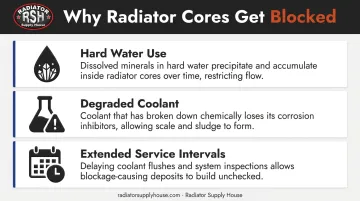
- Hard water use, which accelerates mineral scale formation in core passages
- Degraded coolant that has lost its corrosion inhibitors
- Extended service intervals that allow rust and sediment to accumulate
What Happens If This Problem Is Ignored
Without coolant circulating through the radiator, heat accumulates in the engine block and cylinder head. The temperature gauge climbs, coolant begins to boil, and the engine sustains heat damage that cooling down afterward cannot reverse.
Warning Signs You're Approaching Serious Failure
These signals appear before full overheating occurs. Catching them buys time to shut down safely:
- Temperature gauge rising or erratic — unstable readings mean heat isn't dissipating normally and won't self-correct
- Steam or sweet smell from the hood — coolant is boiling or venting under pressure
- No heat from the cab heater despite a warm engine — the heater core depends on coolant flow, so a cold lower hose typically means a cold cab
These aren't symptoms to monitor from the cab. Cat's service guidance lists overheating, steam, coolant vapor, and a sweet odor as indicators requiring immediate thermostat inspection. Freightliner's Cascadia Driver's Manual explicitly warns that low coolant leads to overheating and engine damage. Both OEMs are clear: pull over and diagnose before continuing operation.
How to Diagnose and Fix the Problem
Work through this in sequence, starting with the simplest checks. Always allow the engine to cool completely before opening the cooling system.
Check Coolant Level and Look for Leaks
Start here — it takes two minutes and costs nothing.
- **Inspect the coolant reservoir and radiator cap** for correct fluid level when cold
- Look for leaks at hose connections, the water pump housing, and the radiator itself
- Squeeze both hoses with the engine warm (not hot) — the upper hose should feel firm and hot; the lower hose should feel warm with some pressure if coolant is circulating
If the lower hose is completely limp and cold, circulation has stopped.
Low coolant is the easiest fix. Rule it out before touching anything else.
Test and Replace the Thermostat
A quick bench test confirms whether the thermostat is the problem:
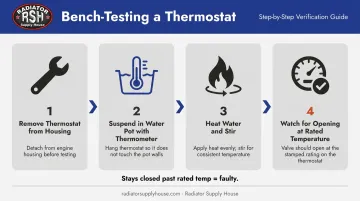
- Remove the thermostat from the housing
- Suspend it in a pot of water with a thermometer
- Heat the water and stir and watch for the thermostat to begin opening at its rated temperature (stamped on the housing)
- A thermostat that stays closed past its rated opening temperature is confirmed faulty
John Deere's technical documentation describes this bench test method for their industrial diesel engines. If the thermostat fails the test, replace it. This is typically one of the least expensive cooling system repairs, and it should be the first component swapped when coolant level is normal and no leaks are found.
Inspect the Water Pump
If the thermostat passes the bench test, the water pump is the next suspect. Look for these specific signs of pump failure:
- Coolant weeping from the weep hole on the pump body — this indicates seal failure
- Excessive shaft play or wobble when you grip and move the pulley
- Grinding or whining noise from the pump area under load
A pump with a corroded or broken impeller can spin without moving coolant: the shaft turns, but no coolant moves. If you confirm pump failure, note that on many engines water pump replacement is scheduled alongside timing belt service to reduce labor costs by consolidating the work.
Flush and Inspect the Radiator
If the thermostat and water pump check out but the lower hose stays cold, the radiator core is likely restricted.
- A radiator flush may restore flow in mildly scaled units
- A severely blocked core requires replacement — flushing cannot restore heavily corroded passages
For heavy equipment and commercial vehicles, sourcing the right replacement unit matters. Radiator Supply House carries OEM-equivalent ICEBOX-brand radiators for Caterpillar, Komatsu, John Deere, Freightliner, Kenworth, Peterbilt, and other major manufacturers — in both all-aluminum and copper-brass construction, available as complete assemblies or modular cores.
How to Prevent This Issue Long-Term
Most of the causes covered above don't appear overnight — they build gradually through skipped intervals, aging components, and slow leaks that go unnoticed. Staying ahead of them is straightforward if you treat cooling system maintenance as a scheduled task rather than a reactive one.
Routine maintenance eliminates the majority of these failures before they strand equipment:
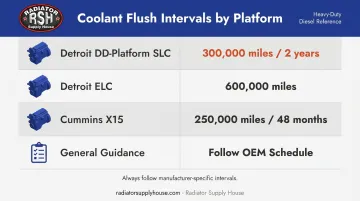
- Flush and replace coolant on the manufacturer's schedule — intervals vary by platform (Detroit DD-platform SLC: 300,000 miles or 2 years; Detroit ELC: 600,000 miles; Cummins X15: 250,000 miles/48 months). Use the interval specific to your engine and coolant type, not a generic estimate
- Inspect hoses and clamps at every major service — rubber hardens and cracks with age, and a failing clamp causes a slow leak that drops coolant levels with no obvious puddle
- Replace the thermostat proactively during water pump or timing belt service — thermostats are inexpensive — bundling them avoids a separate diagnostic visit later
- Monitor the temperature gauge on every trip, especially under load — a gauge that climbs earlier than usual in warm weather is an early warning, not a coincidence
Catching these issues at a scheduled service costs a fraction of what an overheated engine or blown head gasket will. The upper-hot, lower-cold symptom is almost always preventable with consistent attention to coolant condition and thermostat health.
Frequently Asked Questions
Why is my top radiator hose hot but the bottom is cold?
Hot coolant is entering the radiator at the top but not completing the loop — it's not flowing through the core and returning via the lower hose. The most common causes are a stuck thermostat, a failed water pump, or a severely blocked radiator restricting internal flow.
Should the upper and lower radiator hose be the same temperature?
No. The upper hose carries hot coolant from the engine; the lower hose returns coolant that has shed heat through the radiator, so it should be warm but noticeably cooler. A completely cold lower hose indicates a circulation failure, not a normal temperature differential.
Can I still drive if my lower radiator hose stays cold?
Don't drive it. The cooling system isn't circulating properly, and heat will accumulate in the block and cylinder head until you have an overheating failure. Identify and fix the cause before putting the machine back under load.
How do I know if my thermostat is stuck closed?
The temperature gauge climbs unusually high, the upper hose gets very hot and pressurized, and the lower hose stays cold. Confirm with a bench test: submerge the thermostat in heated water and verify it opens at the temperature stamped on its housing.
Can a bad water pump cause the lower radiator hose to stay cold?
Yes. A pump with a worn or cavitation-damaged impeller may spin without actually moving coolant through the radiator. The lower hose stays cold even when coolant levels are correct and the thermostat is functioning properly.
How often should I flush my coolant to prevent cooling system problems?
Follow your engine manufacturer's specified interval — these range from 2 years to 600,000 miles depending on the platform and coolant type. Generic schedules don't account for engine-specific chemistry, and using the wrong one accelerates scale buildup, corrosion, and inhibitor breakdown.