Introduction
The PACCAR MX-13 is the workhorse diesel behind thousands of Kenworth and Peterbilt trucks on the road today. Keeping it running cool depends on a tightly engineered network of hoses that most drivers never think about — until one fails.
A misrouted or deteriorated hose doesn't just leak coolant. It can trigger overheating, warp cylinder heads, or leave a truck stranded roadside, each costing a fleet real money in downtime.
Preventing that outcome starts with understanding exactly how the system connects. This guide walks through the MX-13's coolant hose routing path in plain language, covering every major connection point from the water pump to the deaeration tank. Whether you're troubleshooting an overheating code or replacing a hose after an engine-out repair, you'll know exactly what to check, where to check it, and where to source the right replacement part.
Key Takeaways
- The MX-13 loop holds roughly 13 gallons (49 liters), more with CARB aftertreatment
- Coolant flows through a pressurized loop: pump → block → thermostat → radiator → pump
- Bypass, EGR, and heater hoses branch off this main loop at specific points
- A documented composite fitting issue (TIB 42-056) affects certain 2014–2019 builds
- Always cross-check exact routing against VIN-specific PACCAR service documentation before repairs
PACCAR MX-13 Cooling System Overview
The MX-13 runs a pressurized coolant circuit designed to pull heat away from combustion and keep operating temperatures stable under heavy load. Coolant moves continuously between the water pump, engine block, thermostat housing, radiator, and a surge tank (often called the deaeration tank) that purges trapped air from the system.
Each subsystem has a distinct job:
- Water pump – pressurizes and circulates coolant through the block
- Thermostat – opens or closes based on temperature to control flow to the radiator
- Radiator – dissipates heat as coolant passes through its core
- Surge/deaeration tank – removes air bubbles and maintains system pressure
- EGR cooler – lowers exhaust gas temperature before it re-enters the intake
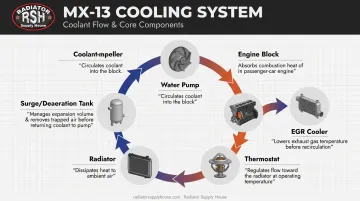
According to PACCAR's operator's manual, the MX-13 cooling system holds approximately 13 gallons (49 liters), though actual volume shifts with installed equipment: trucks with CARB-compliant aftertreatment need an extra 2.5 liters.
The system runs on a 15 psi minimum pressure cap, and factory fill is ethylene-glycol NOAT extended-life coolant meeting PACCAR's MAT74002 and ASTM D6210 standards. Nitrite-free OAT is also approved, but only when it meets the DAF 74002 spec.
Locating the Coolant Temperature Sensor
The coolant temperature sensor sits near the thermostat housing or coolant outlet on most MX-13 builds, a useful landmark when tracing hoses during diagnosis, though exact placement can vary slightly by build year. Confirm it against your truck's service documentation before assuming a location.
PACCAR MX-13 Coolant Hose Routing Diagram Explained
Without a hose lying flat in front of you, the easiest way to trace the MX-13's coolant path is to follow it in sequence. Start at the pump and work outward to the radiator and back.
Engine Block and Water Pump (Starting Point)
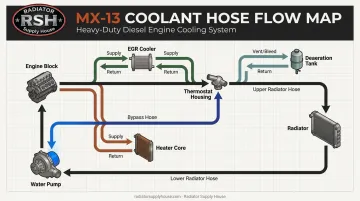
Coolant flow begins at the water pump, mounted on the engine and driven off the front accessory belt. An inlet hose feeds the pump from the lower radiator hose, and the pump pressurizes that coolant before pushing it into the engine block's internal passages, where it absorbs combustion heat.
Thermostat Housing and Bypass Routing
From the block, coolant reaches the thermostat housing on the cylinder head. Two things can happen here:
- Cold engine – the thermostat stays closed, and coolant recirculates through a short bypass hose back to the water pump instead of heading to the radiator
- Warm engine – once coolant hits operating temperature, the thermostat opens and routes hot coolant into the upper radiator hose
This is exactly why a truck idling on a cold morning won't show heat at the upper hose right away — the thermostat simply hasn't opened yet.
Radiator Upper and Lower Hose Path
The upper radiator hose carries hot coolant from the thermostat housing outlet to the top of the radiator tank. After the coolant cools as it passes through the core, the lower radiator hose returns it from the bottom tank back to the water pump inlet. Support brackets and clamps along this path keep both hoses from rubbing against the frame or chassis components during vibration.
Deaeration Tank and Reservoir Hose Connections
Two hoses connect to the deaeration (surge) tank:
- A vent/bleed hose running from the engine or thermostat housing, carrying air-entrained coolant up to the top of the tank
- A return hose feeding de-aerated coolant back into the lower circuit near the water pump inlet
This setup is what lets the system purge air automatically during operation, rather than requiring a manual bleed every time coolant is topped off.
EGR Cooler and Heater Core Hose Routing
Hot coolant is tapped from the engine block or coolant outlet and routed through the EGR cooler, where it pulls heat out of recirculated exhaust gas before that gas re-enters the intake. A return hose sends the coolant back into the block or main return circuit.
Heater hoses follow a similar pattern. A supply hose draws hot coolant from near the thermostat housing to the cab's heater core, while a return hose sends it back to the water pump inlet.
Key Coolant Hose Connection Points and Location Reference
Knowing where each hose lives makes inspection faster and reduces guesswork during a repair. Here's a quick reference:
- Upper radiator hose – runs from the thermostat housing to the radiator's top inlet; it's the largest-diameter hose in the system, making it easy to identify.
- Lower radiator hose – connects the radiator's bottom outlet to the water pump inlet, often with a spring insert to prevent collapse under suction at high RPM.
- Bypass hose – a short hose linking the thermostat housing to the water pump housing, easily missed during inspection since it's tucked close to the engine.
- EGR cooler lines – connect the engine block to the exhaust side, often using reinforced hoses to withstand constant heat cycling.
- Coolant temperature sensor – located near the thermostat housing/coolant outlet, serving as a landmark for tracing nearby hose runs during diagnosis
Exact port locations can shift slightly between MX-13 variants. Always confirm placement against your engine's build documentation or the illustrations available through PACCAR's MX Access parts and service platform before assuming a hose runs where a generic diagram shows it.
Common Coolant Hose Problems on the PACCAR MX-13
Most MX-13 hose failures fall into a few predictable categories:
- External cracking or dry rot on upper and lower radiator hoses from age and heat exposure
- Internal collapse of the lower hose, especially on versions without a spring insert
- Pinhole leaks at EGR cooler hose connections, driven by repeated heat cycling
- Composite fitting cracks: PACCAR's TIB 42-056 flags this issue on Kenworth units built 05/04/2015–05/20/2019 and Peterbilt units built 01/16/2014–05/17/2019; the fix swaps composite fittings for brass
Watch for white residue near clamps, low coolant warnings on the dash, or unexplained overheating. These are early tells.
Beyond material failures, misrouted hoses create their own headaches. A hose that kinks at a bend or brushes against a hot exhaust component wears out fast and restricts flow. This happens most often after engine-out repairs or aftermarket hose swaps where the technician didn't follow the factory routing.
One overlooked culprit: air pockets from improperly connected deaeration tank hoses. These can cause phantom overheating symptoms even when the coolant level in the tank looks completely normal.
Coolant Hose Inspection and Replacement Tips
A quick inspection routine catches most hose problems before they become breakdowns. Do this at every major service interval or any time the cooling system is opened:
- Squeeze test – feel for stiffness or mushiness along the hose length
- Visual check – look for swelling, cracking, or oil contamination on the outer surface
- Clamp inspection – check for corrosion, looseness, or improper seating
When replacing a hose, drain the cooling system first. Reference the factory routing diagram, available through PACCAR's MX Access RMI platform or your engine service manual, rather than relying on generic aftermarket diagrams — routing can vary by build. Torque hose clamps to spec where applicable.
For sourcing OEM-equivalent replacement hoses and other cooling system components for the MX-13, Radiator Supply House stocks a broad inventory of heavy-duty truck cooling parts, including hoses, clamps, and coolant.

Once the new hose is installed, refill with PACCAR-specified NOAT (or approved OAT) coolant and bleed air through the deaeration tank cap. Run the engine until the thermostat opens, then do a final level check.
Frequently Asked Questions
What are the two hoses connected to the coolant reservoir?
The vent/bleed hose carries air-entrained coolant from the engine or thermostat housing into the top of the reservoir. The return hose feeds de-aerated coolant back into the lower circuit near the water pump.
How many gallons of coolant does a PACCAR MX-13 hold?
The system holds approximately 13 gallons (49 liters), though this varies by installed equipment. Trucks with CARB-compliant aftertreatment require roughly 2.5 liters more.
Where is the coolant temperature sensor on a PACCAR MX-13?
It's typically located near the thermostat housing or coolant outlet on the top or front of the cylinder head. Confirm the exact position against your engine's service documentation, since it can shift slightly by build.
What type of coolant does a PACCAR MX-13 use?
PACCAR specifies ethylene-glycol NOAT coolant meeting MAT74002 and ASTM D6210, or nitrite-free OAT meeting DAF 74002. Mixing more than 25% of a different formulation risks corrosion and complicates warranty claims.
How do I know if my PACCAR MX-13 has a coolant hose leak?
Look for visible coolant pooling under the truck, staining near hose clamps, a falling reservoir level, or a low-coolant/overheating warning on the dash. Catching these early prevents serious engine damage.
How often should coolant hoses be replaced on a PACCAR MX-13?
PACCAR doesn't publish a fixed hose replacement mileage — instead, it calls for radiator hose inspection at Interval C (150,000 miles normal duty, 60,000 miles severe duty). Replace any hose showing stiffness, cracking, swelling, or leakage regardless of mileage.