This guide covers the typical weight ranges you'll encounter across Class 8 applications, the variables that push those numbers up or down, and a brand-by-brand reference table built from verified supplier listings. If you're sourcing a replacement radiator for a Freightliner Cascadia, Kenworth T680, Peterbilt 389, or any of the other common platforms, this is the planning data you need before you order.
Key Takeaways
- Catalog weights for Class 8 radiators span 40 to 139 lbs — no single universal figure applies
- Aluminum radiators are 40–60% lighter than copper-brass units of comparable size
- Framed radiator assemblies often weigh nearly twice as much as a bare core for the same platform
- Brand, model year, engine package, and part scope all drive significant weight differences
- Confirm whether a listed weight covers a bare core, full assembly, or packaged shipping unit before scheduling freight or installation
How Much Does a Semi Truck Radiator Weigh?
Typical Dry Weight Range
The short answer: supplier-listed weights for Class 8 semi truck radiators run from roughly 40 to 139 lbs, depending on the platform, material, core size, and what's included in the part.
"Dry weight" refers to the radiator without coolant — the figure most commonly listed on spec sheets and freight invoices. It's what you'd lift off the truck after draining the system.
Most suppliers label their weight field simply as "Weight" without specifying dry or packaged, so treat any catalog figure as an approximation until the vendor confirms what it includes.
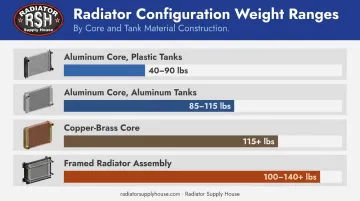
Here's how the numbers break across common configurations:
| Configuration | Typical Supplier-Listed Weight |
|---|---|
| Aluminum core, plastic tanks (Class 8) | 40–90 lbs |
| Aluminum core, aluminum tanks (Class 8) | 85–115 lbs |
| Copper-brass core (Class 8) | 115+ lbs |
| Framed radiator assembly | 100–140+ lbs |
Medium-duty trucks (Class 6–7) like the Freightliner M2 106 will typically fall below the Class 8 range, though one verified Northern Radiator listing for a 2008–2018 M2/106 comes in at 115 lbs — so confirm your vehicle class before using any estimate for planning purposes.
Weight When Filled With Coolant
Dry weight only tells part of the story. Once filled, coolant adds meaningful mass — and knowing that number matters for safe handling and freight planning. 50/50 premixed coolant has a relative density of approximately 1.07, which equals approximately 2.23 lbs per quart (1.07 kg/L).
For a Volvo VN with a D13 and manual transmission, Volvo specifies a total cooling system capacity of 35 liters (9.2 gallons). At that density, the full system fluid load weighs approximately 82.6 lbs — but that's the entire cooling circuit, not just what's inside the radiator itself.
Keep these points in mind when using that figure:
- Don't add full system coolant weight to bare radiator weight and call it the installed handling weight — the radiator holds only a portion of total system fluid.
- Always drain the system fully before removing the radiator. The Freightliner Cascadia Maintenance Manual instructs technicians to open drain plugs at the radiator side tank and lower outlet-pipe elbow before pulling the unit. This keeps handling weight at the dry figure and prevents coolant spills.
What Factors Affect Semi Truck Radiator Weight?
Four variables drive most of the weight difference between one radiator and another.
Core Material
Material is the single biggest factor. According to Northern Radiator, aluminum heavy-duty replacements are 40–60% lighter than equivalent copper-brass products. The density difference is substantial: aluminum runs about 2.70 g/mL versus copper at 8.96 g/mL. Finished-radiator weight ratios differ, though, because tube geometry, fins, solder, and tanks all factor in.
Modern Class 8 trucks overwhelmingly use aluminum cores. Copper-brass units remain available for older platforms and certain specialty applications where field repairability is a priority, but they carry a real weight penalty.
Core Dimensions and Row Count
A larger core means more tubes, more fins, and more tank material. Height, width, and depth all contribute linearly to weight. A radiator sized for a 600-hp engine will be physically larger, and heavier, than one sized for a 400-hp application.
Row count adds depth and weight. A dual-row or triple-row core is measurably heavier than a single-row unit of the same face dimensions, though the exact increment varies by manufacturer and core design.
Tank Construction
Tank material is a secondary but real weight factor:
- Plastic (polymer) tanks — lightest option; common on modern aluminum-core radiators
- Aluminum tanks — heavier than plastic, lighter than steel or brass
- Steel or brass tanks — heaviest; typical on older copper-brass core units
Bare Core vs. Complete Assembly
This distinction causes the most planning errors. A bare replacement radiator core with tanks is lighter than an assembly that ships with a shroud, mounting frame, transmission cooler, or charge air cooler already attached.
The International LT listings illustrate the gap clearly:
| Configuration | Weight |
|---|---|
| Replacement radiator (bare, one supplier) | 60 lbs |
| LKQ radiator assembly with framework | 108 lbs |
That 48-lb difference reflects different part records from different suppliers, so the full gap can't be attributed solely to the frame. Even so, the gap is significant enough to affect freight costs and installation logistics.
When comparing specs across suppliers, confirm whether the weight cited covers the same scope of hardware. Radiator Supply House carries both bare-core radiators and complete cooling package assemblies, including configurations with radiator, charge air cooler, shroud, and mounting hardware, across Freightliner, Kenworth, Peterbilt, and other Class 8 platforms.
Semi Truck Radiator Weight by Popular Brand and Model
Weight varies widely across platforms — and even within the same brand — depending on model year, engine configuration, and supplier. The table below reflects supplier-listed weights from aftermarket and OEM sources. None of these values are confirmed as "dry weight only," so verify scope before ordering.
| Platform | Supplier-Listed Weight | OEM/Aftermarket | Notes |
|---|---|---|---|
| Freightliner Cascadia | 40 lbs | OEM-branded (Freightliner) | Part A05-19870-014; configuration-specific |
| Freightliner Cascadia | 115 lbs | Aftermarket (Northern #238611) | 2007–newer; different part, different weight |
| Freightliner Columbia | 59 lbs | Aftermarket (Mill Supply #239285) | 2004–2007 Century/Columbia with CAT 13/15 |
| Kenworth T680 / Peterbilt 579 | 85 lbs | Aftermarket (BESTfit aluminum) | Shared application |
| Kenworth T680 / Peterbilt 579 | 139 lbs | Genuine PACCAR | Plastic-tank/aluminum-core; fits multiple KW/Pete platforms |
| Kenworth W900 | 115 lbs | Aftermarket (Northern #238638) | Listed for T600/W900 |
| Peterbilt 389 | 90 lbs | Aftermarket (Northern #222239) | Listed for 377/378/385/387/388/389 |
| Volvo VNL | 115 lbs | Aftermarket (Northern #239047) | 2008–2014 VNL/VNM |
| Mack CX/CXU | 54 lbs | Aftermarket | 2015 MP8 12.8L application |
| International LT | 60 lbs | Aftermarket | Bare radiator, 2017–present |
| International LT | 108 lbs | Aftermarket (LKQ assembly) | Radiator with framework |
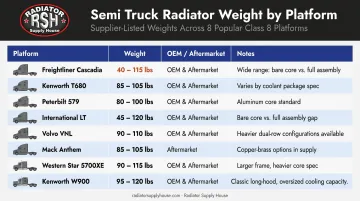
The Cascadia entries alone span 40 to 115 lbs — the same model, two different parts. A Cascadia spec'd with a DD15 may use a larger core than one with a DD13, and model year changes have introduced different part numbers over time. Always verify against your specific VIN or part number rather than relying on model-level estimates.
OEM vs. aftermarket sourcing is noted in the table above — weight differences between the two typically come down to material choices or core design variations.
Why Radiator Weight Matters for Replacement and Shipping
Freight Classification and Shipping Costs
Semi truck radiators typically ship via LTL (less-than-truckload) freight. Under the NMFTA's current density-based classification system, freight class is determined by dividing total handling-unit weight — including pallet and packaging — by the outermost cubic dimensions in feet.
A 90-lb bare radiator core and a 108-lb framed assembly will occupy different dimensional footprints and produce different freight invoices, even before accounting for packaging. The gap can be substantial. One Peterbilt parts retailer lists $400 shipping on multiple radiator pages — but freight costs vary by origin, destination, carrier, and packaging, so that figure shouldn't be treated as a market average.
For accurate freight cost planning:
- Get the packaged gross weight and outer dimensions from the supplier, not just the catalog weight
- Verify the current NMFC item classification for your specific part
- Ask whether the weight listed is net product weight or packaged shipping weight
Installation and Safe Handling
At 85 to 139 lbs, most Class 8 radiators already exceed what a single technician should handle manually — and that's before accounting for the awkward size and reach involved in removing one from a truck.
OSHA sets no fixed legal maximum for manual lifts, but the NIOSH lifting equation puts the ideal-condition load constant at 51 lbs — reduced further by reach, asymmetry, and grip. A shop pulling a 100+ lb radiator out of a Kenworth should plan accordingly:
- Two-person minimum for any bare core in this weight range
- Mechanical assistance (engine hoist, shop crane, or forklift) for heavier framed assemblies
- Full coolant drain before removal — keeping the dry weight also eliminates spill risk
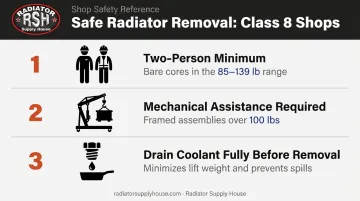
Framed assemblies arrive pre-assembled and simplify installation, but their added weight and bulk make mechanical handling even more critical to plan ahead.
Frequently Asked Questions
How much does a radiator weigh?
Radiator weight varies widely by vehicle type. Passenger car radiators typically weigh 10–15 kg (roughly 22–33 lbs) without coolant. Semi truck radiators are a different category entirely — supplier-listed weights for Class 8 applications run from 40 to 139 lbs, depending on material, core size, and whether the part is a bare core or an assembly.
How much does a semi truck radiator weigh with coolant?
Add approximately 2.23 lbs per quart of 50/50 coolant to the dry radiator weight. The radiator itself holds only a portion of the total system capacity — a Class 8 cooling system can hold 35+ liters overall. Always drain fully before removal to keep lifting weight manageable and avoid spills.
Does aluminum or copper-brass weigh more in a semi truck radiator?
Copper-brass radiators are heavier — 40–60% more than aluminum units of comparable size, according to Northern Radiator's published comparison data. Aluminum is the modern standard for weight efficiency and heat rejection. Copper-brass remains an option for older platforms where field repairability matters, but the weight trade-off is real.
How many people does it take to remove and install a semi truck radiator?
Plan on a two-person team for any Class 8 radiator removal. For complete assemblies in the 100+ lb range, use a shop crane, engine hoist, or forklift — the awkward dimensions make handling harder than raw weight alone suggests.
How much does it cost to replace a semi truck radiator?
Observed aftermarket prices range from roughly $600 to $2,600 depending on platform, supplier, and whether the part is OEM-branded or aftermarket. A Northern Radiator Volvo/Mack unit lists around $603, while a genuine PACCAR T680/579 listing runs approximately $2,599. These are individual listed prices — verify current pricing for your specific part number with a specialized supplier like Radiator Supply House before planning your budget.
What is the difference between a semi truck radiator and a complete cooling module?
A bare radiator is the heat exchanger core with tanks. A complete cooling module adds the charge air cooler, shroud, and mounting frame as a pre-assembled unit — the International LT example shows a jump from 60 lbs (bare) to 108 lbs (framed assembly). The two carry different part numbers and different freight costs.