That gap in understanding leads to real problems: skipped maintenance, incorrect upgrades, and failures that could have been caught early.
This guide explains exactly how a radiator-mounted transmission cooler works — the fluid path, the heat exchange mechanism, and why coolant-based designs behave differently from air-cooled alternatives under real operating conditions.
Key Takeaways
- A radiator transmission cooler uses engine coolant — not outside air — to regulate ATF temperature
- Hot fluid enters the cooler, transfers heat through a metal wall to surrounding coolant, and returns cooled to the transmission
- Coolant buffers ATF temperature in both directions — warming cold fluid at startup, limiting heat spikes under load
- Airflow-dependent external coolers lose effectiveness at low speeds, when loaded transmissions need cooling most
- Contamination from a failed cooler (ATF mixing with coolant) requires immediate shutdown and full system inspection
What Is a Radiator Transmission Cooler?
A radiator transmission cooler is an in-radiator oil-to-water heat exchanger (a metal tube or plate assembly built into the radiator) designed to cool automatic transmission fluid (ATF) using surrounding engine coolant as the heat transfer medium.
Automatic transmissions have no dedicated cooling circuit of their own. Heat builds through hydraulic activity, clutch friction, and fluid shear — and without intervention, ATF temperatures climb to damaging levels. The radiator-mounted cooler provides an integrated, low-overhead solution using the existing cooling infrastructure.
What It Is Not
Two points operators frequently confuse:
- Fluid separation: Under normal operating conditions, ATF and engine coolant remain completely separated — transmission fluid travels through an internal tube or plate channel, while coolant surrounds it on the outside. A failure that breaches this barrier is a serious event (covered in the failure section below).
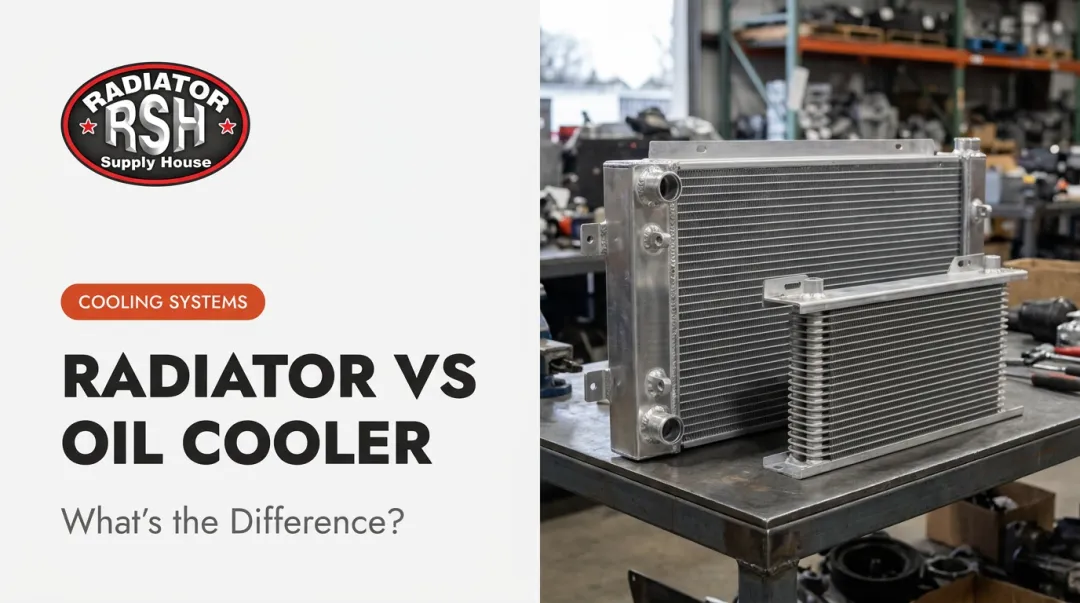
- Not an auxiliary cooler: An auxiliary cooler is air-cooled, mounted outside the radiator in the airstream. The two operate on different principles and serve different roles — they are not interchangeable.
Cooler Design Variations
SAE technical research on oil/coolant heat exchangers identifies two primary designs used across heavy-duty applications:
- Plate-type: Stacked metal plates create multiple narrow channels, maximizing surface area for heat transfer in a compact footprint — common in construction and agricultural equipment
- Tube-bundle type: One or more fluid-carrying tubes run through the coolant tank; simpler to manufacture and easier to inspect for leaks
- OEM variation: The configuration inside any given radiator is application-specific — no single design dominates across all platforms
Both designs achieve the same result through different geometries, and both are susceptible to the same failure modes.
How Does a Radiator Transmission Cooler Work?
The process runs as a continuous, passive loop: hot ATF enters the cooler, gives up heat to the cooler engine coolant surrounding it, and exits at a reduced temperature. The two fluids never contact each other under normal operating conditions.
Fluid Flow Initiation
The transmission's internal hydraulic pump — a positive-displacement gear pump in heavy-duty automatics like the Allison 3000/4000 series — generates the pressure that moves ATF out of the transmission case and through cooler lines to the radiator. This flow is continuous whenever the vehicle or equipment operates under load.
The fluid arriving at the cooler inlet is the hottest ATF in the system: it's coming directly from post-friction, post-valve-body activity inside the transmission. That inlet temperature is what the cooler must manage.
Core Heat Exchange Process
Inside the radiator, ATF travels through the cooler's internal channels, surrounded on all sides by engine coolant. Because the transmission fluid arrives hotter than the coolant at operating temperature, heat transfers through the metal wall from ATF into coolant. The coolant then carries that heat to the radiator core, where airflow from vehicle motion or the engine fan rejects it to atmosphere.
Two factors drive how efficiently this works:
- Surface area — more contact between the cooler tube/plate and surrounding coolant means faster heat transfer
- Flow rate — continuous movement of both fluids prevents heat saturation and keeps exchange consistent
Temperature Regulation Through Coolant Buffering
The coolant environment provides something an air-cooled external cooler cannot: bidirectional temperature control.
- At cold startup, the engine coolant warms faster than the transmission fluid. The cooler transfers that warmth into ATF, helping seals and valve components reach proper operating viscosity sooner — reducing cold-start wear.
- Under heavy load, the coolant acts as a ceiling. Because engine coolant is thermostat-regulated, it stays within a defined temperature band during normal operation. That regulated temperature limits how hot the ATF can get through this cooler — making it a controlled system, not just a passive one.
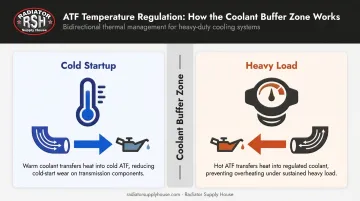
This buffering effect is a structural advantage. The radiator cooler removes heat and regulates ATF temperature within a managed range — in both directions, across all operating conditions.
Radiator Transmission Cooler vs. External Auxiliary Cooler
Understanding the difference between these two designs matters when deciding whether your current setup is adequate.
How an External Cooler Works
An auxiliary air-to-liquid cooler mounts in the airstream — typically ahead of the radiator or AC condenser — where airflow passing over external fins pulls heat from ATF running through internal tubes or plates. No coolant is involved; heat transfers entirely through ambient airflow.
The Core Functional Difference
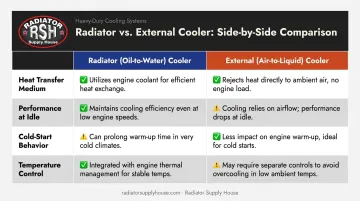
| Factor | Radiator (Oil-to-Water) Cooler | External (Air-to-Liquid) Cooler |
|---|---|---|
| Heat transfer medium | Thermostat-regulated engine coolant | Ambient airflow (variable) |
| Performance at idle | Continues via coolant circulation | Minimal — airflow drops sharply |
| Cold-start behavior | Warms ATF via coolant | No warming effect |
| Temperature control | Regulated (bounded by coolant temp) | Unregulated |
The Low-Speed Problem
Transmission Digest documents a specific scenario that exposes the external cooler's limitation: steep-grade climbing under heavy load generates significant converter heat while lower road speed simultaneously reduces the airflow available to an air-cooled unit. The demand peaks at exactly the moment the supply falls.
Consider a loaded truck or construction machine climbing a long grade in low gear. The torque converter is generating heat rapidly, yet road speed may be just 5–10 mph. At that speed, an air-cooled auxiliary cooler runs at a fraction of its rated capacity.
The radiator-mounted cooler, by contrast, keeps exchanging heat through coolant circulation regardless of road speed.
The Optimal Configuration for Heavy-Duty Work
For most standard fleet and equipment operations, the radiator-mounted cooler handles the job adequately. For high-demand applications — sustained towing, grade work, high-cycle hydraulic equipment — the preferred setup combines both:
- Radiator cooler first: handles baseline temperature regulation and cold-start warming
- Auxiliary cooler second: provides supplemental reduction during peak thermal loads
Transmission Digest notes that many auxiliary cooler GVW ratings assume use in addition to, not instead of, the OEM cooler — so size any standalone external unit accordingly.
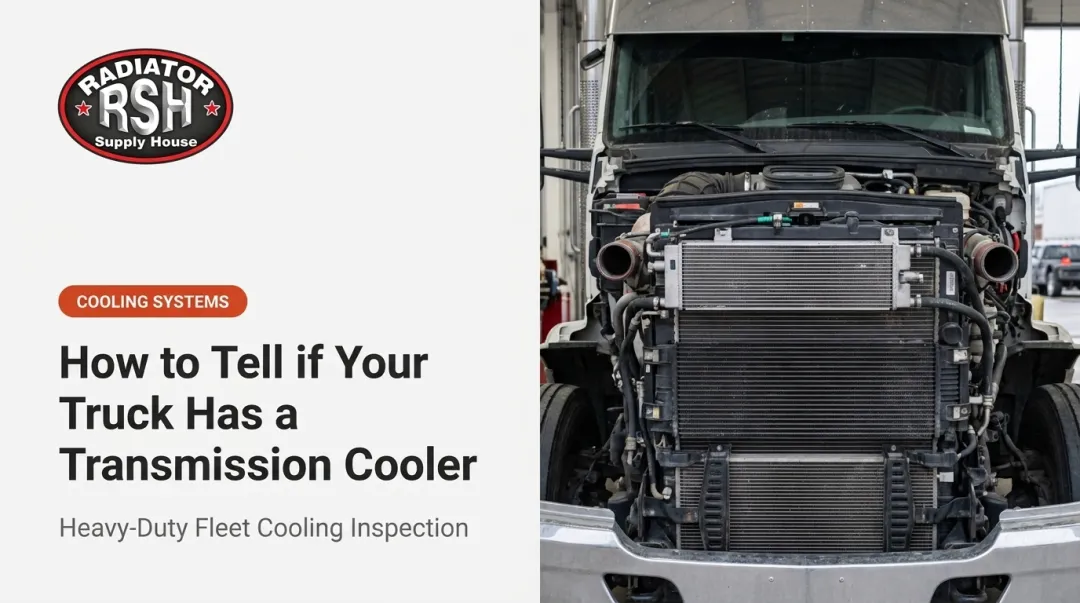
Radiator Supply House stocks replacement radiators with integrated cooler tanks for heavy-duty truck platforms including Freightliner, Kenworth, and Peterbilt, as well as standalone transmission oil coolers for Caterpillar, John Deere, Case, and other major equipment brands — including units designed to support dual-cooler configurations.
When Is an Auxiliary Cooler Necessary?
The built-in radiator cooler is engineered for the vehicle's or machine's rated operating conditions. Push beyond those conditions regularly, and it will fall short.
Operational Thresholds That Indicate an Undersized Cooler
- Sustained heavy towing at or near maximum rated capacity
- Extended operation on steep grades in low range
- High-cycle hydraulic work: excavation, compaction, agricultural loading
- High ambient temperature environments where the coolant itself runs warmer
For Allison 3000/4000 series transmissions, published specifications define normal sump fluid at 160–200°F and normal converter-out fluid at 180–220°F, with sump overtemperature defined at 250°F. These are measurement-specific values — converter-out temperature at the cooler inlet rises much faster than sump temperature during stall or heavy-load events.
If operation consistently pushes toward the upper end of these ranges, add an auxiliary cooler.
Field Indicators the Cooler Is Not Keeping Up
- Delayed or sluggish gear engagement after extended high-load operation
- Burnt smell from transmission fluid despite a recent fluid service
- Fluid that appears dark or degraded before the scheduled change interval
Critical: Don't Bypass the Radiator Cooler
Adding an external auxiliary cooler should complement the radiator-mounted unit — not replace it. Removing or bypassing the internal cooler eliminates the temperature buffering function, exposing the transmission to both over-cooling at startup and under-cooling at peak loads.
Signs Your Radiator Transmission Cooler Is Failing
Cooler failure is one of the more costly deferred maintenance scenarios in heavy equipment and commercial trucking. Catching it early limits the damage to one system rather than two.
Primary Failure Mode: Fluid Crossover
When the internal barrier between ATF and coolant is breached — through corrosion, physical damage, or fitting failure — the two fluids mix. Allison's contamination documentation identifies the following observable indicators:
- Cloudy, gray, pink, or "strawberry milkshake" colored ATF
- Oil visible in the radiator or coolant reservoir
- Milky white material in the transmission pan
- Blistered or wrinkled spacer-plate gaskets
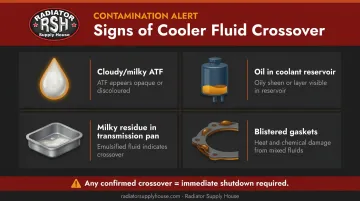
Allison's specification allows no glycol and no more than 0.2% water by volume in transmission fluid. Contamination above those thresholds requires complete disassembly and replacement of seals, gaskets, clutch plates, and bearings.
Caterpillar's fluid analysis guidance notes that oil or fuel in coolant significantly impairs heat transfer — meaning contamination hits both the transmission and engine cooling at once.
Secondary Symptoms: Cooling Loss Without Visible Contamination
Not every cooler failure results in visible fluid mixing. A degraded cooler can show these signs without a breach:
- Sluggish or erratic shifting under load
- Overheating indicators activating during conditions that previously caused no issue
- Transmission slipping under load
- Burnt ATF smell despite recent fluid service
When to Inspect
Inspection is condition-triggered rather than interval-based in most OEM guidance. Inspect the cooler system whenever ATF shows abnormal color or odor, coolant shows discoloration or an oily surface film, or shifting behavior changes without a clear mechanical cause.
Pressure-testing the cooling system is the appropriate next step to confirm whether the integrated cooler is the contamination source.
Frequently Asked Questions
Is a radiator-mounted transmission cooler enough, or do I need an auxiliary cooler?
The radiator cooler is sufficient for standard fleet operations running within rated load conditions. An auxiliary cooler becomes necessary when the machine regularly operates under sustained heavy load, towing, or steep grades where ATF consistently approaches the upper end of the manufacturer's specified temperature range.
Where is the best place to install a transmission cooler?
Mount an auxiliary cooler where it gets consistent airflow, and plumb it to receive fluid after it exits the radiator's internal cooler. That way, the radiator handles primary regulation while the auxiliary unit steps in during peak load events.
How can I tell if a transmission cooler is working?
A functioning cooler keeps ATF within the manufacturer's recommended range under load. Signs of failure or inadequacy include:
- Transmission overheating warnings
- Erratic or delayed shifting
- Milky coolant indicating fluid crossover
- Burnt-smelling ATF despite recent service
Does idling help cool a transmission?
The radiator-mounted cooler remains effective at idle because it exchanges heat through coolant circulation regardless of vehicle speed. An auxiliary air-cooled unit provides minimal cooling at idle — airflow drops to near zero, limiting its usefulness in stationary high-load conditions.
What temperature should transmission fluid be in a radiator cooler?
For Allison 3000/4000 transmissions, normal sump temperature runs 160–200°F and converter-out fluid (entering the cooler) runs 180–220°F under normal operation. These are measurement-point-specific values — consult your transmission's service manual for the exact normal range and overtemperature thresholds applicable to your unit.
Can a radiator transmission cooler leak transmission fluid into the coolant?
Yes. Corrosion, physical damage, or fitting separation can allow ATF and coolant to mix, contaminating both systems. Allison's limits allow no glycol in ATF — any confirmed crossover requires immediate shutdown, pressure testing, and a full transmission inspection before returning to service.
Conclusion
The radiator transmission cooler works through a simple but deliberate principle: thermostat-regulated engine coolant acts as the heat transfer medium, keeping ATF within a safe operating range — warming it at startup and cooling it under load. That dual-directional control is what separates it from a standalone air-cooled unit.
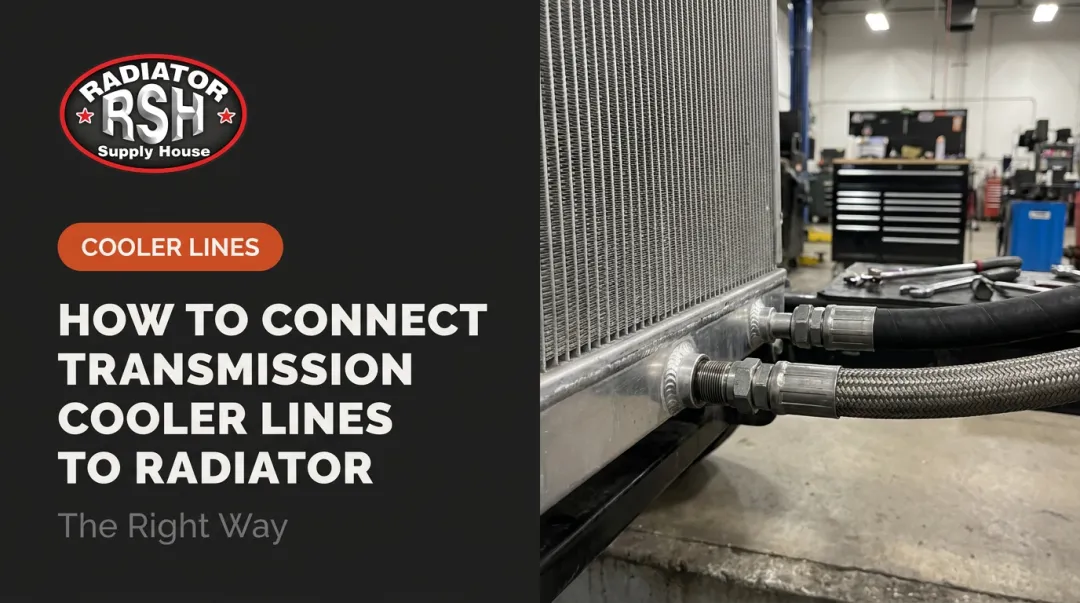
Understanding why the internal cooler outperforms external-only setups at low speeds, when an auxiliary cooler is worth adding, and what contamination or cooling-loss symptoms look like — that's the foundation for protecting a transmission before damage becomes irreversible. For fleet operators and repair shops sourcing replacement coolers or transmission oil cooler lines, Radiator Supply House stocks components across heavy equipment and commercial truck applications, including hard-to-find parts for Caterpillar, Komatsu, Freightliner, and Kenworth machines.