A radiator stop leak product won't replace a proper repair, but the right one can buy you enough time to get off the highway, reach a shop, or schedule a planned fix instead of an emergency one. The key word is right — not every stop leak is built for a 50-quart diesel cooling system running at 15 psi.
This guide covers the best stop leak products for semi trucks, what separates heavy-duty formulas from passenger car products, and when stop leak isn't enough.
Key Takeaways
- Semi truck cooling systems require heavy-duty stop leak formulas — passenger car products lack the sealing power for large-volume, high-pressure diesel systems
- K-Seal HD is the top verified pick for commercial vehicles; Bar's Leaks HDC/J-100 leads for fleet use
- Verify coolant chemistry compatibility before adding any stop leak product to your system
- Stop leak works on pin-hole leaks and minor seeps, not structural cracks or large failures
- When stop leak doesn't hold, a replacement radiator is the only reliable fix
Why Semi Truck Cooling Systems Demand Specialized Stop Leak Products
The Scale Difference
A typical passenger car holds 8 to 12 quarts of coolant. A PACCAR MX-13 holds approximately 52 quarts; a Volvo D13 chassis holds between 37 and 47 quarts depending on transmission. That volume difference changes how stop leak products behave — and not in your favor if you're using a consumer-grade formula.
Consumer-grade stop leaks are calibrated for small, low-pressure systems. Introduced into a commercial diesel cooling system, they may:
- Dilute too much to reach effective concentration at the leak site
- Fail to generate sufficient seal mass under the higher pressure differential
- Circulate harmlessly without bonding if the flow rate exceeds the product's design parameters
Both the PACCAR MX-13 and Cummins X15 specify a 15 psi minimum pressure cap — a meaningful threshold that separates commercial diesel systems from lighter-duty applications.
OEM Coolant Chemistry Matters
Before adding any stop leak product to a semi truck, confirm it's compatible with the coolant already in the system:
- Freightliner/Detroit engines require coolants meeting Detroit 93K217, typically heavy-duty nitrite-free OAT ELC
- PACCAR MX engines (Kenworth, Peterbilt) specify OAT ELC, nitrite-free
- Volvo uses VCS2, a POAT formulation — and Volvo's own driver guide states: "Do not mix the Coolant with any additives"
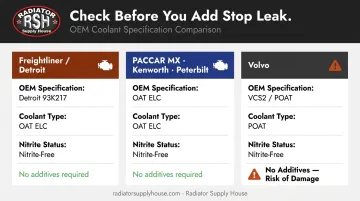
Fleet operators running Volvo trucks should consult their dealer before adding any chemical treatment. Not every stop leak will damage a Volvo cooling system, but the OEM's own guidance is explicit — and warranty implications are real.
Which Leaks Are Candidates for Stop Leak
Stop leak products are designed for specific failure types. Use them for:
- Pin-hole leaks in radiator cores
- Minor seepage at hose connections or fittings
- Small weeps from water pump seals
Do not attempt stop leak treatment on:
- Large visible cracks in tanks or cores
- Physical damage to the radiator structure
- Rapid coolant loss (system draining in 15 minutes or less)
- Confirmed head gasket failures requiring mechanical repair
Best Radiator Stop Leak Products for Semi Trucks
Two products have clear, verifiable heavy-duty credentials for semi truck applications. A third carries meaningful fleet-use evidence. The others commonly mentioned online lack current manufacturer documentation confirming Class 6-8 suitability. That distinction matters when you're treating a 50-quart cooling system.
The three worth considering for semi trucks:
- K-Seal HD — explicitly rated for HGVs and commercial vehicles, best-documented option
- Bar's Leaks J-100 — fleet-formula tablets with OAT/HOAT compatibility verified
- BlueDevil Radiator & Block Sealer — particle-free chemical bond, diesel-compatible but no HGV rating
K-Seal HD (Heavy Duty)
K-Seal HD is explicitly designed for HGVs, tractors, heavy plant, and commercial vehicles rather than a passenger car formula upsized for trucks. It's the most clearly verified semi truck stop leak product on the market with current manufacturer documentation.
The sealing mechanism uses a suspension of ceramic microfibers and copper particles that circulate through the coolant and coagulate around a leak site when exposed to heat and pressure. Per the manufacturer, no system flushing is required after use.
| Category | Detail |
|---|---|
| Compatibility | Compatible with all coolant types per manufacturer; does not enumerate OAT/HOAT/IAT separately. No named US engine brands (Cummins, Detroit, PACCAR) on packaging. |
| Sealing Capacity | Holes up to 0.635 mm (0.025 in) diameter; cracks up to 0.254 mm (0.01 in) wide × 12.7 mm (0.5 in) long |
| Limitations | Leaks draining a system in ~15 minutes are too severe; if unsealed after 10 days, unlikely to improve |
| Size / Price | 16 fl oz (SKU ST5516/K5516); approximately $26.99 at O'Reilly Auto Parts |
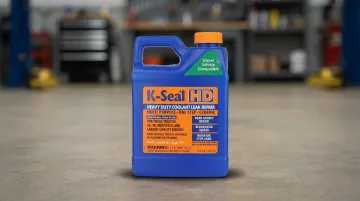
Note: Single-truck dosage for a 50-quart system is not specified by the manufacturer. Contact K-Seal directly or check packaging for large-system dosing guidance.
Bar's Leaks HDC / J-100 (Fleet Formula)
Bar's Leaks produces a family of heavy-duty cooling system treatments under the HDC, J-100, T-1000, and T-2000 labels. The J-100 Professional SKU is explicitly intended for fleet and over-the-road vehicles.
It carries verified compatibility across conventional silicate, OAT, and HOAT coolants, covering the three chemistries most common in commercial diesel systems.
The J-100 uses dissolvable tablet format (100 5-gram tablets per jug), with an initial dose of 4 tablets per gallon of system capacity. For a 50-quart system (~12.5 gallons), that calculates to approximately 50 tablets — the tablet format handles that volume cleanly without measuring errors.
| Category | Detail |
|---|---|
| Compatibility | Conventional silicate, OAT/HOAT ELC; safe for aluminum, other metals, plastics, hoses |
| Sealing Capacity | Claims 0.025-in round holes and 0.015-in slots/cracks (per J-100 PDS) |
| Approvals | GM, Ford, Chrysler references listed; no Class 6-8 OEM certification documented |
| Size / Price | 100-tablet jug; retail price varies by supplier — check AutoZone or fleet supply accounts |
Important: The detailed product data sheet available is for the J-100 fleet SKU, not the HDC retail package specifically. Verify dosing instructions on your actual product label before treatment.
BlueDevil Radiator & Block Sealer
BlueDevil's Radiator & Block Sealer uses a non-particulate, liquid chemical-bonding formula that seals at the leak site when exposed to air. The manufacturer confirms diesel compatibility and marks it safe for all antifreeze types, plastic, aluminum, and metal radiators.
Its key differentiator from particle-suspension products is reduced risk of debris accumulation in narrow cooling passages. That matters in complex diesel cooling circuits where turbo oil coolers and aftercoolers are in the loop.
| Category | Detail |
|---|---|
| Compatibility | Diesel-compatible per manufacturer; all antifreeze types; no Class 6-8 or HGV rating found |
| Formula | No solids/particles; chemical bonding at leak site; permanent repair claim |
| Size | 16 oz bottle |
| Limitation | No commercial dosing guidance for 40-50+ quart systems; multiple bottles may be needed |
For semi truck use, treat BlueDevil as a backup option: reach for it when K-Seal HD isn't available and the failure is a confirmed pinhole in the radiator core. Skip it for complex system failures or multi-point leaks.
How We Chose the Best Radiator Stop Leak Products for Semi Trucks
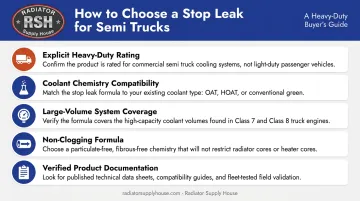
Products were evaluated against criteria that matter specifically for Class 7-8 applications:
- Explicit heavy-duty or commercial vehicle rating from the manufacturer
- Coolant chemistry compatibility with OAT, HOAT, and ELC formulations used in Detroit, PACCAR, Cummins, and Volvo engines
- Ability to treat large-volume systems (37–52+ quarts) without dilution failure
- Non-clogging formulas that won't restrict coolant flow through complex passages
- Verified product documentation , including spec sheets and compatibility data
One pattern worth flagging: fleet operators commonly grab a consumer-grade stop leak off a truck stop shelf, a product calibrated for a 10-quart passenger car system, and introduce it into a 50-quart commercial diesel cooling system. The result is usually no effect at all — or partial restriction of a coolant passage that creates a new problem. Every product above was selected because it meets documented heavy-duty suitability standards, not just general automotive use.
When stop leak isn't enough: If the gap is too large, the location is wrong, or system pressure keeps defeating the seal, a direct radiator replacement is the correct answer. Radiator Supply House stocks replacement radiators for Freightliner, Volvo, Kenworth, and Peterbilt under their ICEBOX brand, engineered as direct OEM-equivalent replacements with model-specific fitment. Options include aluminum construction, copper-brass cores, and complete assemblies, depending on the truck model and application.
Conclusion
Radiator stop leak products are a legitimate tool for semi truck operators. Used correctly — on the right type of leak, with the right formula — they can buy time between a roadside breakdown and a planned repair. That matters when you're 200 miles from the nearest shop.
That said, stop leak is not a substitute for proper diagnosis. A leaking radiator on a Class 8 truck carries far more downside than on a passenger car:
- Coolant volumes are larger
- System pressure is higher
- The engine is more expensive to replace
- Downtime translates directly to lost revenue
Treat stop leak as a temporary measure, not a closed ticket.
When a permanent fix is the call, Radiator Supply House carries replacement radiators for all major semi truck brands — Freightliner, Kenworth, Peterbilt, and Volvo — with OEM-equivalent ICEBOX units in multiple core configurations. Contact their team at +1 877-615-3002 to find the right radiator for your truck.
Frequently Asked Questions
Is there a radiator stop leak that actually works?
Yes — certain products do seal pin-hole leaks and minor seeps effectively. K-Seal HD and Bar's Leaks J-100 both have documented use in commercial vehicle applications. Results depend heavily on leak size and location; large cracks, structural damage, or rapidly draining systems are beyond what any chemical treatment can address.
Can you put a radiator stop leak in a diesel engine?
Yes, but use a formula specifically rated for diesel. Diesel cooling systems run at different temperatures and pressures than gasoline engines, and the coolant chemistry — OAT ELC, HOAT, or POAT — must be compatible with the product you're adding. Always check the label before use.
How long does radiator stop leak last in a semi truck?
Duration varies by leak size, system pressure, and the product used. A successful treatment may hold through several weeks of operation, but sustained heat and pressure in a diesel system can degrade the seal faster than in lighter-duty applications.
Will radiator stop leak damage my semi truck's cooling system?
The main risk comes from using a particulate-based consumer product in a complex diesel cooling circuit — tight passages can restrict flow. High-quality, non-clogging formulas used at the correct dose carry low risk. Follow dosing instructions for large-volume systems, not passenger car defaults.
What size leak can radiator stop leak fix in a semi truck?
Stop leak is most effective on pin-hole leaks and minor seeps — K-Seal HD claims sealing up to 0.635 mm (0.025 in) diameter holes. Visible cracks, failed plastic tanks, or physically damaged cores are beyond what chemical stop leak can reliably address and require component replacement.
When should I replace the radiator instead of using stop leak?
Replace it when: stop leak has been applied and the leak continues, coolant loss is rapid, the damage is visible and structural, or the truck is a primary revenue unit where a stop leak failure would cause more disruption than the replacement cost. When in doubt, the radiator is cheaper than an overheated engine.