Introduction
A passenger car and a 50-ton excavator both rely on radiators — but that's roughly where the similarity ends. The cooling demands couldn't be more different, and using the wrong radiator for the application creates real problems: chronic overheating, premature component failure, and costly unplanned downtime.
Many buyers make this choice based on cost alone, and that's a costly mistake. The upfront price difference between a standard and heavy duty radiator is trivial compared to the cost of an engine failure or an unplanned shutdown on a job site.
The right choice comes down to four factors: your engine type, typical load conditions, operating environment, and what the equipment manufacturer specifies. Get those right, and the radiator decision becomes straightforward.
This guide covers exactly how these two radiator types differ, where each belongs, and how to identify which your application requires.
Key Takeaways
- Standard radiators suit passenger vehicles and light-duty applications with moderate, intermittent heat loads.
- Heavy duty radiators are engineered for diesel-powered commercial trucks, construction equipment, agricultural machinery, and industrial engines running under sustained load.
- An undersized radiator in a high-demand application risks cavitation damage and outright engine failure, not just overheating.
- Four variables determine the right choice: engine type, load duration, operating environment, and OEM specs.
- If the application is borderline, the heavier-rated option is always the safer long-term investment.
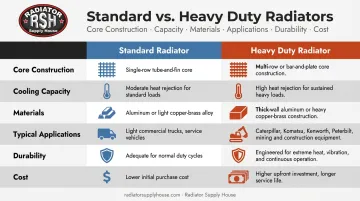
Standard vs. Heavy Duty Radiator: Quick Comparison
Before going deeper, here's a side-by-side reference across the key attributes:
| Attribute | Standard Radiator | Heavy Duty Radiator |
|---|---|---|
| Core Construction | Thinner single or dual-row core | Multi-row core with reinforced tanks |
| Cooling Capacity | Designed for moderate, intermittent heat loads | Built for sustained high heat loads |
| Materials | Aluminum core with plastic end tanks (modern) or copper/brass (older) | High-grade aluminum or copper/brass with reinforced construction |
| Typical Applications | Passenger cars, SUVs, light trucks, vans | Commercial trucks, construction, mining, agricultural, industrial equipment |
| Durability | Adequate for normal driving conditions | Built to withstand vibration, thermal cycling, and extended operation |
| Cost | Lower upfront cost | Higher upfront cost, lower long-term failure risk |
Cost should never be the deciding factor here. Installing a standard radiator in a heavy-duty application to save a few hundred dollars risks far steeper consequences: Freightliner reports unscheduled truck downtime costs operators between $300 and $1,000 per day, not counting engine repair bills on top of that.
What Is a Standard Radiator?
A standard radiator is a cooling component designed for light-duty vehicles — passenger cars, SUVs, light pickup trucks, and small vans — that operate under normal load conditions and moderate ambient temperatures. It circulates coolant through tubes and fins to dissipate heat generated by the engine, then returns cooled fluid back to repeat the cycle.
Construction and Design
Most modern standard radiators use aluminum cores with plastic end tanks — a design that prioritizes weight reduction and cost efficiency. Older vehicles used copper/brass construction. Core thickness typically runs one to two rows, adequate for the heat output of a standard gasoline engine under typical operating loads.
The tradeoffs built into this design are intentional:
- Lightweight — supports better fuel economy in passenger vehicles
- Cost-efficient — affordable to manufacture and replace
- Adequate thermal performance — meets the cooling demands of engines not operating under sustained high load
Use Cases for Standard Radiators
Standard radiators are designed for:
- Everyday passenger cars and SUVs
- Light delivery vans used in normal urban or highway conditions
- Personal pickup trucks not used for heavy towing or hauling
- Small utility vehicles in mild to moderate climates
Standard radiators have firm design limits. Sustained high-RPM operation, towing at or near capacity, extended idling in hot climates, and high-horsepower engines will push them beyond their design range. For heavy equipment, commercial trucks, and fleet vehicles — the applications most readers here are managing — those conditions aren't the exception. They're the baseline, which is exactly where heavy-duty radiators begin.
What Is a Heavy Duty Radiator?
A heavy duty radiator is a cooling component engineered for high-load diesel and gasoline engines: commercial trucks, construction equipment, agricultural machinery, mining equipment, industrial generators, and buses. These engines run hotter and longer than any passenger vehicle engine — and standard radiators aren't built to keep up.
Construction Differences
The engineering differences between a standard and heavy duty radiator are substantial:
- Multi-row cores: more coolant volume and greater surface area for heat dissipation
- Thicker tube walls: handle higher pressures and resist physical wear
- Reinforced tank connections: designed to absorb the vibration and pressure cycles that destroy lighter construction over time
- Heavier-gauge materials: high-grade aluminum or copper/brass alloy suited to thermal cycling, physical shock, and corrosive environments
SAE J1393 governs heavy-duty cooling system performance testing, while SAE J1597 covers pressure-cycle durability. These standards test whether the complete system meets real-world thermal requirements — not just whether the radiator looks right on paper.
The Cavitation Risk Most Buyers Miss
There's a technical issue in heavy duty diesel applications that doesn't get enough attention: cavitation damage to wet sleeve cylinder liners.
Many large-displacement diesel engines use wet sleeve cylinder liners, meaning the liner is directly surrounded by and cooled by coolant. Piston vibration creates micro-bubbles in the coolant that collapse against the liner wall with enough force to erode the metal. Over time, this pitting can pierce the liner entirely, causing catastrophic engine failure.
SAE research confirms that diesel wet-cylinder-liner erosion is typically cavitation erosion caused by liner vibration. A properly rated heavy duty radiator, paired with the right coolant containing cavitation inhibitors, is part of the complete system defense against this failure mode.
Application-Specific Designs
That system complexity is exactly why heavy duty radiators aren't interchangeable across equipment types. A long-haul truck radiator differs from a construction equipment radiator in mounting configuration, fin density, and tank design. A Caterpillar 320 excavator rated for 52°C (125°F) ambient temperatures has very different cooling requirements than a Class 8 highway truck, and the radiator is engineered accordingly.
Radiator Supply House carries heavy duty radiators for 300+ manufacturers, including Caterpillar, Komatsu, John Deere, Freightliner, Kenworth, Peterbilt, and Volvo. The catalog covers complete assemblies and individual cores, along with ICEBOX OEM-equivalent replacement parts, so you can replace exactly what failed without swapping out serviceable components.
Use Cases for Heavy Duty Radiators
Industries and applications where heavy duty radiators are non-negotiable:
- Long-haul commercial trucking (Freightliner, Kenworth, Peterbilt, Volvo)
- Mining and earthmoving equipment (excavators, haul trucks, bulldozers)
- Agricultural combines, tractors, and harvesters
- Construction equipment (loaders, graders, compactors)
- Bus and transit fleets
- Industrial generators and stationary diesel power units
- Forestry and oil and gas machinery
These environments all share one demand: sustained high-load operation, extreme ambient temperatures, or both at once. A properly rated heavy duty radiator reduces overheating-related failures, extends service intervals, and keeps equipment running through the long cycles these industries depend on.
Standard vs. Heavy Duty: Which One Is Right for You?
Decision Factors
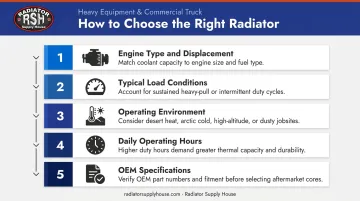
Run through these variables before choosing:
- Engine type and displacement — Large-displacement diesel engines generate more heat and often use wet sleeve construction, both of which require heavy duty radiators.
- Typical load conditions — Does the engine run at sustained high RPM? Pull heavy loads? Operate under continuous duty?
- Operating environment — High ambient temperatures, dust exposure, remote locations where a breakdown has serious consequences.
- Daily operating hours — A machine running 10+ hours daily needs cooling capacity built for that cycle.
- OEM specifications — The equipment manufacturer's recommendation is the baseline. Don't work against it.
Scenario-Based Recommendations
Choose a standard radiator if:
- Your application is a light commercial vehicle, utility van, or smaller fleet unit used for low-intensity duty cycles
- The engine is a smaller-displacement unit without sustained high-load requirements
- Operating conditions are mild to moderate with no extended high-RPM or continuous-load cycles
Choose a heavy duty radiator if:
- You operate commercial trucks, buses, or any construction, agricultural, mining, or industrial equipment
- Your engine is a large-displacement diesel
- The machine runs for extended hours daily
- You work in high-temperature, high-vibration, or remote environments where cooling failure means significant downtime and repair costs
The Gray Zone
Medium-duty trucks, larger pickup trucks used for heavy towing, and equipment sitting at the edge of standard ratings create a judgment call. In these cases, err toward the heavy duty option. The performance margin it provides costs less than a single unplanned breakdown — and far less than an engine rebuild.
The Real Cost Calculus
A heavy duty radiator costs more upfront — but consider the alternative. An undersized radiator fails under load, the engine overheats, and you're looking at head gasket replacement, liner damage, or a full engine overhaul, plus the cost of a machine sitting idle.
At $300–$1,000 per day in downtime costs for a commercial truck alone, the math clearly favors getting the right radiator from the start.
Need help identifying the right radiator for your specific make, model, and application? Radiator Supply House carries an extensive inventory of both standard and heavy duty radiators covering 300+ manufacturers — construction, agricultural, trucking, industrial, and more. Their team can cross-reference OEM part numbers to confirm the right fit without guesswork. Call +1 877-615-3002 or visit radiatorsupplyhouse.com to get started.
Conclusion
The choice between a standard and heavy duty radiator isn't a matter of preference — it's about matching the radiator's design capacity to the actual demands of the engine and working environment. A standard radiator is the correct tool for light-duty applications. A heavy duty radiator is essential wherever cooling failure carries serious operational and financial consequences.
To make the right call, keep three things in mind:
- Match capacity to load — if the equipment runs hot, works long hours, or operates in harsh conditions, heavy duty is the baseline
- Verify OEM specs — consult your equipment manual or cross-reference part numbers before ordering
- Source from a reliable supplier — OEM-equivalent aftermarket parts from a specialist like Radiator Supply House can meet performance requirements without the OEM markup
Get the spec right the first time. A failed radiator on a job site costs far more than the price difference between tiers.
Frequently Asked Questions
What is the difference between a heavy duty radiator and a regular radiator?
Heavy duty radiators feature multi-row cores, reinforced tank construction, and higher cooling capacity designed to handle the sustained heat loads of diesel engines in commercial trucks and heavy equipment. Standard radiators use thinner cores suited to lighter gasoline engines in passenger vehicles with moderate, intermittent heat output.
What is the difference between heavy duty coolant and regular coolant?
Heavy duty coolants contain additional inhibitors — such as nitrite and molybdate — that protect against cavitation corrosion in wet sleeve diesel engines. Regular automotive coolant lacks these additives and should never be used in heavy-duty diesel applications. That said, "heavy duty" on the label isn't sufficient — always verify OEM approval and confirmed cavitation protection for your specific engine.
Can you use a heavy duty radiator in a standard passenger vehicle?
There's no practical reason to. A heavy duty radiator adds weight and cost without improving performance in a light-duty application, and OEM fitment dimensions would need to be confirmed before installation. For commercial and industrial equipment, though, heavy duty radiators are the correct choice — not an upgrade, a requirement.
How long does a heavy duty radiator last compared to a standard one?
Heavy duty radiators are built for longer service life under harsh conditions and can last many years with proper maintenance. Standard radiators also hold up well within their design limits, but are more vulnerable to early failure when operating conditions regularly push past those limits.
What are the warning signs that my radiator needs to be replaced?
Key indicators include persistent engine overheating, visible coolant leaks, discolored or rusty coolant, visible corrosion or physical damage to the core or tanks, and a noticeable drop in cooling efficiency. Any of these warrant immediate inspection and likely replacement.
Does engine type (diesel vs. gasoline) determine which radiator I need?
Engine type is a strong indicator. Large-displacement diesel engines in commercial and industrial equipment generate more heat and often use wet sleeve liner construction — both require heavy duty radiators. Gasoline engines in light vehicles are well served by standard radiators matched to their heat output range.