
The WA470 has gone through eight generations since it launched, and specs shift significantly between them. A manual written for a WA470-3 won't tell you what you need to know about a WA470-8's cooling system or torque converter.
This guide breaks down the specs that matter, what a proper OEM service manual actually contains, the maintenance intervals that keep these machines running, and where to source both the documentation and the replacement parts your WA470 will eventually need.
Key Takeaways
- Operating weight ranges 21,200 kg to 25,670 kg across WA470 generations, so confirm your exact model
- Bucket capacity spans 3.4 to 6.0 m³ based on generation, boom, and bucket type
- The OEM manual details engine, hydraulic, electrical, and cooling specs to exact torque values
- WA470-8 Komatsu Care checkpoints fall at 500, 1,000, 1,500, and 2,000 hours; older models follow separate schedules
- Overheating remains a leading WA470 failure point, making cooling component quality a real priority
Komatsu WA470 Wheel Loader: Key Specifications at a Glance
The WA470 sits in Komatsu's mid-size wheel loader class, built for construction sites, quarries, and material handling yards where operators need serious bucket capacity without the footprint of a full-size loader. It's a workhorse machine, and it's been in continuous production long enough that "the WA470" really means eight distinct machines with different engines, weights, and hydraulic architectures.
Engine & Power Specifications
Komatsu's SAA6D125E engine family powers most modern WA470 generations, though the exact suffix changes with each update:
| Generation | Engine | Output |
|---|---|---|
| WA470-3 | S6D125 | 194 kW / 263 hp |
| WA470-5 | SAA6D125E-3 | 202 kW / 271 hp gross |
| WA470-6 | SAA6D125E-5 | 204 kW / 274 hp gross |
| WA470-7 | SAA6D125E-6 | 203 kW / 272 hp net |
| WA470-8 | SAA6D125E-7 | 203 kW / 272 hp net |
Notice the pattern: horsepower stays fairly flat across later generations, but emissions compliance and internal engineering change substantially between suffixes. Treat engine rebuild procedures as generation-specific: a WA470-5 torque spec doesn't automatically apply to a WA470-7. The same logic applies to cooling system components: radiators, oil coolers, and thermostats are built around each generation's specific engine architecture, so a part that fits a WA470-5 won't necessarily bolt onto a WA470-7 without modification.
Operating Weight & Dimensions
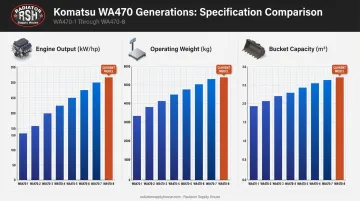
If you're asking "how much does a WA470 weigh," the honest answer is: it depends heavily on which one you own. Verified operating weights run from about 21,200 kg (46,738 lb) on the original WA470-1 up to 25,670 kg (56,593 lb) on European WA470-8 configurations.
According to SMS Equipment's WA470-8 specification sheet, North American WA470-8 units run 24,200 to 25,210 kg (53,352 to 55,579 lb) depending on configuration. That's not a small spread. Always pull the exact weight from your machine's spec plate or serial-matched documentation before planning transport, load calculations, or foundation work for attachments.
Bucket Capacity & Attachment Options
Standard bucket capacity across the WA470 range falls between 3.8 and 4.4 m³ (5.0 to 5.8 yd³) on most recent generations, with older and European configurations reaching as high as 6.0 m³ depending on boom and bucket combination.
Common bucket types include:
- General-purpose buckets for everyday loading
- Excavating buckets for digging applications
- Loose-material buckets for lightweight bulk handling
- Heavy-duty and spade-nose rock buckets for abrasive material
Fork attachments exist through dealer-fitted attachment programs on many generations, though fitment should always be confirmed against your specific serial number before ordering.
Attachment configuration is just one factor buyers weigh when sizing up a used machine. On pricing: used WA470 values swing widely based on age, indicated hours, application, structural condition, leaks, tire wear, and transmission behavior. A Ritchie Bros. guide to buying used wheel loaders recommends comparing all of these factors together rather than relying on hour meter readings alone: a low-hour machine that spent its life in quarry dust can be worse off than a higher-hour unit that ran clean applications.
What's Inside a Komatsu WA470 Service & Repair Manual
A genuine OEM service manual is built around diagnosis, disassembly, reassembly, and exact specifications tied to your machine's serial number range. That serial-number specificity is exactly why generic or mismatched manuals cause so much trouble in the field.
Komatsu now binds much of this documentation to registered equipment through the My Komatsu portal, which delivers parts manuals, service manuals, and software updates specific to the equipment on file. That's a meaningful shift from the days of one universal binder per model.
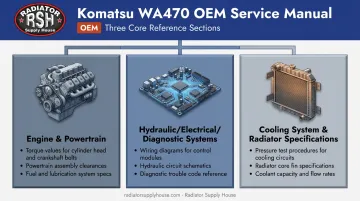
Engine & Powertrain
This section covers full engine overhaul procedures, transmission specifications, torque converter tolerances, and rebuild clearances. Because engine suffixes change across generations (S6D125 to SAA6D125E-7), rebuild tolerances and torque values are never interchangeable between them.
Hydraulic, Electrical & Diagnostic Systems
Expect complete hydraulic schematics, wiring diagrams, sensor location maps, and step-by-step diagnostic procedures tied to fault codes. This is where technicians spend the most time when a machine throws an unfamiliar warning.
Fault code charts and sensor testing tables help pinpoint failures before you start pulling components apart, saving hours of unnecessary disassembly.
Cooling System & Radiator Specifications
Manuals detail radiator, oil cooler, and aftercooler specifications, including pressure test procedures and torque values for reinstallation. Get these torque values wrong and you'll be chasing coolant leaks for months.
When a cooling component fails inspection, sourcing OEM-equivalent parts, such as those supplied by Radiator Supply House, keeps the replacement matched to what the manual specifies — core dimensions, pressure ratings, and mounting points included.
Maintenance Schedule & Critical Service Procedures
Every WA470 service routine starts with a daily pre-start check:
- Fluid levels (engine oil, coolant, hydraulic fluid, transmission)
- Visible leaks around hoses, fittings, and seals
- Tire condition and inflation
- Undercarriage and structural inspection
Beyond daily checks, WA470-8 units follow Komatsu Care checkpoints at 500, 1,000, 1,500, and 2,000 hours, covering DEF tank breather elements, crankcase ventilation filters, and other regular service items. Older generations follow their own serial-specific O&M schedules — don't assume a WA470-5 shares a WA470-8's intervals.
Cooling, Hydraulic & Engine Service
Cooling system maintenance deserves special attention:
- Clean radiator fins regularly to prevent airflow restriction
- Follow manual-specified coolant flush intervals
- Pressure test the system periodically to catch weak seals early
When inspection reveals a failing radiator or oil cooler, Radiator Supply House offers replacement radiators, oil coolers, and complete cooling packages sized to match OEM specifications.
Hydraulic and engine systems demand the same diligence:
- Change hydraulic fluid and filters at manual-specified intervals to prevent contamination-driven wear
- Replace engine oil and filters on schedule, torquing drain plugs and filter housings to manual spec to avoid leaks
- Log every service against machine hours so patterns in premature wear become visible over time
Common WA470 Issues & Troubleshooting Tips
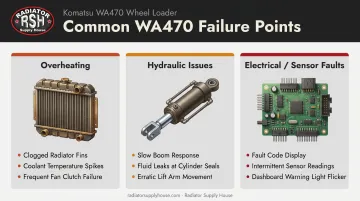
Overheating shows up again and again as a WA470 complaint, often stemming from clogged, corroded, or physically damaged radiators and oil coolers. Newer generations built wider-core coolers with swing-out fans specifically to fight this, but that design only helps if technicians inspect and clean the components on schedule.
Radiator Supply House stocks OEM-equivalent radiators and oil coolers for WA470 loaders, worth checking once cleaning alone stops solving the overheating.
Hydraulic performance is the next common trouble spot. Hydraulic symptoms worth watching for:
- Visible leaks at hose fittings or cylinder seals
- Slow or weak bucket/boom response
- Pressure loss during heavy lifting
The manual's hydraulic schematics make isolating these issues far faster than guesswork, since they show exactly which valve or line feeds which function.
Hydraulic troubles aside, electrical and sensor faults make up a third common failure pattern, surfacing through the machine's monitor system. WA470-7 and later units run EMMS (Equipment Management Monitoring System), which displays real-time fault messages, while KOMTRAX relays cautions remotely. Recording the exact code before touching anything, then cross-referencing it against the serial-specific manual's diagnostic tables, resolves faults considerably faster than trial-and-error part swapping.
Where to Get the Manual & Genuine Replacement Parts
Sourcing the right WA470 manual means going through channels that guarantee serial-number accuracy:
- Authorized Komatsu dealers: can confirm the exact manual edition for your machine
- My Komatsu digital portal: binds manuals and updates to registered equipment
- Certified service centers: often maintain manual libraries across multiple generations
Before using any manual, verify it matches your machine's serial number and model year. Specs differ enough between generations that a mismatched manual can lead you straight to the wrong torque value or fluid capacity.
When the manual calls for cooling system component replacement, Radiator Supply House provides OEM-equivalent radiators, oil coolers, aftercoolers, and complete cooling packages for Komatsu equipment.
Their team can cross-reference your WA470's OEM part numbers to identify a compatible ICEBOX replacement, whether you need a single core or a full cooling package.
Reach their sales team at +1 877-615-3002, Monday through Friday, 7 AM to 5 PM PST.
Frequently Asked Questions
How much does a Komatsu WA470 wheel loader weigh?
Operating weight varies by generation, ranging from roughly 21,200 kg on early models to over 25,000 kg on later WA470-8 configurations. Check your specific model's spec sheet or serial plate for the exact figure.
What is the bucket capacity of the Komatsu WA470?
Standard capacity typically falls between 3.8 and 4.4 m³ on recent generations, though it can reach up to 6.0 m³ depending on bucket type and configuration. Confirm your exact bucket spec before ordering replacement parts or attachments.
How much does a Komatsu WA470 cost?
Pricing depends heavily on age, hours, application history, and region, with well-maintained used units commanding a premium over machines with heavy wear or structural issues. Get an inspection-based comparison rather than relying on hour meter readings alone.
Where can I find a Komatsu WA470 service manual PDF?
Authorized Komatsu dealers and the My Komatsu portal are the most reliable sources, since they bind documentation to your machine's specific serial number. Always verify the manual matches your exact model year before using it.
How often should a Komatsu WA470 be serviced?
Newer WA470-8 units follow Komatsu Care checkpoints at 500, 1,000, 1,500, and 2,000 hours. Older generations follow their own serial-specific intervals detailed in the matching operation and maintenance manual.
What causes a Komatsu WA470 wheel loader to overheat?
Clogged radiator fins, corroded oil coolers, and low coolant levels are common culprits behind WA470 overheating. Routine inspection and quality replacement parts, like the radiators and oil coolers Radiator Supply House stocks, go a long way toward preventing unplanned downtime.