This guide walks through how the ISX cooling system operates, what each major component does, how to identify the primary hoses, where leaks most commonly appear, and what a practical maintenance routine looks like. Use it as a working reference in the shop, not just a reading exercise.
One important note before diving in: hose dimensions, thermostat counts, and total system capacity vary by engine control module generation, truck chassis, and model year. Always verify specifications against your engine serial number in Cummins QuickServe and your truck's chassis manual before ordering parts.
Key Takeaways
- The ISX runs a pressurized coolant circuit with the EGR cooler integrated into the loop; air contamination and incorrect coolant chemistry are the top damage drivers
- Cummins approves fully formulated coolant premixed 50/50 with deionized water for ISX15 applications
- The pressure cap on CM2250 and CM2350 applications is rated at 15 psi — never substitute a lower-rated cap
- EGR cooler failures, water pump weep holes, and thermostat housing connections are the top three external and internal leak locations
- Always verify thermostat count, hose sizing, and coolant capacity by engine serial number, as specs vary across ISX generations
How the Cummins ISX Coolant System Works
The Basic Circuit
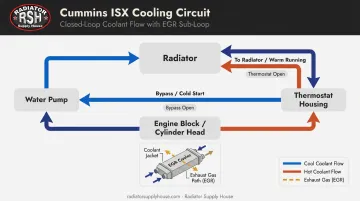
The ISX cooling system circulates coolant through the engine block and cylinder head to absorb combustion heat, routes that heated coolant to the radiator for rejection to ambient air, and returns cooled coolant back to the engine via the water pump. The EGR cooler sits within this circuit, using engine coolant to reduce exhaust gas temperature before recirculated gases re-enter the intake.
This integration matters for diagnostics. Unlike older single-loop diesel engines where a coolant loss had one obvious source, the ISX's EGR cooler adds an internal failure mode — one where coolant disappears with no visible external puddle.
Water Pump, Thermostat, and Flow
The water pump mounts on the front of the engine and drives coolant circulation via an impeller. Flow volume rises with RPM, so low-speed city driving or extended idling puts less coolant movement through the system than highway operation.
The thermostat controls where coolant flows based on temperature:
- Closed thermostat: Coolant recirculates through the bypass loop, staying within the engine rather than routing to the radiator. This accelerates warm-up and prevents overcooling.
- Open thermostat: Hot coolant is directed to the radiator for heat rejection. ISX thermostats are commonly rated at 180°F (82°C) opening temperature, though variants exist — verify by part number for your specific engine generation.
Some ISX configurations use two thermostats rather than one. The Interstate-McBee aftermarket catalog documents both single and dual thermostat configurations depending on engine variant. Check your engine serial number before replacing thermostats.
Surge Tank and System Pressurization
The surge tank (also called the deaeration or expansion tank) mounts at the highest point in the cooling circuit. Its elevated position allows air bubbles to vent out of the coolant stream rather than becoming trapped in engine passages or the EGR cooler.
The pressure cap on this tank directly affects the coolant's boiling point: Cummins ISX15 maintenance guides for CM2250 and CM2350 specify checking the cap for 15 psi at every service interval. Installing a lower-rated cap reduces the system's margin against boiling under load.
Cummins ISX Cooling System Components Guide
Radiator
The radiator sits at the front of the cooling module. Hot coolant from the engine enters through the inlet tank, passes through the core where ambient air absorbs the heat, and exits through the outlet tank back toward the water pump. A restricted or failing radiator core causes chronic overheating even when the pump, thermostat, and hoses are all functioning normally — there's nowhere for the heat to go.
For replacement units, Radiator Supply House stocks ISX-compatible radiators and complete cooling packages for common ISX-powered platforms including Peterbilt 386/387/389, Kenworth T800/W900, and others. Their Cummins cooling package (#990404) bundles a radiator and charge air cooler together, which can simplify sourcing when multiple components need replacement simultaneously.
Water Pump
The water pump on the ISX mounts at the front of the engine. The pump design varies by engine generation — the Interstate-McBee parts catalog distinguishes one-piece pumps for early ISX variants from two-piece pumps used on CM871 and CM2250 EGR configurations.
The weep hole below the pump housing is your early warning system. A minor seep at the weep hole indicates seal wear is progressing. Active dripping or a coolant trail running down the front of the engine signals seal failure requiring prompt replacement. Ignoring it leads to bearing wear, shaft wobble, and eventual impeller damage.
Thermostat Housing and Thermostats
The thermostat housing sits at the front-top of the engine and connects to the upper radiator hose. Thermostat count varies by configuration: some ISX variants use one thermostat, others use two.
- Stuck-open thermostat: Engine runs cold, heater output is weak, fuel economy suffers
- Stuck-closed thermostat: Coolant cannot reach the radiator, engine overheats rapidly
Replace the housing gasket any time you remove the housing. Reusing a compressed gasket at this location is one of the most common sources of post-service leaks.
EGR Cooler
The EGR cooler routes recirculated exhaust gases through a coolant-jacketed heat exchanger, dropping their temperature before they re-enter the intake manifold. Coolant flows through the cooler's jacket; exhaust gases flow through internal passages.
When internal corrosion or thermal fatigue cracks those passages, the failure mode is subtle — exhaust gases or combustion byproducts contaminate the coolant internally. No puddle on the ground. Instead, watch for:
- Unexplained coolant consumption with no visible external leak
- Foamy or discolored coolant in the surge tank
- White exhaust smoke under load
According to a Cummins service bulletin, internal pitting of EGR cooler corrugated pipes is a confirmed failure mechanism, with Procedure 011-019 designated for EGR cooler testing.
Coolant Surge/Deaeration Tank
The surge tank holds the system's pressure cap and connects to the radiator and engine via small-diameter hoses and vent lines. Its elevated position serves a purpose: air naturally rises, and the surge tank provides the exit point for that air.
Blockage of the vent lines feeding the surge tank traps air in the system. Symptoms include a fluctuating temperature gauge, intermittent cold air from the heater, and unexplained coolant consumption — all frequently misdiagnosed as thermostat failure.
Cummins ISX Coolant Hose Identification Guide
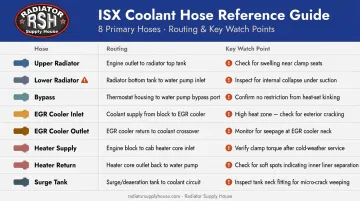
Radiator hose sizing and routing on the ISX is chassis-specific, not universal. The hose that fits a 2010 Kenworth T800 may differ from the one on a 2013 Peterbilt 386 even with the same engine. Always cross-reference by VIN and engine serial number.
Primary Hoses at a Glance
| Hose | Routing | Key Watch Point |
|---|---|---|
| Upper radiator hose | Thermostat housing → radiator inlet tank | Clamp area seepage, hose softness near ends |
| Lower radiator hose | Radiator outlet tank → water pump inlet | Inner-wall collapse as hose ages |
| Bypass hose | Thermostat housing → water pump (short loop) | Frequently overlooked; common seep-leak site |
| EGR cooler inlet hose | Main coolant loop → EGR cooler | Cracking at connection collar from thermal cycling |
| EGR cooler outlet hose | EGR cooler → main coolant loop | Same thermal stress as inlet; inspect together |
| Heater supply hose | Engine → cab heater core | Leaks show as foggy windshield or sweet cab smell |
| Heater return hose | Cab heater core → engine | Smaller diameter; check routing through firewall |
| Surge tank hose | Surge tank → radiator/engine | Blockage causes air-lock symptoms |
Lower Radiator Hose Collapse
The lower radiator hose handles returning cooled coolant and operates under slight vacuum as the water pump draws from it. As the hose ages, the internal spring or coil support that maintains hose shape deteriorates. The hose collapses inward, restricting flow — and the restriction isn't visible from the outside. Squeeze the hose with the engine cold. A hose that compresses too easily or feels soft throughout its length is a candidate for replacement regardless of its external appearance.
Bypass Hose
The bypass hose routes coolant from the thermostat housing back to the water pump inlet when the thermostat is closed. It keeps coolant moving through the engine block during warm-up, preventing localized hot spots near the cylinder head. It's short, tucked close to the engine block, and easy to skip during a visual inspection — making it a common seep location that only surfaces at a PM check.
Surge Tank Vent Lines
These small-diameter lines connect high points in the cooling circuit to the surge tank. Partial blockage — from scale buildup or collapsed inner walls — traps air in the system. The symptoms mimic a failing thermostat: temperature gauge swings, inconsistent heater output, occasional overheat warnings. If those symptoms persist after a thermostat swap, the vent lines and surge tank connections are the next logical check — not more parts.
Common Coolant Leak Points on the Cummins ISX
EGR Cooler Internal Failure
EGR cooler failures often leave no visible puddle — internal cracking of the heat exchanger passages allows combustion gases and coolant to cross-contaminate without any external drip. Symptoms include:
- Coolant level dropping with no visible external puddle
- Foamy or discolored coolant in the surge tank
- White exhaust smoke under load
- Pressurized cooling system (cap releasing, overflow occurring)
Cummins TSB170004 (released May 7, 2019) documents a related failure mode: injector sleeve seal shrinkage on ISX CM570, CM870, CM871, and CM871 E engines. A leak path forms between the cylinder head cooling jacket and the injector bore, producing similar symptoms — fuel in coolant, coolant in fuel, and a pressurized system.
Diagnostic procedure 002-014 (cooling system pressure test) is the recommended starting point for isolating both failure types.
Water Pump Seal and Bearing Failure
Inspect the weep hole below the pump housing at every PM service. Dried residue or a faint coolant stain there means the seal is wearing but still functional. Active dripping — coolant visibly running or pooling — means it has failed.
A failed seal left in service leads to bearing wear, shaft wobble, impeller damage, and ultimately a sudden loss of cooling capacity. Catch it at the weep hole; don't wait for the next symptom.
Thermostat Housing and Hose Connection Points
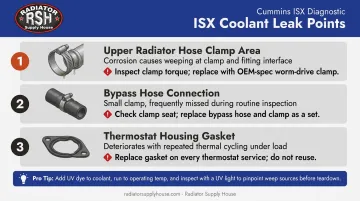
The most common external leak locations on the ISX are:
- Upper radiator hose clamp area — clamp corrosion allows the hose to weep at the fitting interface
- Bypass hose connection — small hose, small clamp, frequently overlooked
- Thermostat housing gasket — deteriorates over time and after temperature cycling
Adding UV dye to the coolant and scanning with a blacklight locates the source faster than visual inspection alone. When a corroded clamp is the culprit, replace it — retightening won't restore consistent clamping force and the leak will return.
Cummins ISX Coolant System Maintenance Schedule & Tips
Coolant Type and Mixing Ratio
Cummins ISX15 maintenance documentation for CM2250 and CM2350 applications specifies fully formulated antifreeze/coolant premixed 50/50 with deionized water. Approved chemistries include:
- Fully formulated conventional coolant with SCA precharge (per TMC RP 329 for ethylene glycol, RP 330 for propylene glycol)
- OAT (Organic Acid Technology) coolant approved to Cummins spec CES 14603
- Hybrid (HOAT-style) products approved to CES 14603
Do not mix coolant chemistries. Conventional, OAT, and hybrid formulations use incompatible additive packages. Mixing them degrades inhibitor effectiveness and can cause additive dropout. When switching coolant type, perform a complete drain and flush first.
SCA Monitoring for Conventional Coolants
If you're running conventional coolant after that flush, SCA concentration becomes a critical ongoing concern. Conventional (non-OAT) coolants require Supplemental Coolant Additives (SCAs) to protect wet cylinder liners from cavitation erosion. Without adequate SCA levels, rapid pressure waves from cylinder liner flex pit the liner surface from the outside — damage that stays hidden until teardown.
Cummins CM2250 interval: Check DCA concentration at 25,000 miles / 800 hours / 6 months
Cummins CM2350 interval: Check DCA at 30,000 miles / 1,000 hours / 6 months (normal/severe duty)
Use Fleetguard test strips to measure concentration.
For hybrid coolants using Cummins' PGXL HD product, the acceptable range is 0.3 to 0.8 SCA units/L, with 0.7 units/L as the target.
Hose and Clamp Inspection Routine
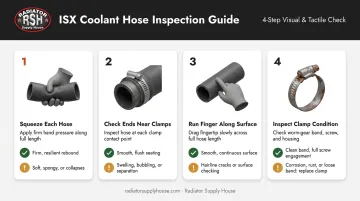
Conduct a tactile and visual inspection at every PM service:
- Squeeze each hose — softness, sponginess, or collapse indicates internal degradation
- Check ends near clamps — swelling or separation at the clamped ends is a failure sign
- Run a finger along the hose surface — surface cracking, even hairline cracks, means replacement is due
- Check clamp condition — replace corroded worm-gear clamps; they lose clamping force over time
There's no universal calendar interval for hose replacement on the ISX — it's condition-based. Sourcing OEM-equivalent replacement hoses from a specialized supplier like Radiator Supply House ensures correct routing geometry and pressure ratings for ISX-specific applications — wrong dimensions mean fitment failures and coolant leaks under load.
Frequently Asked Questions
How many gallons of coolant does a Cummins ISX take?
Capacity varies by chassis, cab type, and heater circuit volume, so there's no single universal figure. Check your chassis operator's manual by VIN for the correct spec. When refilling after a full drain, use a 50/50 premix of approved coolant and deionized water, and follow the manufacturer's deaeration procedure to bleed trapped air.
Where do coolant leaks most commonly occur on a Cummins ISX?
The top three locations are: the EGR cooler (internal failure causing coolant loss with no external puddle), the water pump weep hole (seal deterioration progressing to active drip), and hose connection points at the thermostat housing and radiator fittings , particularly the upper radiator hose clamp area and bypass hose collar.
Which hoses are connected to the Cummins ISX coolant system?
Primary hoses include the upper and lower radiator hoses, the thermostat bypass hose, EGR cooler inlet and outlet hoses, cab heater supply and return hoses, and the surge tank fill and vent lines. Each hose is chassis-specific in diameter and routing ; confirm sizes by VIN and engine serial number rather than using generic ISX specifications.
What type of coolant does a Cummins ISX engine require?
Cummins approves fully formulated coolant premixed 50/50 with deionized water. Accepted types include conventional coolant with SCA precharge, OAT (CES 14603), and hybrid OAT (CES 14603). Never mix coolant types; incompatible additive packages degrade protection and can cause precipitation.
How do I know if my Cummins ISX coolant system is losing pressure?
Common signs are a dropping coolant level with no visible leak, white exhaust smoke under load, the pressure cap repeatedly releasing into the overflow, or overheating at normal operating temperature. Run a cooling system pressure test (Cummins Procedure 002-014) as your first diagnostic step.
How often should coolant hoses be replaced on a Cummins ISX?
No blanket calendar interval applies. Inspect hoses at every PM service for surface cracking, swelling near clamps, softness, or inner-wall collapse on the lower radiator hose. Replace on condition rather than on a fixed schedule ; replace proactively when inspection reveals any of these signs, before a hose fails on the road.