Introduction
Anyone who's tried to start a diesel engine after a night in sub-zero temperatures knows the drill: sluggish cranking, thick coolant, and an engine that runs "cold" for far longer than it should.
Overnight temperature drops pull heat out of the cooling system, leaving coolant dense and slow to circulate right when the engine needs it most.
This isn't just an inconvenience. At 32°F/0°C, a battery can lose up to 35% of its power, according to Caterpillar's cold-weather maintenance guidance, adding to the strain cold-soaked engines already face.
For fleet operators, construction crews, and farms running equipment through northern winters, a no-start morning means lost production hours.
That's where the lower radiator hose heater comes in. This guide breaks down exactly how it works, what happens inside the cooling system before you turn the key, and where it delivers the most value.
Key Takeaways
- Pre-warms coolant using resistance heat and natural convection via an inline electric device.
- Circulates coolant through thermosiphon flow, so no water pump involvement is needed.
- Plugs into a standard outlet and includes thermostat protection against overheating.
- Commonly found on light-industrial, medium-duty, and agricultural diesel equipment.
- Provides a simpler, less invasive alternative to a full engine block heater.
What Is a Lower Radiator Hose Heater?
A lower radiator hose heater is an electrically powered inline heating unit installed directly into the lower radiator hose. Its job is to heat engine coolant before the engine starts, so the system isn't running on cold, sluggish fluid during those critical first minutes.
Cold coolant is thick and slow to move. When an engine fires up with cold coolant sitting stagnant in the block, components run without adequate thermal protection until things warm up naturally. A lower hose heater gets ahead of that problem by warming the coolant before ignition ever happens.
This device is often confused with a few similar products. It isn't:
- Engine block heater: installs into the engine casting itself, heating coolant plus the surrounding metal mass.
- Coolant reservoir heater: heats fluid sitting in a separate tank, not the active hose loop.
- Cab pre-heater: warms the operator compartment, not the cooling system.
The lower radiator hose heater targets only the coolant moving through that lower hose loop.
Despite newer heating technologies on the market, this device remains popular because it's simpler and less invasive than a full block heater installation. For fleet operators managing dozens of units, that simplicity translates directly into lower parts and labor costs.
Types of Lower Radiator Hose Heaters
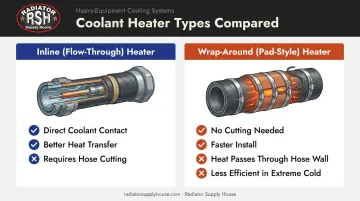
There are two main configurations:
- Inline (flow-through) heaters: the hose is cut so the heating unit sits directly in the coolant path, giving the element direct contact with the fluid. Phillips & Temro's Zerostart line fits non-corrugated hoses in five sizes up to 2 inches, with thermostat protection built in.
- Wrap-around or pad-style heaters: these clamp externally onto the hose and transfer heat through the hose wall instead of directly into the coolant.
Inline units generally deliver better heat transfer since the coolant makes direct contact with the heating element. Wrap-around styles install faster (no hose cutting required) but lose efficiency in extreme cold because heat has to pass through the hose material first.
How Does a Lower Radiator Hose Heater Work?
The device operates through a straightforward electrical-to-thermal sequence. It's positioned in the coolant circuit so heat transfers into the system long before the ignition key gets turned.
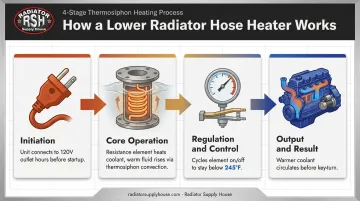
Initiation
The process starts when the unit gets plugged into a standard 120V AC outlet, often the night before and several hours ahead of the planned start time. Many fleet operators simply plug in overnight and let the heater run through the coldest hours.
Some models run continuously once powered. Others include a built-in thermostat that regulates the heating element to prevent overheating, rather than an ambient-temperature activation switch. This distinction matters: the thermostat's job is protection, not simply turning the unit on and off based on outside air temperature.
One operational dependency worth planning around: the heater needs access to power. At a depot with outlets on every parking spot, that's a non-issue.
On a remote job site or a field far from shore power, running the heater means using a generator or a long extension cord. Cord gauge matters here, since undersized cords cause voltage drop that reduces heating performance over long distances.
Core Operation
Inside the unit, an electric resistance heating element (conceptually similar to what's inside a residential water heater) warms the coolant as it passes through or around it.
Here's the mechanism that moves that heat through the rest of the system:
- Coolant near the heating element warms up and becomes less dense
- The warmer, lighter coolant rises naturally
- Cooler coolant from the engine block sinks and gets drawn toward the heater
- This creates a slow, continuous circulation loop with zero water pump involvement
Hotstart, a manufacturer of thermosiphon-based engine heaters, describes this process as the "natural expansion and rising action of a heated fluid", meaning buoyancy does the work that a pump would normally handle. Phillips & Temro confirms its own lower-hose products rely on this same upward-rise principle to circulate warmed coolant into the block.
A quick note on wattage and heat rise: verified manufacturer specs for the Zerostart lower-hose line show a 600W, 120V rating with a maximum heater temperature limit of 245°F/118°C for safety.
No independently verified test data exists showing exact coolant-temperature gains at specific run times. Treat any "X degrees after Y hours" claim you see elsewhere with some skepticism, since actual warm-up depends heavily on ambient temperature, system volume, and insulation.
Regulation and Control
Thermostat-equipped units cycle the heating element on and off to keep coolant within a safe operating range, functioning primarily as a protection mechanism rather than a comfort feature.
Uncontrolled, continuous heating could:
- Degrade hose material over time from sustained high heat
- Contribute to pressure buildup in a sealed system
- Damage seals and gaskets at connection points
A functioning thermostat keeps the heater well below its rated maximum (245°F/118°C for verified Zerostart units), protecting both the hose and the surrounding components from thermal stress.
Output and Result
By the time the operator turns the key, coolant is already circulating at a warmer baseline temperature instead of sitting cold and stagnant. That translates into less time spent running the engine on inadequate lubrication viscosity and cold metal-on-metal contact.
A 2000 SAE study on diesel warm-up behavior found that during the first minute of operation, roughly 50% of fuel energy gets absorbed simply heating the mass of the engine's metal components. Pre-warmed coolant helps offset this hard physical reality by giving the system a head start.
The U.S. Department of Energy's Alternative Fuels Data Center similarly notes that coolant preheating can reduce cold-start impact and cut down on warm-up idling time, though exact fuel savings vary by application and aren't standardized across device types.
Where Lower Radiator Hose Heaters Are Used
These heaters earn their keep in specific conditions: sustained sub-freezing temperatures, overnight parking outdoors, and operations where equipment needs to fire up reliably first thing without extended idling to warm up.
Equipment types that benefit most:
- Diesel-powered heavy equipment (excavators, loaders, dozers)
- Commercial trucks and tractor-trailers
- Agricultural machinery (tractors, combines)
- Buses and municipal fleet vehicles
Diesel engines are particularly sensitive here because they rely on compression ignition rather than a spark. Cold air compresses less efficiently, making that first start harder, which is why OEMs build in specific thresholds for cold-weather starting aids.
Detroit's 2024 operator's manual for the DD13/DD15/DD16 platform, for instance, recommends an electrical grid heater below 4°C/40°F and a block or oil-pan heater below -20°C/-4°F.
Those thresholds apply to the specific devices named in that manual. They're a useful reference for how OEMs stage cold-weather protection, even though they don't map directly onto every lower-hose heater application.
Usage patterns also vary by setting:
- Remote construction and mining sites often need generator-sourced power to run heaters, since shore power isn't available.
- Fleet depots typically have outlets at every parking space, making overnight plug-in straightforward.
For operators managing cooling systems across this kind of mixed equipment fleet, sourcing the right parts matters just as much as the heater itself.
Radiator Supply House carries cooling system components for heavy equipment and commercial vehicles across major manufacturers, including Caterpillar, John Deere, Komatsu, Freightliner, Kenworth, Peterbilt, and Volvo. That's useful when a hose connection, bottom tank, or radiator needs attention alongside cold-weather heating upgrades.
Conclusion
A lower radiator hose heater works on a simple principle: electric resistance heat warms coolant in the lower hose, and thermosiphon convection carries that warmth into the engine block passively, without any pump running. The mechanism is straightforward yet effective, solving a very specific problem — cold, sluggish coolant at startup.
Understanding that mechanism helps operators make better decisions: choosing the right wattage, planning realistic plug-in windows, and watching for thermostat issues before they become bigger problems. That knowledge protects the equipment and keeps operations running reliably on cold mornings.
Frequently Asked Questions
Should the lower radiator hose be warm?
Yes, but not hot. The lower hose carries cooled coolant returning from the radiator to the engine, so it runs cooler than the upper hose. If it stays cold even after the engine fully warms up, suspect a thermostat problem.
What does the lower radiator hose go to?
It connects the bottom of the radiator to the water pump inlet on the engine. This hose carries cooled coolant back into the block to continue the cooling cycle.
What happens if the lower radiator hose breaks?
A broken lower hose causes rapid coolant loss and overheating within minutes. Continuing to drive risks serious engine damage, including warped heads or a seized engine. Stop as soon as it's safe to do so.
How much does it cost to fix a lower radiator hose?
Heavy equipment and commercial truck hose replacement typically runs $150 to $500 for parts and labor, though larger machines with harder-to-access hoses can cost more. Get a quote specific to your make and model.
What is the difference between a lower radiator hose heater and a block heater?
A block heater installs directly into the engine block and heats the coolant plus the block's metal mass. A lower radiator hose heater installs in the hose and heats coolant through convection. Block heaters are generally more powerful; hose heaters are easier to install and less invasive.
How long should I run a lower radiator hose heater before starting my engine?
Most operators plug in several hours ahead of startup, often running the heater overnight in harsh winter climates. Exact timing depends on ambient temperature, unit wattage, and how quickly you need the engine ready.