The confusion usually comes down to one thing: not understanding how coolant hoses are actually sized. Inside diameter, outside diameter, nominal size — these terms get used interchangeably in the field, but they mean different things and serve different purposes during selection.
This guide covers exactly that. You'll find a complete coolant hose size chart with fitting dimensions, a dash size conversion reference, a practical field measurement method, and clear guidance on matching hoses to fittings correctly — with a focus on the larger-bore, heavy-duty applications where sizing errors are most costly.
Key Takeaways
- Coolant hoses are sized by inside diameter (ID) — not outside diameter
- Nominal sizes (such as "1-1/2 inch") approximate the ID but won't always match exactly due to manufacturing tolerances
- Common heavy-duty coolant hose sizes run from 5/8" to 2-1/2" ID (approximately 16mm to 64mm)
- Hose ID must closely match the fitting or nipple OD — too loose causes leaks; too tight prevents installation
- Always verify dimensions against OEM specifications for your specific make and model
Understanding Coolant Hose Sizing: ID, OD, and Nominal Dimensions
Inside Diameter — The Primary Specification
Inside diameter (ID) is the measurement that actually matters for hose selection. It defines the internal bore, which controls both flow capacity and fitting compatibility. Unlike rigid pipe or metal tubing (typically specified by outside diameter), flexible coolant hoses follow an ID-based sizing convention.
When a hose is listed as "1-inch," that label refers to its bore. Every catalog comparison, every OEM cross-reference, and every fitting match should start with ID.
Outside Diameter and Why It Varies
Outside diameter (OD) is a derived value. It depends on ID plus wall thickness, so two hoses with the same nominal size can have noticeably different ODs depending on their construction. Parker's Series 6750 silicone coolant hose catalog illustrates this clearly : a 3/4" ID hose carries an OD of approximately 1.1 inches, while a 2-1/2" ID hose OD reaches 2.9 inches.
OD matters when routing hoses through tight spaces, selecting clamps, or checking clearance around engine components — but it does not determine fitting compatibility.
Nominal Size and Manufacturing Tolerance
Nominal size is a rounded label — a shorthand, not a precision specification. A nominal 3/4" hose won't necessarily measure exactly 0.750" ID. According to SAE J20, the applicable coolant hose standard, ID tolerances run ±0.8mm for most sizes below 51mm ID, and ±1.6mm at 51mm and above. That's enough variation to cause a poor fit if you rely solely on the nominal label.
Wall Thickness: Light-Duty vs. Heavy-Duty
Wall thickness is a separate specification from ID and OD, and it has real consequences for durability. SAE J20 establishes two construction classes relevant to heavy-duty applications:
- 20R1 standard wall: 4.3–5.6mm finished wall thickness
- 20R1 heavy wall: 5.8–7.1mm finished wall thickness
- 20R4 radiator hose (below 50.8mm ID): approximately 4.3–5.6mm
Heavier walls increase pressure resistance and reduce collapse risk under vacuum — critical in construction, mining, and commercial truck cooling systems. Don't assume a hose that fits dimensionally will also handle the thermal and pressure demands of a given application.
Hose Sizing vs. Tube Sizing
Rigid metal tubes and many fittings are specified by OD. Flexible hoses are specified by ID. These are not interchangeable conventions. When a cooling circuit mixes hard lines and flexible hoses (common in commercial truck and heavy equipment installations), applying the wrong convention leads to ordering errors. Always confirm whether a dimension refers to the hose bore or the tube outer wall before placing an order.
Coolant Hose Size Chart: Common Fitting Sizes Reference
Common Hose Size Reference Table
The table below covers the standard nominal sizes used across most heavy equipment and commercial vehicle cooling systems. OD values are based on Parker Series 6750 silicone coolant hose catalog data and are product-specific, not universal SAE standards — actual OD varies by manufacturer and construction class.
| Nominal Size | ID (inches) | ID (mm) | Typical OD (inches)* | Typical OD (mm)* | Common Application |
|---|---|---|---|---|---|
| 5/8" | 0.625 | 15.9 | 0.945 | 24.0 | Heater circuits, small auxiliary lines |
| 3/4" | 0.750 | 19.1 | 1.10 | 27.9 | Heater hoses, bypass lines |
| 7/8" | 0.875 | 22.2 | 1.20 | 30.5 | Bypass and crossover lines |
| 1" | 1.000 | 25.4 | 1.40 | 35.6 | Thermostat housing connections |
| 1-1/4" | 1.250 | 31.8 | 1.60 | 40.6 | Smaller radiator connections |
| 1-1/2" | 1.500 | 38.1 | 1.90 | 48.3 | Mid-size radiator inlets/outlets |
| 1-3/4" | 1.750 | 44.5 | 2.10 | 53.3 | Agricultural and construction equipment |
| 2" | 2.000 | 50.8 | 2.40 | 61.0 | Heavy equipment main coolant lines |
| 2-1/4" | 2.250 | 57.2 | 2.60 | 66.0 | Large excavators, commercial trucks |
| 2-1/2" | 2.500 | 63.5 | 2.90 | 73.7 | High-capacity radiator connections |
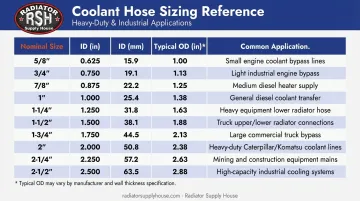
*OD values from Parker Series 6750 catalog. Verify against your specific hose series before ordering.
OEM manufacturers including Caterpillar, Komatsu, John Deere, Freightliner, and Volvo frequently use non-standard or intermediate sizes, with metric dimensions, stepped ends, and asymmetric inlet/outlet pairings all common in the field. For example, certain Caterpillar units use a stepped 56.5 × 62.5mm ID hose, and John Deere part DZ106634 measures 15.30mm ID, close to but not exactly 5/8".
Radiator Supply House stocks OEM-equivalent hoses across 300+ manufacturers specifically to match these non-standard dimensions — a critical detail when generic aftermarket catalogs only list nominal sizes.
Dash Size Reference for Coolant Hose Applications
The dash sizing system identifies hose ID in 1/16" increments: divide the dash number by 16 to get the ID in inches. A -16 hose is 1-inch ID; a -24 hose is 1-1/2-inch ID.
| Dash | ID (in) | ID (mm) | Dash | ID (in) | ID (mm) |
|---|---|---|---|---|---|
| -8 | 1/2 | 12.70 | -24 | 1-1/2 | 38.10 |
| -10 | 5/8 | 15.88 | -26 | 1-5/8 | 41.28 |
| -12 | 3/4 | 19.05 | -28 | 1-3/4 | 44.45 |
| -14 | 7/8 | 22.23 | -32 | 2 | 50.80 |
| -16 | 1 | 25.40 | -36 | 2-1/4 | 57.15 |
| -20 | 1-1/4 | 31.75 | -40 | 2-1/2 | 63.50 |
Important distinction: Refrigerant hose and SAE 100R5 transportation hose use a different dash-size-to-ID convention than standard coolant hose. A -12 refrigerant hose does not have the same bore as a -12 coolant hose. Never cross-apply dash sizes between hose categories.
How to Measure Coolant Hose Size in the Field
Accurate field measurement is essential when the original part number is unknown — a common situation with aging equipment, aftermarket replacements, or multi-brand cooling circuits.
Getting the right fit requires two measurements: inside diameter (ID) for hose selection, and outside diameter (OD) plus wall thickness for clamp sizing.
Measuring Inside Diameter
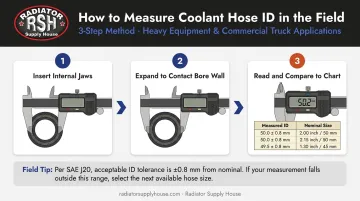
The correct tool is a vernier caliper with internal measuring jaws:
- Insert the internal jaws into the hose bore at a section free from clamp marks or deformation
- Expand gently until both jaws make light contact with the bore wall
- Read the measurement — this is your actual ID
Compare the result against the size chart, accounting for the ±0.8mm SAE J20 tolerance. A worn or aged hose may have a slightly stretched bore, so match to the table range rather than a single exact value.
If a caliper isn't available in the field, a bolt or dowel of known diameter works as a quick gauge. Insert it into the bore; a snug fit without forcing identifies the approximate ID.
Measuring Outside Diameter and Wall Thickness
Use the external jaws of the caliper to measure the hose OD. Once you have both OD and ID:
Wall thickness = (OD − ID) ÷ 2
This calculation matters for clamp selection — the clamp must span the hose OD when installed over the fitting nipple, which adds wall thickness on both sides.
Field tip: If the hose is still installed and only one end is accessible, measure the fitting nipple OD instead. The hose ID should match that dimension closely — a useful cross-check when you can't pull the hose to measure its bore directly.
Hose-to-Fitting Compatibility: Making Sure Sizes Work Together
The Interference Fit Principle
A proper coolant hose seal relies on an interference fit: the hose ID should be slightly smaller than the fitting nipple or barb OD. The hose stretches slightly over the nipple during installation, creating a compression seal that clamp pressure reinforces.
If the hose slides on without resistance, it won't seal reliably — even with a properly torqued clamp. Conversely, a hose ID significantly smaller than the nipple OD is difficult or impossible to install without damage.
The target: hose ID slightly smaller than nipple OD, with just enough stretch to require moderate hand pressure during installation.
Clamp Selection by Hose OD
Hose clamps are sized by the assembled OD — the outer diameter of the hose when it's installed over the fitting. This is larger than the bare hose OD because the fitting wall adds to the diameter underneath.
Key points for clamp selection:
- Match the clamp's diameter range to the assembled OD, not the bare hose OD
- A clamp band too narrow for the hose will create uneven sealing pressure and potential leak paths
- Per NORMA Group connection guidelines, fit, torque, and even force distribution must all be correct for a reliable connection
Radiator Supply House Cooling Packages
When Radiator Supply House supplies complete cooling packages — radiators, oil coolers, and charge air coolers together — product documentation lists port diameters using the Ø or Φ notation (for example, Ø2½" or Φ1½"). These values are your target hose ID.
Before ordering, verify the following:
- Cross-reference each documented port diameter against your hose ID
- For asymmetric configurations — such as the John Deere 120C/160C LC radiator with a 2-1/2" inlet and 2-1/4" outlet — verify each hose connection individually
Common Coolant Hose Sizing Mistakes
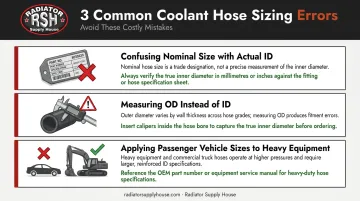
Three errors account for the majority of incorrect coolant hose orders in heavy equipment applications:
1. Confusing nominal size with actual ID Ordering a "1-inch hose" based on the label alone, without verifying the actual bore against the fitting, can result in a hose that's too loose or too tight. SAE J20 tolerances mean two nominal 1" hoses from different manufacturers can differ by several millimeters in measured ID. Always confirm actual dimensions against the size chart.
2. Measuring OD instead of ID An installed hose is easiest to measure from the outside, but coolant hoses are specified by ID. Ordering by OD consistently produces hoses that are too large. Always measure and specify by inside diameter.
3. Applying passenger vehicle hose sizes to heavy equipment Standard automotive hose charts stop at sizes too small for heavy equipment cooling circuits. The 5/8"–2-1/2" range above covers most heavy equipment applications, but OEM service manuals frequently specify intermediate or metric dimensions that don't appear in consumer-grade catalogs.
A Cat D8T, for example, uses an asymmetric pairing with a 3/4" inlet and 6-1/4" outlet pipe. No automotive chart covers that combination — always start with the OEM service manual or a supplier catalog built specifically for heavy equipment.
Frequently Asked Questions
What size are coolant hoses?
Coolant hose sizes vary by equipment type, typically ranging from 5/8" to 2-1/2" inside diameter for heavy equipment and commercial vehicle applications. Smaller heater and bypass lines can run as small as 1/2" ID, with the correct size determined by your thermostat housing, radiator port, and water pump connection dimensions.
How can I tell if a coolant hose is 1/2, 5/8, or 3/4 inch?
Measure the inside bore with a vernier caliper: a 1/2" hose measures approximately 12.7mm ID, a 5/8" hose approximately 15.9mm ID, and a 3/4" hose approximately 19.1mm ID. Round your measurement to the nearest standard nominal size to account for manufacturing tolerance.
What is the outside diameter of a 5/8-inch coolant hose?
The 5/8" designation refers to the inside diameter. Parker's Series 6722 heater/cooling hose, for example, lists a 5/8" ID with a 0.945" (approximately 24mm) OD. Heavy-duty hoses with thicker walls will have a larger OD than standard hoses at the same nominal ID.
What is the difference between coolant hose ID and OD?
ID (inside diameter) is the bore measurement used to specify hose size and determine fitting compatibility; OD (outside diameter) is relevant for clamp selection and routing clearance. Always select coolant hoses by ID. Rigid tubes are specified by OD, and mixing these conventions causes ordering errors.
How do I match a coolant hose size to a fitting?
The hose ID should match or be slightly smaller than the fitting nipple or barb OD, producing a snug interference fit. A hose that slides on without resistance will not seal reliably under clamp pressure, even if the clamp is correctly torqued.
Does wall thickness matter when replacing a coolant hose on heavy equipment?
Yes. Wall thickness determines pressure resistance and the hose's resistance to vacuum collapse. Heavy equipment cooling systems can operate at pressures and temperatures that demand OEM-equivalent wall specifications. A thinner-wall hose — even one with the correct ID — can collapse under vacuum or fail under pressure spikes in demanding applications.