Fan failures on Freightliner trucks — Cascadia, Columbia, and others — don't usually come from one universal cause. The fault could sit in the electrical circuit, the pneumatic fan clutch system, a failing sensor, or even the Motor Control Module (MCM). The most expensive mistake technicians make is replacing parts before diagnosing the root cause. A documented DTNA case shows a truck where both the fan and solenoid were replaced — and the fan still ran continuously, because the actual fault was MCM programming.
This guide covers the most common failure causes, a structured five-step diagnostic sequence, targeted fixes for each failure mode, and guidance on when replacement makes more sense than repair.
Key Takeaways
- Any break in the chain — temperature sensor → MCM → solenoid → pneumatic fan clutch — kills fan engagement
- Most failures trace to the solenoid valve, fan circuit protection, coolant temperature sensor (CTS), wiring faults, or MCM issues
- Diagnose in sequence — jumping to parts replacement without testing wastes money and often misses the real cause
- Fault codes SPN 1071/FMI 3, 4, or 5 indicate fan stage circuit faults on Detroit DD-platform engines
- A fan that won't engage and one that runs constantly are separate failure modes; this guide covers non-engagement
Common Reasons a Freightliner Radiator Fan Stops Working
Most radiator fan failures on Freightliner trucks fall into a handful of categories. Understanding each one before touching any components saves real diagnostic time.
Failed Fan Clutch Solenoid Valve
On Cascadia models fitted with Kysor or Horton pneumatic fan clutches, the solenoid valve is the gatekeeper. It's a three-way valve: when energized, it routes air pressure to the fan clutch cylinder, engaging the fan. When it fails electrically (open circuit, short to ground) or sticks mechanically, no air reaches the clutch.
Watch for:
- Fan doesn't engage even as coolant temperature climbs
- No audible click or air movement from the fan clutch area at operating temperature
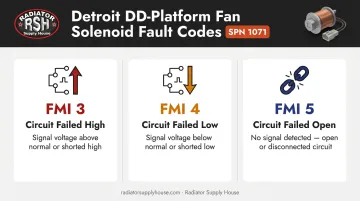
- Fan clutch solenoid-related fault codes present (SPN 1071/FMI 3, 4, or 5 on Detroit DD-platform engines)
According to Detroit's EPA10-GHG14 diagnostic documentation, FMI 3 indicates the fan stage 2 circuit failed high, FMI 4 failed low, and FMI 5 failed open — all pointing to the solenoid circuit as the monitored load.
Blown Fuse or Failed Fan Relay
The fan circuit runs through protection components in the Power Distribution Center. If that protection fails or the relay drops out, the circuit breaks entirely.
Symptoms:
- Fan doesn't respond under any condition
- No engagement even when commanded through a diagnostic tool
- No power at the solenoid connector when tested
Important: Don't publish or assume a specific MEGA fuse amperage or PDC location — these vary by model and build year. Always consult your truck's VIN-specific EZWiring diagram for exact fuse and relay positions.
Faulty Coolant Temperature Sensor (CTS)
The MCM reads coolant temperature to determine when to command fan engagement. If the CTS reports a temperature lower than actual, the MCM never issues the engage signal — the engine overheats while the fan sits idle.
Drivers typically report:
- Fan fails to engage as temperature rises
- Temperature gauge reads lower than expected or fluctuates erratically
- Overheating warning with no fan response
Damaged Wiring Harness or Corroded Connectors
Freightliner wiring harnesses in the fan area are exposed to vibration, heat cycling, and moisture. Wires chafe against metal edges, connector pins corrode, and insulation breaks down over time.
Intermittent problems are the telltale sign here:
- Fan engages inconsistently — works sometimes, fails at others
- No power at the solenoid connector despite a functioning relay
- Fault codes that appear and clear without a consistent pattern
ECM/MCM Fault or Incorrect Programming
On Detroit-powered Freightliners, the Motor Control Module (MCM, not the Aftertreatment Control Module) issues the fan engagement command. A software issue, corrupted parameter, or internal MCM fault can prevent the signal from reaching the solenoid.
Symptoms:
- Fan doesn't respond after solenoid, fuses, and sensors all check out
- Fan engages when the solenoid is powered directly but not under MCM control
- Active or inactive fan-stage fault codes without an obvious hardware cause
In documented field cases, restoring OEM MCM programming has resolved fan faults that survived both fan replacement and solenoid replacement — making the MCM the last stop in a systematic diagnostic process.
How to Diagnose a Freightliner Radiator Fan That Won't Engage
Skipping steps costs time and parts. Work through this sequence before replacing anything.
Step 1: Check Fuses and Circuit Protection
Locate the fan circuit fuse and relay in the Power Distribution Center. Use a multimeter to verify continuity across the fuse — a blown fuse shows no continuity. If the fuse blows again after replacement, there's a downstream short that needs to be found before proceeding.
Note: Fuse location and rating vary by model and configuration. Use your truck's VIN-specific wiring diagram — don't assume a universal location.
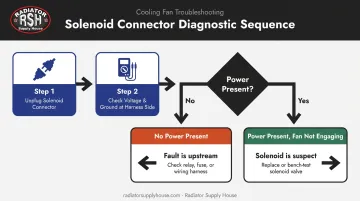
Step 2: Test for Power and Ground at the Solenoid Connector
With the key on and the engine at operating temperature:
- Unplug the solenoid connector
- Use a multimeter to check for voltage and ground at the harness side
- No power → fault is upstream (relay, fuse, or wiring)
- Power present, fan still not engaging → the solenoid itself is suspect
Step 3: Inspect and Test the Coolant Temperature Sensor
Connect a diagnostic scanner compatible with your engine platform (DiagnosticLink for Detroit engines, which replaced ServiceLink in 2014 for supported systems). Read live coolant temperature data from the MCM and compare it against an infrared thermometer reading on the coolant hose or upper radiator tank.
- A sensor reading significantly lower than actual temperature confirms a faulty CTS
- Also inspect the sensor connector for corrosion, cracked insulation, or moisture intrusion
Step 4: Inspect the Wiring Harness and Connectors
Visually trace the harness from the solenoid back toward the MCM connector. Look for:
- Chafing against sharp metal edges or frame members
- Heat damage near the exhaust
- Corroded or pushed-back connector pins
- Cracked or missing loom protection
Wiggle the harness while monitoring voltage at the solenoid connector. A voltage drop or intermittent reading during the wiggle test points to a broken wire or bad connection that won't show up any other way.
Step 5: Pull Fault Codes and Check MCM Outputs
Connect DiagnosticLink (or an equivalent compatible scanner) and retrieve all active and inactive fault codes. On Detroit DD-platform engines, look specifically for:
- SPN 1071/FMI 3, 4, or 5 — fan stage circuit faults
- SPN 647 — referenced in some fan/Jake Brake shared-circuit diagnostics
- Any CTS-related fault codes
Note: If no codes are present and all hardware tests correctly, have a qualified technician perform an MCM output test to verify whether the fan engagement command signal is being issued. MCM programming becomes a real suspect at this stage, but only after the hardware is confirmed good.
How to Fix the Freightliner Radiator Fan Based on the Diagnosed Problem
The right repair depends entirely on what the diagnosis found. Mismatched fixes waste time and leave the root cause in place.
If the Solenoid Valve Has Failed
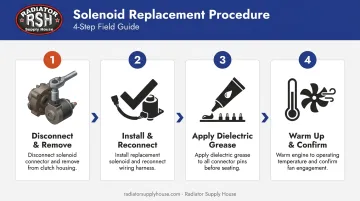
- Disconnect the solenoid connector and remove the solenoid from the fan clutch housing
- Install the replacement solenoid and reconnect the harness
- Apply dielectric grease to the connector pins to slow future corrosion
- Warm the engine to operating temperature and confirm fan engagement
Detroit's diagnostic specifies replacing the solenoid when measured resistance exceeds 10 kΩ during circuit testing. Use this threshold, not a generic resistance spec.
If a Fuse or Relay Has Failed
- Replace the blown fuse with the correct amperage rating — never upsize a fuse as a workaround
- Replace the relay with an OEM-equivalent part
- If the fuse blows again, stop — there's a short in the circuit that must be found and repaired before reinstalling protection
If the Coolant Temperature Sensor Is Faulty
- Drain enough coolant to safely remove the CTS without excessive spillage
- Remove the old sensor and install the replacement (apply thread sealant if required by the OEM spec)
- Refill and bleed the coolant system
- Confirm accurate live temperature readings through the diagnostic tool after startup
If the Wiring Harness or Connectors Are Damaged
- Repair broken wires using butt connectors or heat-shrink solder connectors — electrical tape alone is not a reliable fix
- Clean corroded connector pins with contact cleaner, then apply dielectric grease
- Re-route and protect repaired sections with split loom tubing
- For extensive harness damage, a replacement harness section is more reliable than multiple spot repairs scattered along the same run
When the MCM Needs Replacement
ECM/MCM replacement should only happen after every other potential cause has been eliminated — it's the last resort, not a first guess.
If replacement is necessary, the module must be programmed specifically for the truck's configuration: vehicle parameters, engine family, and emissions calibration. Work with a Freightliner dealer or certified Detroit technician. Incorrect programming can create new faults or disable other systems entirely.
Fix vs. Replace: Making the Right Call on Fan Components
On a commercial truck, downtime cost usually outweighs the price of a quality replacement part. That said, not every fault warrants a full replacement.
Repair when:
- The solenoid connector shows corrosion but the solenoid tests within spec
- A single wire is chafed but the rest of the harness is intact and undamaged
- The fuse blew once due to an identifiable, corrected cause
Replace when:
- The solenoid fails resistance testing and the fan clutch shows excessive bearing play, lining wear past OEM limits, or physical damage — replace the complete assembly rather than chasing repeat solenoid failures
- The CTS has failed on a high-mileage truck where the sensor was likely already drifting
- Wiring damage is extensive enough that spot repairs would leave ongoing reliability concerns
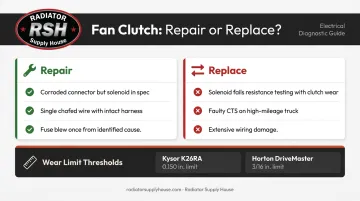
For Cascadia Kysor K26RA clutches, Freightliner's Cascadia Maintenance Manual specifies lining replacement when the engaged/disengaged measurement difference exceeds 0.150 inches. For Horton DriveMaster clutches, replace the friction facing at 3/16 inch or less. These are measurable thresholds — use them to make the call objectively rather than guessing.
When the diagnosis points to the radiator itself — a degraded core, cracked tank, or failing integrated oil cooler — Radiator Supply House stocks ICEBOX-branded replacement radiators for Freightliner models including the Cascadia, Columbia, Coronado, M2, and 108SD. Options span all-aluminum, copper-brass, and plastic/aluminum constructions, with OEM cross-reference numbers to confirm fitment.
Preventive Maintenance to Avoid Future Fan Failures
The Cascadia Maintenance Manual places the fan clutch check at the M2 interval: 50,000 miles for Schedule I (short-haul) and 100,000 miles for Schedule II (long-haul). Columbia places its fan clutch check at M1 — consult your model's specific schedule.
At each scheduled service, include these checks:
- Solenoid connector: Inspect for corrosion, cracked seals, or moisture intrusion — clean and re-grease as needed
- Fan clutch: Check for excessive bearing play or noise, oil contamination, burn marks, and lining thickness against OEM spec
- Fan blade: Inspect for cracks or physical damage — a cracked blade can contact the radiator at speed
- Wiring harness: Verify all clamps are secure, split loom is intact where the harness runs near heat sources or moving parts, and connectors are fully seated
During PM services, pull live CTS data and compare it against actual coolant temperature. A sensor drifting 10–15°F low won't trigger an active fault code, but it will prevent the fan from engaging when the engine needs it most.
Pull inactive fault codes as well. Codes that set and clear on their own typically point to an intermittent wiring fault — one that will eventually become a permanent failure.
Frequently Asked Questions
Why won't my Freightliner radiator fan come on?
The most common causes are a failed fan clutch solenoid valve, a fault in the fan circuit protection, a faulty coolant temperature sensor, or a wiring fault between the solenoid and MCM. Check circuit protection and test for power at the solenoid connector first, then work toward the sensors and control module.
What sensor triggers the Freightliner radiator fan?
The coolant temperature sensor is the primary trigger — the MCM reads its signal and commands the solenoid to engage the pneumatic fan clutch when coolant temperature exceeds the programmed threshold. Intake manifold air temperature is also an input to the fan control logic on ECM-controlled systems.
Is there a fuse for the Freightliner radiator fan?
Yes — the fan circuit runs through fuse and relay protection in the Power Distribution Center. The exact fuse location, amperage, and relay position vary between Cascadia, Columbia, and other Freightliner models, so consult your truck's VIN-specific wiring diagram rather than assuming a universal location.
Can a bad ECM cause the radiator fan not to work on a Freightliner?
Yes, but it's the last thing to suspect. The MCM issues the fan engagement command, and an internal fault or programming error can prevent it from signaling the solenoid. Verify the solenoid, circuit protection, CTS, and wiring first — MCM faults that pass full hardware testing do occur, but they're rare.
How do I test the fan clutch solenoid on a Freightliner?
With the key on and engine at operating temperature, use a multimeter to check for voltage and ground at the solenoid connector. If power is present but the fan won't engage, replace the solenoid — Detroit's diagnostic calls for replacement when circuit resistance exceeds 10 kΩ. Applying direct power to the solenoid can also confirm whether it's the failure point.
How do I know if my Freightliner fan clutch needs to be replaced?
Key indicators include: the fan not engaging despite a functioning solenoid and correct electrical signals, bearing play or noise from the clutch hub, lining wear past OEM spec (0.150-inch difference on Kysor K26RA, 3/16-inch or less on Horton DriveMaster), or a fan that spins freely by hand when it should be locked. Any of these points to replacement over continued component-level diagnosis.