Introduction
You're halfway through a field, and the temperature gauge starts climbing. For John Deere operators, that moment usually means one thing: something in the cooling system needs attention, fast.
Overheating is one of the most common (and most preventable) causes of engine downtime in agricultural equipment. Understanding how coolant moves through your tractor, and what each component does, is the difference between a quick fix and a blown head gasket.
This guide breaks down the John Deere cooling system diagram in plain terms. You'll learn how the system works, the key parts involved, the coolant specs to follow, and the maintenance steps that keep engines running cool all season.
Key Takeaways
- Water pump or thermo-siphon action circulates coolant continuously between the engine block and radiator
- John Deere's pressurized systems use separate de-aeration and recovery tanks for fill and overflow
- Cool-Gard II coolant extends drain intervals well beyond what generic antifreeze allows
- Low coolant, clogged fins, and a stuck thermostat cause most overheating complaints
How the John Deere Cooling System Works
The cooling system exists to pull heat out of combustion before it warps metal, seizes pistons, or blows a head gasket. Every part in the diagram, hoses, tanks, pump, radiator, works toward that single goal.
Coolant follows a loop. Heat gets absorbed at the engine block, travels up through the upper hose to the radiator, cools as it passes through the core, then returns through the lower hose to be recirculated.
On paper it looks simple. In practice, any blockage in that loop, a collapsed hose, a clogged core, stops heat transfer cold.
Thermo-Siphon vs. Pressurized Systems
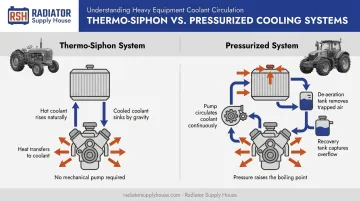
Older John Deere tractors, including the 40 series, rely on thermo-siphon circulation instead of a mechanical pump. Hot coolant naturally rises into the radiator's top tank because heated fluid is less dense; cooled coolant sinks back into the block. No pump, no belt, just physics.
That design has a weakness: any restriction stalls the whole loop. A sagging lower hose or a partially blocked core does more damage in a thermo-siphon setup than in a pressurized one, since there's no pump forcing flow past the obstruction.
Modern 8000 and 9000 series tractors use pump-driven, pressurized systems instead. Pressure raises the coolant's boiling point, which improves heat transfer and lets the engine run hotter without vapor pockets forming.
These systems add two extra components:
- A de-aeration tank, the high-pressure fill point
- A separate coolant recovery tank for expansion overflow
On 8130-8530 tractors specifically, John Deere's service manual specifies a 60 kPa (9 psi) system pressure test to confirm the circuit is holding properly.
The Thermostat's Role
Whether the system is thermo-siphon or pressurized, one component still regulates temperature: the thermostat. It stays closed during warm-up so the engine reaches operating temperature quickly.
Once coolant hits the calibrated threshold, it opens and allows full circulation. Without it, engines take longer to warm up and run inefficiently in cold conditions.
Key Components of the John Deere Cooling System
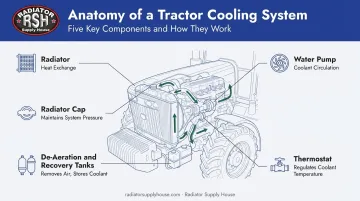
Five parts do most of the work in any John Deere cooling system diagram. Here's what each one does and why it matters.
- Radiator – The primary heat exchanger. Hot coolant passes through core fins where airflow (from the fan or forward motion) pulls heat out. Clogged or bent fins are a direct path to overheating.
- Water Pump – Belt-driven off the crankshaft in pressurized systems, it forces coolant through the loop. A failed pump means immediate stagnation, even if every other component is fine.
- Thermostat – A wax-element valve that opens at a set temperature. John Deere's service procedures call for replacing the thermostat any time the system gets flushed, not just when it fails.
- De-Aeration and Recovery Tanks – The de-aeration tank fills the high-pressure circuit; the recovery tank absorbs expansion and feeds coolant back as the engine cools. A recovery tank level that doesn't move after a heat cycle often points to a leak elsewhere in the system.
- Radiator Cap – Functions as a pressure-relief valve. On 8130-8530 models, spec calls for 60-80 kPa (9-12 psi). A weak or damaged cap lets air in and coolant out, so it's worth pressure-testing every time you flush the system.
Sourcing note: If a cracked core or corroded tank is behind repeated coolant loss, replacing the radiator outright is often faster than chasing a leak. Radiator Supply House stocks ICEBOX-brand replacement radiators for a wide range of John Deere platforms, from vintage models like the 4020 and 8760 to loader and construction equipment like the 544B and 710/710C. Construction options include both aluminum and copper-brass cores, depending on the model.
John Deere Coolant Specifications
Not all antifreeze is created equal, and John Deere's own service documentation makes that clear.
Key specifications include:
- Coolant type: John Deere recommends Cool-Gard II, a ready-to-use 50/50 premix meeting ASTM D6210 requirements. Non-approved coolants can cut your drain interval to as little as 2 years or 2,000 hours, instead of the extended intervals Cool-Gard allows.
- Mixture ratio: Premix is correct straight from the container. If blending concentrate yourself, always mix antifreeze and water together first, never separately, since too much antifreeze thickens the coolant and restricts flow, which is especially rough on thermo-siphon systems already relying on gravity.
- Water quality: Use distilled or demineralized water only. Tap water minerals build scale in the block and radiator passages over time, gradually cutting cooling efficiency until overheating sets in.
How to Drain, Flush, and Refill the John Deere Cooling System
Draining and Refilling Safety
Safety first. Shut the engine off and let it cool completely before touching any cap. Pressurized coolant can release explosively if the system is still hot.
When it's time to relieve pressure, loosen the de-aeration tank cap slowly, just to the first stop, and let pressure bleed off before removing it fully.
Draining
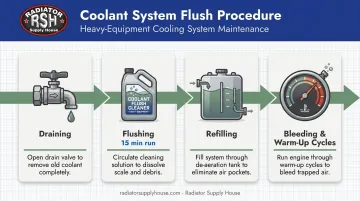
Open the radiator drain valve (typically beneath the core) and the engine block drain valve. On 8000/9000 series tractors, also remove the EGR cooler vent plug to prevent air locks from forming during drainage.
Flushing
- Fill the drained system with a John Deere-approved cooling system cleaner mixed with clean water
- Run the engine at roughly 1,500 rpm for 15 minutes to circulate the solution
- Drain completely
- Repeat with clean water before refilling with coolant
Refilling and Bleeding
Fill at the de-aeration tank first, never the recovery tank, until coolant appears at the EGR vent port. Close the vent plug, then finish filling the recovery tank to the Full Hot mark.
Run the engine through a few warm-up cycles afterward. A slight drop in recovery tank level during those first cycles is normal air purging, not a leak.
This is also the point to replace the thermostat, since John Deere's procedures call for it whenever the system is flushed. If hoses or gaskets show wear during teardown, replace those too. Radiator Supply House stocks OEM-equivalent hoses, gaskets, and coolant lines for John Deere agricultural cooling systems.
Once refilled, your service interval resets: initial service lands at 3 years or 3,000 hours, extending to 5-6 years or 5,000-6,000 hours when Cool-Gard is used and tested at recommended intervals.
Common John Deere Cooling System Problems and Fixes
Most cooling issues trace back to one of three root causes.
Overheating. Start by checking coolant level and radiator fin condition before assuming a component failure. Common culprits include:
- Low coolant level or incorrect antifreeze-to-water ratio
- Clogged radiator fins from mud, chaff, or field debris
- Stuck-closed thermostat blocking flow
- Worn water pump losing circulation efficiency
On older thermo-siphon models, a sagging lower hose or overly thick coolant mix is usually the first thing to check.
Coolant leaks. Pressure test the system to around 9 psi. An immediate pressure drop signals an external leak, while a recovery tank sitting below the Full Hot mark after a full cool-down cycle points to an internal leak.
Likely culprits include:
- Cracked radiators from age, vibration, or impact damage
- Worn or cracked coolant hoses
- Failing water pump seals losing their seal
If the radiator itself is compromised, sourcing a replacement from a supplier like Radiator Supply House avoids the longer wait times often associated with OEM dealer orders.
Coolant contamination and sludge. Mixing incompatible coolant types or skipping drain intervals produces a gel-like sludge that blocks internal passages. Watch for persistent overheating despite proper fluid levels, along with discolored coolant. The fix is a thorough flush with approved cleaner followed by a complete coolant replacement, not a top-off.
Frequently Asked Questions
What are the 5 main parts of the cooling system?
The core components are the radiator, water pump, thermostat, coolant hoses, and radiator/pressure cap. Together they move coolant through the engine, release heat into the air, and regulate flow based on temperature.
What is the operating temperature of a John Deere engine?
Most John Deere diesel engines run between 180°F and 200°F once warmed up, with the thermostat holding that range under normal load. Exact thresholds vary by engine family, so check your specific operator's manual for the precise spec.
How does the water cooling system work in a tractor engine?
A water pump (or thermo-siphon action in older models) pushes coolant from the engine block to the radiator, where heat escapes into passing air. Cooled fluid then returns to the block to absorb more heat, repeating the loop continuously.
What color coolant does John Deere use?
Cool-Gard II is gold in color, though color alone shouldn't be used to confirm compatibility. Always check that the product meets John Deere's stated specifications before use.
How often should I flush my John Deere cooling system?
Initial service falls at 3 years or 3,000 hours. With Cool-Gard used consistently and coolant tested at recommended intervals, that window extends to 5-6 years or 5,000-6,000 hours.
What are signs of a failing water pump on a John Deere tractor?
Look for coolant leaking from the pump's weep hole, overheating despite adequate coolant level, noise or play in the pulley bearing, and lower hoses that stay cool after a proper warm-up cycle.