That's where an auxiliary transmission cooler comes in. It sounds like a simple fix, and in many cases, it is. But it's not automatically the right call for every application.
This guide breaks down how automatic transmission coolers work, where they genuinely help, where they can backfire, and how to decide if your equipment or fleet actually needs one.
Key Takeaways
- Automatic transmissions run best around 175–180°F; heat above that range breaks down fluid and wears out components fast.
- Auxiliary coolers pay off most for towing, hauling, and heavy-duty equipment under sustained load.
- Overcooling is nearly as damaging as overheating: fluid that runs too cold causes almost as much wear as fluid that runs too hot.
- A cooler won't fix an internal transmission problem, and it doesn't replace regular fluid and filter changes.
How an Automatic Transmission Cooler Works
Transmission fluid does double duty. It lubricates internal components and absorbs the heat generated by clutch packs, the torque converter, and moving parts inside the case. That heated fluid then has to go somewhere to cool off before it recirculates.
In most factory setups, fluid routes through a cooler built into the radiator's tank. It picks up heat inside the transmission, travels through a dedicated section of the radiator, and returns cooled.
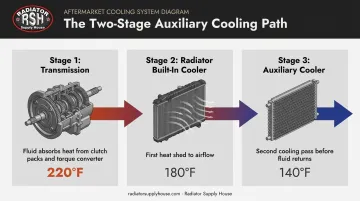
An auxiliary cooler adds a second stage to that process:
- Fluid first passes through the transmission, picking up heat from the clutch packs and torque converter
- It then routes through the radiator's built-in cooler, shedding most of that heat
- Before returning to the transmission, it passes through the auxiliary cooler for a second round of cooling
Why Turbulators Matter
Inside many cooler tubes, small metal strips called turbulators disrupt fluid flow on purpose. Instead of letting fluid glide smoothly through the middle of the tube, turbulators force it to churn against the tube walls, where the actual heat transfer happens.
Without that agitation, fluid would pass through the cooler without meaningfully cooling down. It's a small detail, but it's the difference between a cooler that works and one that just adds length to the fluid's path.
Most stock trucks and heavy equipment ship with adequate factory cooling built into the radiator. Auxiliary coolers become relevant when that factory capacity gets overwhelmed by towing weight, heavy loads, or high ambient heat.
Types of Automatic Transmission Coolers
Not all coolers cool the same way. The design determines how much surface area the fluid contacts, and that directly affects how much heat gets pulled out.
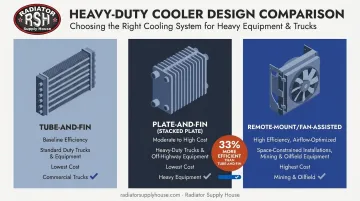
Tube-and-Fin
This is the entry-level design: a single tube snakes back and forth through a stack of aluminum fins. Air passing over the fins pulls heat out of the fluid inside the tube.
It's affordable and works fine for moderate towing or light-duty use, though it's the least efficient of the three common designs, which matters once loads get heavier.
Plate-and-Fin (Stacked Plate)
Stacked plate coolers push fluid through narrow, flat channels instead of a round tube. That geometry dramatically increases surface contact between the fluid and the cooling fins.
Hayden's transmission cooler engineering data shows plate-and-fin designs run roughly 33% more efficient than tube-and-fin units. This is why stacked plate coolers are the default choice for commercial trucks and heavy equipment where sustained cooling under load isn't optional.
Remote-Mount / Fan-Assisted
These coolers include a built-in electric fan and a thermal switch. When fluid temperature crosses a set threshold, the fan kicks on regardless of vehicle speed or airflow.
That matters for equipment where consistent airflow across the cooler can't be guaranteed, such as certain heavy equipment mounting configurations or low-speed, high-load operation.
Whichever design fits the job, matching the right cooler to the equipment matters as much as the cooler type itself. Radiator Supply House stocks ICEBOX aluminum coolers engineered as OEM-equivalent replacements across dozens of equipment models for construction, agricultural, and commercial truck applications.
Pros of an Automatic Transmission Cooler
Extends Transmission Lifespan
Heat is the single biggest enemy of an automatic transmission. Every degree above the optimal operating range accelerates wear on clutch packs, seals, and the torque converter. Keeping fluid temperature in check slows that wear curve consistently over the life of the equipment.
There's a fluid-life benefit too. Fluid that isn't cooking under constant heat holds its viscosity and lubrication properties longer. That means:
- Fewer premature fluid changes
- Reduced clutch pack glazing
- Less varnish buildup inside the valve body
Improved Performance Under Heavy Load
A transmission under load, pulling a trailer, grading a site, or running a loader all day, generates far more heat than one in normal daily driving. An auxiliary cooler helps maintain fluid viscosity and hydraulic pressure, which directly supports consistent shift quality and clutch engagement during extended heavy-duty runs.
This is exactly where Radiator Supply House's core customer base sees the most benefit. Fleet operators, agricultural equipment owners, and commercial trucking companies running transmissions hard for hours at a stretch gain the most from added cooling capacity.
Reduces Long-Term Repair and Rebuild Costs
Transmission rebuilds on heavy equipment aren't cheap. Semi-truck transmission repairs alone commonly run into the thousands of dollars depending on severity. A full rebuild on a loader or excavator transmission can cost even more once labor and downtime are factored in.
An auxiliary cooler, by comparison, is a modest upfront investment. Properly installed, it's a preventive expense measured in a few hundred dollars, not a five-figure rebuild bill.
Flexibility Across Equipment Types
Coolers scale to the job. From compact utility vehicles to full-size commercial trucks and heavy construction machinery, there's a design and capacity to match. Operators aren't locked into a one-size-fits-all solution: a stacked plate unit built for a wheel loader looks nothing like the tube-and-fin cooler on a light-duty pickup.
Cons of an Automatic Transmission Cooler
Risk of Overcooling
Fluid that runs colder than about 175°F thickens up. It doesn't flow as freely, which causes sluggish shifting, increased internal wear, and premature component failure — the same outcomes a cooler is meant to prevent in the first place.
Auxiliary coolers with built-in thermostats bypass fluid flow through the cooler until it reaches around 180°F, specifically to prevent this problem. Skip that safeguard, and an oversized cooler on a vehicle that doesn't generate much heat can push temperatures too low.
This risk is highest for equipment running in cold climates or spending most of its time at light load. A cooler sized for maximum towing capacity can easily overcool a transmission during routine, low-demand use.
Not a Fix for Existing Transmission Problems
If a transmission is already overheating because of an internal fault, slipping clutches, a failing torque converter, or a clogged filter, an auxiliary cooler won't solve it. Overheating in these cases is a symptom, not a cooling capacity shortfall.
Operators who bolt on a cooler to mask an overheating symptom without diagnosing the root cause often end up accelerating the failure they were trying to prevent.
Installation Risks and Complexity
Transmission fluid lines run under pressure. Cut them without proper barb fittings, and lines can pop loose, dumping fluid fast and burning out the transmission. Transmission fluid is also flammable, adding a real safety concern to a rushed install.
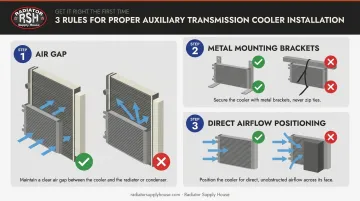
Proper installation requires:
- An air gap between the cooler and adjacent components like the condenser or radiator
- Metal mounting brackets, not zip ties, to secure the unit against vibration
- Direct airflow positioning, not mounted flat against another component (which kills any cooling benefit)
Can Encourage Neglected Maintenance
Some operators treat a cooler as a reason to stretch out maintenance intervals. It isn't. Regular fluid changes, filter replacements, and system inspections stay necessary regardless of cooling upgrades. A cooler doing its job doesn't stop fluid from degrading through normal use over time.
When Does a Transmission Cooler Make Sense for Heavy Equipment?
An auxiliary cooler earns its keep in specific scenarios, not as a blanket upgrade for every machine:
- Towing and hauling beyond moderate loads: transmission temperatures that climb above 200°F under load call for a targeted cooler, as long as the equipment is otherwise mechanically sound and not simply overloaded past its rated capacity.
- High-ambient-temperature environments: construction equipment running through summer heat, mining machinery in desert conditions, and agricultural equipment working through harvest season all face compounded heat, as ambient temperatures stack on top of load-generated heat.
- Equipment lacking adequate factory cooling: older machinery, or equipment pressed into service more demanding than it was originally spec'd for, is often a good candidate for an aftermarket cooler.
Sourcing the right unit. Once one of these scenarios applies, matching the cooler to the machine matters as much as the decision to add one. Radiator Supply House carries transmission oil coolers and complete cooling packages across construction, agricultural, and commercial vehicle brands, spanning more than 300 manufacturers. That range makes it a practical starting point for operators trying to match a cooler to a specific machine rather than guessing at fitment.
Frequently Asked Questions
Do automatic transmissions need a cooler?
Most vehicles already include factory cooling integrated into the radiator, which is sufficient for normal use. An auxiliary cooler becomes worthwhile when the transmission regularly runs hot due to towing, hauling, or heavy-duty demands.
Where is the best place to put a transmission cooler?
Mount it in front of the radiator or AC condenser where it gets direct airflow, with at least a half-inch gap from adjacent components. It should be installed inline, after the factory cooler, not as a replacement for it.
What temperature should an automatic transmission run at?
The normal range is roughly 175–180°F. Consistent readings above 200°F point to a cooling problem, while chronically low temperatures from an oversized cooler can cause their own performance issues.
Can a transmission cooler cause overcooling?
Yes. A cooler that's too large for the application, or a high-capacity unit used in low-load or cold-weather conditions, can drop fluid below its optimal range, thickening it and accelerating wear.
Will a transmission cooler fix my overheating transmission?
Not if the overheating stems from an internal issue like slipping clutches or a failing torque converter. That's a symptom needing diagnosis and repair, not just cooling.
How do I know if my transmission cooler is failing?
Watch for burnt-smelling or discolored fluid, slipping shifts, or milky coolant on radiator-integrated coolers (a sign of cross-contamination). Any of these warrant immediate inspection.