Yet despite how common these components are, many operators and fleet mechanics have only a rough sense of what an intercooler actually does — and almost no idea how it fails. That gap leads to misdiagnosed power loss, delayed maintenance, and replacement decisions made on guesswork rather than diagnostics.
This guide explains exactly how a diesel intercooler works, from turbocharger compression through combustion, in terms that mechanics and equipment operators can apply on the job.
Key Takeaways
- An intercooler cools compressed air between the turbocharger outlet and the intake manifold
- Compression generates significant heat; hot air is less dense and carries less oxygen per cylinder charge
- Cooler, denser charge air enables more complete combustion, improving power, fuel economy, and emissions
- Air-to-air designs dominate heavy equipment; air-to-liquid designs suit marine, confined-bay, and stationary applications
- A failing intercooler shows up as lost power, excess exhaust smoke, and high intake temperatures — inspect it promptly
What Is a Diesel Engine Intercooler?
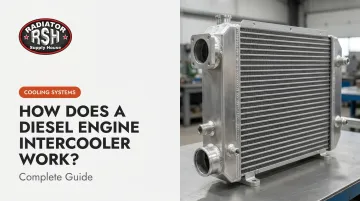
A diesel intercooler — more precisely called a charge air cooler (CAC) — is a heat exchanger positioned between the turbocharger outlet and the engine's intake manifold. Its only job is to reduce the temperature of compressed intake air before it reaches the combustion chamber.
Here's why that matters: turbochargers increase engine output by compressing intake air, delivering more oxygen per cylinder charge. But compression generates heat. In severe-duty diesel applications, charge air exiting the turbocharger compressor can reach temperatures exceeding 200°C. MTU's documentation of a 16-cylinder Series 4000 mining engine records charge air temperatures reaching 250°C, reduced to approximately 50°C through staged charge air cooling.
At those temperatures, air expands and loses density. The oxygen content per unit volume drops, which undercuts the very benefit the turbocharger was designed to provide.
The intercooler closes that gap, restoring air density so the engine can actually use the boost pressure the turbo generates.
Naming Confusion: Intercooler vs. Aftercooler vs. Charge Air Cooler
These terms get used interchangeably in the field, but SAE J1148 draws a technical distinction:
- Intercooler — cools air between two compression stages (two-stage turbo systems)
- Aftercooler — cools air after the final compression stage, before it enters the engine
- Charge air cooler (CAC) — the generic term covering both functions
In single-turbo diesel engines used in construction, agriculture, and on-highway trucking, all three terms describe the same device.
Two Types of Diesel Intercoolers
| Type | How It Works | Common Applications |
|---|---|---|
| Air-to-air | Ambient airflow draws heat through a finned core | Heavy trucks, construction equipment, agricultural machinery |
| Air-to-liquid | A liquid coolant circuit absorbs heat, routes it to a secondary radiator | Marine diesel, confined engine bays, stationary generators |
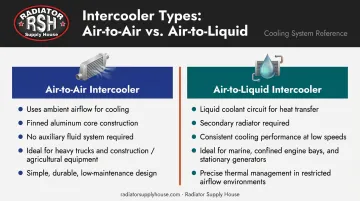
Air-to-air designs dominate heavy equipment because they're mechanically simple, durable, and require no auxiliary fluid systems. Air-to-liquid designs offer more consistent cooling performance in environments where reliable ambient airflow isn't available — slow-moving mining equipment, marine installations, or enclosed generator enclosures.
How Does a Diesel Engine Intercooler Work?
The intercooler doesn't switch on or respond to commands. It functions continuously and passively the moment the turbocharger generates boost pressure. Understanding the process means following the airflow sequence from compression to combustion.
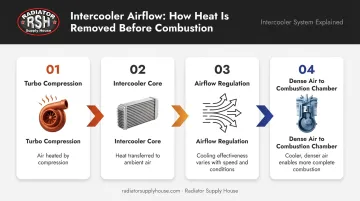
Step 1: Turbocharger Compression Builds Heat
Exhaust gases spin the turbocharger's turbine wheel, which drives the compressor wheel — drawing in ambient air and pressurizing it above atmospheric pressure. The compression ratio varies by engine, application, load, and altitude — there's no single universal figure that applies across truck engines, excavators, and generators.
What's consistent is the thermodynamics: compressing air converts mechanical energy partly into thermal energy. The higher the pressure ratio, the hotter the compressed air. Without an intercooler, that hot compressed air would enter the engine directly, delivering less oxygen per cylinder charge and placing additional thermal stress on pistons, valves, and the turbocharger itself.
Step 2: Heat Transfer Through the Intercooler Core
Hot compressed air from the turbocharger outlet enters the intercooler and passes through a network of narrow tubes or channels. The core's fins — or fluid passages in air-to-liquid designs — provide the surface area that pulls heat from the charge air into the cooler external medium. Heat always moves toward cooler material; the core's design ensures enough contact surface and dwell time for that transfer to occur at the flow rates diesel engines demand.
Core design directly affects performance. A larger core with higher fin density transfers more heat. An undersized, clogged, or physically damaged core transfers less — which limits safe power output under load regardless of what the turbocharger is doing.
According to DieselNet's charge air cooling reference, effective air-to-air intercooling can deliver intake manifold temperatures as low as 14–19°C above ambient — though actual results depend on ambient temperature, load, cooler effectiveness, and fin cleanliness.
Step 3: Airflow Regulation
In air-to-air systems, cooling effectiveness is governed by two variables:
- The temperature differential between charge air and ambient air
- The volume of ambient air flowing through the core (which varies with vehicle speed and fan operation)
This creates a dependency on operating conditions. A truck running highway speeds has abundant airflow through the core. The same intercooler on slow-moving equipment in a hot environment has less airflow and a smaller temperature differential — meaning less cooling capacity available exactly when the engine may be working hardest.
Debris, oil contamination, or physical damage to the core compounds this problem — charge air temperatures rise even if the turbocharger and engine are functioning correctly. Keeping airflow paths clear is as important as core sizing.
Air-to-liquid systems solve the low-airspeed problem with a coolant pump that circulates the liquid medium regardless of vehicle speed, providing more consistent performance in high-ambient-temperature or confined-operation environments.
Step 4: Cooler, Denser Air Enters the Combustion Chamber
When the intercooler is working correctly, charge air exits at a significantly lower temperature than it entered. Cooler air is denser — the same cylinder volume holds more air mass and more oxygen molecules than it would with hot air.
More oxygen means more fuel can be injected and burned completely. Injection systems calibrate fuel delivery to the available air mass, so denser air enables more fuel per cycle, producing higher power and torque without increasing engine displacement.
The downstream effects extend further:
- Maintains consistent power under sustained load without heat-soak degradation
- Lowers exhaust temperatures, reducing thermal stress on downstream components
- Reduces NOx tendency, since cooler charge air moderates peak combustion temperatures
What a Diesel Intercooler Does for Engine Performance
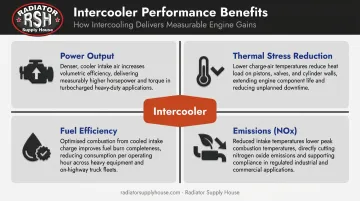
The intercooler's role in engine performance goes beyond temperature reduction. It directly affects four measurable outcomes:
Power output: At a fixed manifold pressure, lower charge temperature means higher air density — more oxygen mass per combustion cycle. The engine extracts more mechanical energy from each charge without raising boost pressure.
Thermal stress reduction: Hot charge air drives up combustion temperatures and increases thermal load on pistons, valves, and the turbocharger itself. Effective intercooling keeps these temperatures in check during sustained high-load operation — long grades, heavy towing, extended mining cycles.
Fuel efficiency: Cooler, denser air supports more complete combustion. The engine burns more of the injected fuel rather than expelling unburned hydrocarbons. Volvo's CAC technical documentation identifies decreased fuel economy as a direct symptom of a leaking charge air cooler — a direct cost consequence for fleet operators running degraded intercoolers.
Emissions: Lower combustion temperatures reduce nitrogen oxide (NOx) formation. EPA Tier 4 Final and EU Stage V standards set NOx limits of 0.40 g/kWh across the 56–560 kW power band for most nonroad equipment. Charge air cooling works alongside EGR, combustion management, DPF, and SCR systems to control engine-out NOx — each system handles a piece of the compliance picture.
Where Diesel Engine Intercoolers Are Used
Intercoolers are standard equipment across virtually every category of turbocharged diesel application:
- Heavy construction — Cat compact track loaders, D-series dozers, wheel loaders, excavators
- Mining — Cat 797F haul trucks, underground equipment, drilling rigs
- Agriculture — John Deere S-series combines, 9-series tractors; Deere's service manual explicitly includes charge air cooler cleaning alongside the radiator stack
- On-highway trucks — Volvo, Freightliner, Kenworth, Peterbilt; Volvo publishes a dedicated CAC technical sheet for its heavy truck fleet
- Stationary generators — Cummins uses radiator-mounted air-to-air coolers; MTU offers both air-to-air and water-to-air variants on the same generator frame
- Marine — MAN's L23/30DF project guide specifies a two-pass cooling-water CAC as standard
Operating Conditions That Stress Intercoolers
Not all operating environments are equal. Three conditions place peak demand on charge air coolers:
- High altitude: Lower ambient air density forces the turbo to run higher pressure ratios, sharply increasing compressor discharge temperatures
- Hot ambient conditions: A reduced temperature differential between charge air and outside air cuts heat transfer effectiveness across the core
- Sustained high load: Long grades, heavy towing, or continuous mining cycles hold boost pressure at peak levels for extended periods
In these conditions, a degraded or undersized intercooler will limit engine output before any other system shows a problem.
When a cooler does fail under these conditions, fast access to the right replacement matters. Radiator Supply House stocks OEM-equivalent intercoolers and charge air coolers for Caterpillar, Komatsu, Freightliner, John Deere, Kenworth, Peterbilt, and 300+ other manufacturers under its ICEBOX product line — covering construction, agricultural, on-highway, and industrial applications.
Signs of a Failing Diesel Intercooler and When to Replace
Symptoms to Watch For
- Reduced power or sluggish throttle response: less dense air in the combustion chamber limits how much fuel can burn effectively
- Increased exhaust smoke: black or excessive smoke points to a compromised air-fuel mixture from reduced charge density
- Elevated intake air temperatures: measurable with a scan tool; rising intake temps without a corresponding turbocharger fault point directly at the intercooler
- Higher DPF regeneration frequency: Volvo's service documentation lists more frequent regen cycles among the indicators of a leaking CAC
- Oil mist in the intake: oily residue in the intercooler inlet hose or at the throttle body indicates internal contamination, typically from a failed turbocharger seal
Common Failure Modes in Heavy Equipment
- Physical core damage from road debris, equipment impacts, or improper pressure washing can bend fins and fracture tubes
- External fouling from mud, chaff, insects, and debris blocks fin passages in agricultural and off-road environments; John Deere's combine service manual specifically calls out chaff management as part of CAC maintenance
- Internal oil contamination from a turbocharger seal failure coats the core interior and dramatically reduces heat transfer efficiency
Cleaning vs. Replacement: The Right Call
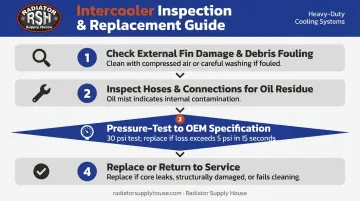
Not every failure mode calls for a new unit. International's service procedure pressure-tests charge air coolers at 30 psi — a loss greater than 5 psi in 15 seconds means replacement; units that hold pressure may proceed through an approved cleaning process.
Inspect first, then decide:
- Check for external fin damage and debris fouling — compressed air or careful washing often resolves this
- Inspect hoses and connections for oil residue indicating internal contamination
- Pressure-test to the OEM specification for your engine
- Replace if the core leaks, shows structural damage, or fails cleaning under the applicable OEM procedure
When replacement is the right call, OEM-equivalent fit matters. ICEBOX charge air coolers from Radiator Supply House are built to match original dimensions, inlet/outlet sizing, and mounting configurations exactly. Each unit is cross-referenced to specific OEM part numbers for Cat, Komatsu, Freightliner, John Deere, Kenworth, Peterbilt, and other major lines, with aluminum core construction matching the OEM design.
Conclusion
The diesel intercooler is mechanically simple but critical in practice. It cools compressed air to restore density before combustion — which is what separates a well-performing turbocharged engine from one that runs hot, burns excess fuel, and falls short of its rated output.
Operators and fleet managers who understand how intercoolers work catch performance problems earlier. They know what service intervals actually matter, and when it's time to replace a component, they can match it to their equipment's real operating demands — not just grab the nearest available part after a power loss has already stalled a job.
Frequently Asked Questions
Does a turbo diesel need an intercooler?
Yes. Turbocharger compression generates significant heat, which reduces air density and strips away the oxygen content that makes boost pressure useful. Without an intercooler, compressed air enters the combustion chamber hot and thin — and the engine can't take advantage of it.
What does an intercooler do on a diesel engine?
It cools the hot compressed air leaving the turbocharger before it enters the engine, increasing air density and oxygen content. Denser charge air supports more complete combustion, improving power output and fuel economy while reducing thermal stress on engine components.
Do intercoolers use coolant on a diesel?
Air-to-air intercoolers rely solely on ambient airflow across a finned core — no coolant circuit involved. Air-to-liquid (water-to-air) intercoolers use a separate liquid coolant loop and are common in marine, confined-bay, and stationary generator applications.
What is the difference between an intercooler and an aftercooler?
On single-turbo diesels, the terms are interchangeable — both refer to the same device. In two-stage systems, the intercooler sits between compressor stages, while the aftercooler handles final cooling after the last compression stage before air enters the engine.
What are the signs of a failing diesel intercooler?
Watch for power loss, sluggish throttle response, increased exhaust smoke, elevated intake air temperatures on a scan tool, more frequent DPF regenerations, or oil mist in the intake tract. Any of these symptoms warrants inspection of the intercooler core and connecting hoses.
How often should a diesel intercooler be inspected?
Visually inspect for external fin damage and debris fouling at routine service intervals. Perform a more thorough inspection — including a pressure test — any time turbocharger work is done or when a drop in engine performance appears without an obvious cause. Equipment operating in dusty, muddy, or high-temperature environments warrants more frequent checks.