Introduction
An oil cooler failure rarely picks a convenient time. It shows up mid-shift, mid-haul, or mid-pour, and every hour the machine sits idle is an hour it isn't earning money.
When the replacement part finally arrives, the question of OEM versus aftermarket suddenly matters a lot more than it did back in the parts catalog.
Sourcing has only gotten trickier. By 2022, 95% of construction equipment manufacturers reported ongoing supply chain disruptions, and fleets across the industry started holding onto older machines longer because repairs kept stalling on backordered parts.
Meanwhile, more OEM-branded components are increasingly built by third-party suppliers, blurring a line that used to feel absolute.
So what actually separates an OEM oil cooler from an aftermarket one? For most operators, it comes down to three things: cost, quality, and how long the fix holds up. This guide breaks down both options so you can make the call with confidence.
Key Takeaways
- Factory-spec fit comes standard with OEM coolers, but availability and pricing now favor aftermarket.
- Aftermarket quality varies widely: premium tiers rival OEM, budget tiers often fall short.
- Core construction outperforms brand name for high-load, high-heat duty cycles.
- Base decisions on equipment age, environment, and budget, not brand loyalty.
- OEM-equivalent aftermarket coolers now cover 300+ manufacturers, cutting downtime without dealer markup.
OEM vs. Aftermarket Oil Coolers: A Quick Comparison
Here's how OEM and aftermarket oil coolers compare across the factors that matter most:
| Factor | OEM | Aftermarket |
|---|---|---|
| Price | Typically higher due to dealer markup and branded packaging | Ranges from budget to premium; OEM-equivalent options often cost less |
| Material/Construction | Matches factory spec exactly | Varies by manufacturer — budget aluminum to engineered high-flow cores |
| Fit & Compatibility | Guaranteed drop-in fit | Direct-fit available for most major brands; confirm fitment before buying |
| Thermal Performance | Matches original design intent | Can match or exceed OEM with improved core geometry |
| Availability | Hard to source for older or discontinued models | Broad inventory, frequently stocked and ready to ship |
Notice the pattern: OEM wins on certainty, aftermarket wins on flexibility. The right answer depends on which of those two you need more.
What Is an OEM Oil Cooler?
OEM stands for Original Equipment Manufacturer — a part built to the exact dimensions, material grades, and flow rates of the component that came installed on the machine from the factory. Here's the nuance most buyers miss: "OEM" doesn't always mean the equipment brand built the part in-house.
Third-party suppliers like Modine manufacture engine, transmission, and retarder oil coolers for on- and off-highway OEM customers, including major brands such as Caterpillar and John Deere. The badge on the box says one thing; the factory floor that produced it might belong to someone else entirely.
How OEM Coolers Function
An oil cooler transfers heat from engine oil into a coolant loop, or directly into ambient air on external air-cooled designs. Keeping oil within its designed temperature range matters more than most operators realize.
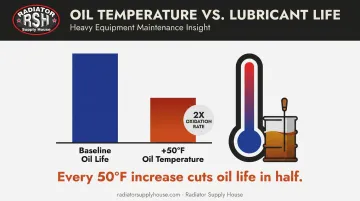
Every 50°F increase in a lubricant's base temperature can cut oil life in half and double the rate of oxidation, according to Shell's heavy-duty lubricant guidance. Run too hot, and viscosity drops, accelerating wear on bearings and other moving parts.
Core benefits of OEM parts:
- Guaranteed fitment with zero modification required
- Predictable performance within the machine's original design envelope
- Simplified documentation for warranty or fleet compliance records
For equipment still under factory warranty, using OEM parts can be a contractual requirement, not just a preference.
Use Cases of an OEM Oil Cooler
OEM makes the most sense when:
- Active factory or extended warranty still covers the equipment
- Exact-spec documentation is required for government or fleet compliance
- The part is readily available with minimal lead time or price premium
- Standard load ranges and moderate climates match the original design conditions
If none of those apply, aftermarket coolers deserve a closer look.
What Is an Aftermarket Oil Cooler?
Aftermarket oil coolers are built by third-party manufacturers to replace the original part, without any license or affiliation with the equipment brand. That single label covers an enormous range, from low-cost generic units to purpose-engineered replacements built to match or exceed OEM standards.
Construction Differences That Actually Matter
Not all aftermarket cores are built the same way. The details that separate a good replacement from a mediocre one include:
- Core design: number of rows, tube diameter, and fin density
- Material: all-aluminum versus copper-brass construction
- Pressure ratings: how much system pressure the unit can handle before failure
Premium manufacturers often refine core geometry to reduce pressure drop and improve heat transfer efficiency compared to the original factory design. That upgrade matters most for equipment running in high-ambient-temperature environments or under sustained heavy load, such as desert construction sites or mining haul routes.
The Practical Case for Aftermarket
Beyond performance, aftermarket parts solve a logistics problem. Broader availability means shorter lead times, especially for older or discontinued equipment where OEM channels have gone quiet. For fleet operators juggling multiple machines, lower per-unit parts costs free up budget for other maintenance priorities.
This is where Radiator Supply House's ICEBOX line of replacement oil coolers fits in. Engineered to OEM-equivalent specifications, ICEBOX coolers cover more than 300 equipment manufacturers, with especially deep coverage across Caterpillar, John Deere, and Komatsu platforms.
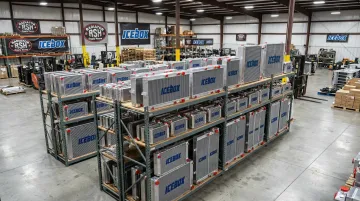
Some parts even consolidate multiple machine models under a single SKU. One Case oil cooler, for instance, fits the 650K, 750K, and 850K models simultaneously, simplifying inventory for shops juggling several machine generations.
Use Cases of an Aftermarket Oil Cooler
Aftermarket is the preferred path when:
- OEM parts are backordered, discontinued, or priced well above budget
- Equipment operates beyond original design parameters: high heat, sustained towing loads, or uprated power output
- A fleet runs mixed manufacturers and needs one supplier instead of five separate dealer relationships
In demanding conditions, a premium aftermarket cooler with improved flow geometry can genuinely outperform the OEM part it replaces.
OEM vs. Aftermarket Oil Coolers: Which One Should You Choose?
Choosing between OEM and aftermarket comes down to matching part quality and design to the application. Three variables should drive the call:
- Operating environment and duty cycle intensity: standard conditions, or extreme heat and heavy loads?
- Equipment age and OEM part availability: is the original part even in production anymore?
- Budget relative to acceptable risk: can you afford a repeat failure if the cheaper option doesn't hold up?
Choose OEM When...
- The equipment is under active warranty
- The part is readily available without a significant lead time or price premium
- The machine operates within standard load and climate conditions
- There's no history of that specific part failing prematurely
Choose Premium Aftermarket When...
- OEM parts are hard to source or heavily backordered
- The equipment runs in demanding conditions: high ambient temperatures, sustained heavy loads, high annual hours
- The OEM cooler has already failed once, and replacing it with the same design doesn't fix an underlying weakness
That last point has a well-documented real-world example. Ford's own Technical Service Bulletin 09-8-3 acknowledges a restricted oil cooler design on 2003-2007 6.0L Power Stroke engines, a flaw serious enough that Ford issued a redesigned service replacement.
The bulletin's diagnostic test flags a problem when oil temperature runs 15°F or more above coolant temperature under load. That delta test has since become a standard diagnostic benchmark in the diesel repair world.
The lesson generalizes well beyond one truck platform: when an OEM design has a documented weak point, repeating the original repair doesn't solve anything.
Downtime makes the stakes concrete. In mining operations, downtime for a dump truck or excavator can exceed $1,000 per hour, according to Cummins. A part that fails again in six months costs far more than the price difference between a budget cooler and a properly engineered one.
How to Verify Aftermarket Quality
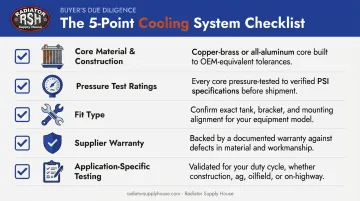
The word "aftermarket" alone tells you almost nothing. Before buying, check for:
- Core material and construction: aluminum versus copper-brass, and whether it matches your duty cycle
- Pressure test ratings: has the unit been validated under real operating pressure?
- Fit type: direct-fit for your exact model, or a universal unit requiring adaptation?
- Supplier warranty: what's covered, and for how long?
- Application-specific testing: is the part listed as tested for your equipment, or just cross-referenced by dimension?
For fleet operators, repair shops, and equipment owners juggling multiple makes and models, Radiator Supply House stocks ICEBOX oil coolers engineered to OEM-equivalent specs for 300+ manufacturers, ready to ship instead of sitting on a dealer backorder list. If you don't see your exact part listed, their team can help track it down or build it.
Frequently Asked Questions
Are aftermarket oil coolers as good as OEM?
Quality varies widely. Premium aftermarket coolers engineered to OEM-equivalent specifications can match or exceed original performance, while budget-tier parts may cut corners. Evaluate construction and supplier reputation rather than defaulting to the OEM label.
What happens if an oil cooler fails in heavy equipment?
A failed cooler can cause overheated oil, loss of lubrication effectiveness, and accelerated wear on bearings and injectors. In severe cases, coolant can contaminate the oil or the engine can overheat, leading to catastrophic and expensive damage.
How do I know when my oil cooler needs replacing?
Watch for rising oil temperatures under load, milky or contaminated oil, unexplained coolant loss, and reduced cooling efficiency. Monitoring the delta between oil temperature and coolant temperature is one of the most reliable early indicators.
Do aftermarket oil coolers void equipment warranties?
For equipment under active OEM warranty, non-OEM parts may affect coverage depending on the manufacturer's specific policy — confirm terms with your dealer first. For out-of-warranty equipment, aftermarket parts generally carry no warranty implications.
How many hours does it take to change an oil cooler on a 6.0 Powerstroke?
Ford's own labor guide lists roughly 5.5 to 6.1 hours for the oil cooler operation, depending on model year. Shops often quote more when the EGR cooler is replaced at the same time, which is commonly recommended.
What oil temperature is too hot for a 6.0 Powerstroke?
Ford's diagnostic approach focuses on the gap between oil and coolant temperature rather than a single absolute number. A delta of 15°F or more under load signals a problem, making it a more reliable indicator than any fixed threshold.