The challenge is that "condenser replacement cost" means something very different depending on your situation. A homeowner replacing a 2.5-ton residential unit faces a completely different calculation than a fleet manager sourcing a cab AC condenser for a Caterpillar dozer or a property manager replacing a commercial rooftop unit.
This guide breaks down verified cost ranges for all three segments — residential, commercial, and heavy equipment — along with the specific factors that drive pricing up or down, and how to build an accurate budget before getting a quote.
Key Takeaways
- Heavy equipment cab condenser parts run $95–$1,989+ depending on brand, with labor and refrigerant added on top
- Replacement cost varies significantly by equipment type — construction, mining, and agricultural machines each carry different part pricing
- OEM and aftermarket options exist for most major brands; aftermarket parts typically offer meaningful savings without sacrificing fit or function
- Sourcing from a specialized distributor reduces lead time and simplifies finding specs for older or hard-to-match equipment
- Fleet operators can lower per-unit costs by consolidating condenser purchases across similar machine models
How Much Does AC Condenser Replacement Cost?
AC condenser replacement costs vary widely by application type, unit capacity, and scope of work. A residential swap runs a few thousand dollars; a commercial rooftop unit can reach $35,000+; industrial and heavy equipment condensers are priced differently again — parts-only, sourced by equipment make and model.
Residential AC Condenser Replacement Cost
According to Angi, the average residential AC condenser replacement costs $2,900, with most jobs falling between $1,300 and $6,100 all-in. HomeGuide's core range is slightly narrower at $1,200–$4,200. Both figures include the condenser unit and standard labor but exclude permits ($250–$400) and refrigerant recharge.
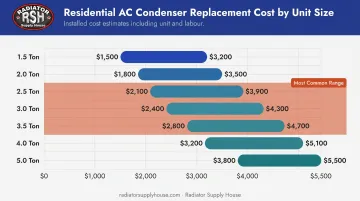
Residential cost by unit size (parts + labor):
| Unit Size | Installed Cost Range |
|---|---|
| 1.5 ton | $1,200 – $2,300 |
| 2.0 ton | $1,300 – $2,500 |
| 2.5 ton | $1,300 – $2,900 |
| 3.0 ton | $1,400 – $3,100 |
| 3.5 ton | $1,500 – $3,500 |
| 4.0 ton | $1,600 – $4,000 |
| 5.0 ton | $1,900 – $5,000 |
Not every situation requires a full condenser replacement. For newer units still under warranty, individual component repairs may be more cost-effective:
- Capacitor: $100–$400
- Compressor: $900–$2,900
- Condenser coil: $1,000–$4,000+
Commercial AC Condenser Replacement Cost
Commercial rooftop and packaged units serving offices, retail spaces, or multi-unit properties operate at much higher tonnage and involve greater installation complexity. For benchmarking purposes, full rooftop unit (RTU) replacement costs are the most widely cited reference — condenser-only commercial swaps are rarely quoted separately.
Commercial installed cost ranges:
| Scope | Cost Range |
|---|---|
| Light commercial (3–10 ton, Chicago benchmark) | $7,000 – $14,000 |
| Medium commercial (15–50 ton) | $15,000 – $35,000+ |
| Large warehouse/industrial systems | $300,000+ |
Two line items that catch building managers off guard: crane lifts for rooftop access typically run $1,500–$3,000 per day. After-hours labor in occupied buildings adds another 15–35% to the total.
Heavy Equipment and Industrial AC Condenser Cost
Mobile equipment such as excavators, combine harvesters, loaders, and semi-trucks uses purpose-built cab condensers that differ significantly from residential HVAC split systems. These are equipment-specific parts, and pricing varies by brand and whether you're sourcing OEM or aftermarket.
Representative parts-only benchmarks:
| Equipment Category | Aftermarket Price Range |
|---|---|
| Caterpillar construction equipment | ~$1,633 (aftermarket) |
| John Deere ag equipment | $296 – $1,989 |
| Case IH combines/tractors | $758 – $1,259 |
| Semi-trucks (Volvo VNL, Freightliner Cascadia) | $95 – $393 |
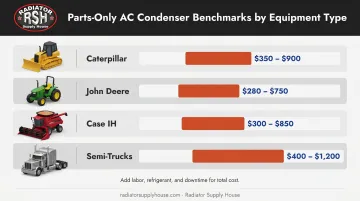
These are parts-only figures. To get to a real replacement cost, add:
- Shop labor and refrigerant recovery/recharge
- Replacement hoses or drier (if required)
- Freight and equipment downtime
Suppliers like Radiator Supply House stock complete AC condenser assemblies across 300+ equipment manufacturers — including Caterpillar, Komatsu, John Deere, Freightliner, and Volvo — which gives fleet operators and repair shops a sourcing alternative to OEM dealer pricing.
Key Factors That Affect the Cost of AC Condenser Replacement
Pricing is shaped by technical, operational, and sourcing decisions. Understanding each one helps avoid budget surprises.
Unit Size and Cooling Capacity
AC condenser size is measured in tons for residential systems and BTU/hour output for commercial and industrial applications. Larger units cost more to purchase and install — the residential tonnage table above illustrates this clearly, with a 5-ton job running roughly twice the cost of a 1.5-ton replacement.
Sizing matters beyond cost. The Department of Energy warns that oversized units cool too quickly without adequate dehumidification, while undersized units can't keep up on peak-demand days. Don't size by square footage alone — a proper load calculation (ACCA Manual J) should precede any replacement decision.
Application Type and System Configuration
The cost structure changes completely depending on application:
- Residential split systems — standard labor, straightforward refrigerant handling
- Commercial packaged/rooftop units — higher tonnage, crane access, permit complexity, controls integration
- Heavy equipment cab condensers — equipment-specific parts, shop labor, potential downtime costs
Heat pump condensers also carry a premium over standard AC condensers because they require additional components, including a reversing valve.
OEM vs. Aftermarket Parts
OEM condensers carry a dealer premium — and for heavy equipment brands like Caterpillar or Komatsu, OEM catalog prices often aren't even publicly listed, requiring dealer login to obtain a quote. Aftermarket OEM-equivalent parts deliver comparable fit and function at lower cost.
For fleet operators and repair shops, this is where sourcing strategy matters most. Radiator Supply House stocks ICEBOX-branded condensers as direct OEM replacements across 300+ manufacturers, with over 10,000 units on hand. Parts carry a one-year manufacturer warranty, with a lifetime warranty on charge air coolers for Class 7, 8, and 9 trucks.
For most buyers, the real question is which aftermarket supplier has the right part in stock and ready to ship.
Labor, Accessibility, and Regional Rates
Residential HVAC technicians typically charge $75–$150/hour for standard work, with emergency or weekend rates reaching $160–$250/hour. Commercial and heavy equipment labor runs higher. Accessibility factors add real cost:
- Rooftop mounts require crane access
- Confined engine bays take longer to work in
- Remote job sites may require travel charges
- Summer demand peaks drive residential rates up 20–40%
Refrigerant Type and Regulatory Compliance
The 2025 EPA rule under the AIM Act set a 700 GWP limit for residential and light commercial AC systems manufactured or imported from January 1, 2025. New systems now use R-454B or R-32 rather than R-410A.
An EPA docket memo from September 2025 confirmed technicians faced significant price increases and R-454B scarcity during spring and summer 2025 due to supply-chain disruptions.
What this means practically:
- R-22 — most expensive to service; refrigerant runs $90–$150/lb installed
- R-410A — recharge runs $40–$90/lb installed
- R-454B — approximately $80/lb installed
- Refrigerant recharge ($200–$500 for a residential system) is almost always an additional cost not included in base replacement quotes
Full Cost Breakdown: What You're Really Paying For
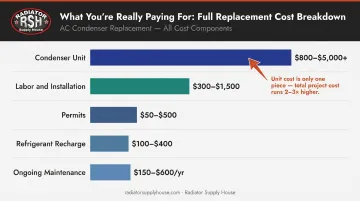
The condenser unit is just one piece of the total replacement cost. Whether you're replacing a residential AC unit or a condenser on a piece of heavy equipment, the final bill reflects several line items beyond the part itself:
- Condenser unit — the largest single cost item; ranges from under $200 for semi-truck aftermarket parts to $5,000+ for large residential units or heavy equipment OEM parts
- Labor and installation — disconnection, refrigerant evacuation, installation, brazing, system recharge, and testing; condenser coil-only replacements are especially labor-intensive, sometimes exceeding $1,500 in labor alone
- Permits — residential and commercial HVAC replacements often require local permits; budget $250–$400 if applicable, and confirm your contractor handles the permit pull before signing off on the job
- Refrigerant recharge — typically billed separately; $200–$500 for residential systems, more for R-22 or new R-454B systems
- Ongoing maintenance — according to ENERGY STAR's maintenance guidelines, airflow problems can reduce HVAC efficiency by up to 15%; for heavy equipment operators, this translates directly to cooling system degradation and shortened component life — regular coil cleaning and annual inspections protect the investment regardless of application
How to Budget Accurately — and What Most People Get Wrong
A smart budget is built on total cost of ownership, not the lowest upfront quote. For heavy equipment operators, that means factoring in downtime exposure, parts availability, and the real cost of a second repair when the first one doesn't hold.
Before finalizing any budget, confirm:
- Correct unit size and configuration — verify tonnage or BTU requirements before sourcing parts or requesting quotes
- Three separate quotes minimum — ensure each quote line-itemizes labor, refrigerant, and permits
- Warranty status — if the unit is under manufacturer warranty, parts may be covered and only labor costs apply
- Replace-vs-repair threshold — when a single repair exceeds 50% of full replacement cost, or the unit is past its expected service life, replacement typically wins on total cost
Common mistakes that inflate total cost:
- Comparing quotes that don't include the same scope (one includes refrigerant, another doesn't)
- Repairing an aging unit repeatedly instead of replacing — cumulative repair costs on older equipment often exceed replacement cost within one to two seasons
- Skipping the repair-vs-replace analysis entirely on heavy equipment, where downtime cost can dwarf the part cost
- Assuming OEM dealer pricing is the only option — aftermarket OEM-equivalent parts from category-focused suppliers frequently match quality at 20–40% lower cost
Frequently Asked Questions
What is the average cost to replace an AC condenser?
The Angi-supported average for residential replacement is $2,900, with a range of $1,300–$6,100 depending on unit size, refrigerant type, and labor market. Commercial and heavy equipment applications vary significantly higher based on tonnage, access requirements, and parts sourcing.
When should I replace my AC condenser instead of repairing it?
If a repair costs 50% or more of full replacement, replacement is usually the smarter financial call. Residential condensers older than 10–15 years, systems still running R-22, or units with repeated breakdowns are the clearest candidates for replacement.
How long does an AC condenser typically last?
Residential condensers generally last 15–20 years with good maintenance. Trane and ENERGY STAR both cite 10–12 years as the threshold where replacement deserves serious consideration, particularly if the unit is showing performance decline.
Does the application type affect replacement cost?
Significantly. Residential, commercial, and heavy equipment condensers are engineered differently and priced at completely different scales. A Caterpillar or Komatsu cab condenser involves specialized parts not found in any HVAC catalog — OEM dealer pricing for those parts often exceeds the cost of a full residential condenser replacement.
Are aftermarket AC condenser parts as reliable as OEM?
OEM-equivalent aftermarket parts from reputable suppliers can match OEM fit and performance at a lower cost. Radiator Supply House stocks application-specific condensers across 300+ manufacturers, backed by a one-year warranty — a reliable alternative to dealer supply chains with faster availability.